The consequences of deferred maintenance aren't abstract. Rising energy bills, unexpected shutdowns during peak cooling season, shortened equipment life, and emergency repair costs all land on the facility manager's budget. A chiller that fails in August at a hospital or data center isn't just expensive — it's a crisis.
This guide covers why maintenance matters, the four maintenance types every facility manager should understand, the warning signs that demand immediate attention, and a practical scheduling framework you can implement now.
Key Takeaways
- Condenser coil cleanliness and unrestricted airflow are the two maintenance variables facility managers control most directly.
- Preventive maintenance is more cost-effective than reactive repair or premature equipment replacement.
- ASHRAE Standard 180-2018 sets inspection intervals: quarterly coil checks, semiannual controls, and annual performance verification.
- Tube sheet corrosion is frequently overlooked but can silently reduce efficiency and cause premature failure.
- Rising energy use, unusual noise, or reduced cooling output all warrant immediate inspection — not a wait-and-see response.
Why Air-Cooled Chiller Maintenance Matters
An air-cooled chiller is a significant capital investment, and its long-term value depends directly on how consistently it's maintained. Deferred maintenance raises repair costs, shortens equipment life, and moves replacement timelines forward.
The Efficiency Cost of Neglect
Fouled condenser coils restrict heat rejection. When the condenser can't shed heat efficiently, condensing pressure rises. As Carrier's technical documentation confirms, coil fouling and fan failure can cause abnormally high condensing pressure and automatic compressor unloading — the compressor works harder to produce the same cooling output, drawing more power and accumulating wear.
The same dynamic applies to refrigerant charge. Low refrigerant forces the compressor to cycle more frequently and operate outside its design envelope. Neither condition is immediately catastrophic, but both erode efficiency continuously until maintenance corrects them.
Lifespan Implications
ASHRAE's service life database shows air-cooled reciprocating chillers currently in service with a median age of 28.5 years — a figure that reflects what consistent maintenance can achieve. Air-cooled rotary/screw units in the same database show a median of 8.5 years currently in service, reflecting both a newer technology mix and different operating profiles.
The data doesn't segment by maintenance quality, but the pattern in practice is consistent: units that receive regular attention reach the upper end of their category's range. Units that don't are replaced early, often at a cost far greater than a sustained maintenance program would have required.
Compliance and Safety Obligations
Maintenance programs must also address regulatory requirements that carry direct liability exposure:
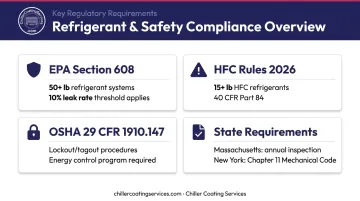
- EPA Section 608 requires owners of systems with 50+ lb of ozone-depleting refrigerant to log service dates, quantities added, leak inspections, and repair records. Comfort-cooling equipment triggers corrective action at a 10% annual leak rate.
- HFC rules effective January 1, 2026 (40 CFR Part 84) extend leak-repair requirements to systems with 15+ lb of HFC refrigerants, using the same 10% threshold.
- OSHA 29 CFR 1910.147 (lockout/tagout) applies whenever servicing could expose technicians to unexpected startup or stored energy release — an energy-control program and documented procedures are required.
- State-level requirements vary: Massachusetts mandates annual refrigeration system inspection and biennial pressure vessel inspection. New York places refrigeration pressure vessels under Chapter 11 of the 2025 Mechanical Code.
Types of Air-Cooled Chiller Maintenance
No single maintenance approach is sufficient on its own. A complete strategy layers four types, each with a different trigger, scope, and cost profile.
Routine / Preventive Maintenance
Preventive maintenance (PM) is calendar-based and forms the backbone of any sound program. Core tasks include:
- Condenser coil inspection and cleaning
- Fan motor lubrication
- Refrigerant pressure logging against baseline
- Electrical connection checks for corrosion or looseness
- Air filter cleaning where present
PM is well-suited for in-house technicians or a service contract. DOE/FEMP documents four contract structures — from full-coverage (labor, parts, emergency service) to inspection-only with separate billing for repairs. Full coverage carries higher baseline cost; inspection-only is least expensive upfront but exposes facilities to unpredictable repair billing.
For most facility managers, PM's real value is predictability: known costs, avoidable failures, and no surprises during peak demand.
Corrective / Reactive Maintenance
Reactive maintenance is triggered by unexpected shutdowns, fault codes, significant performance drops, or refrigerant loss found during routine checks. It's unavoidable at times — but over-reliance on it compounds costs. Failures rarely occur at convenient times, and secondary damage almost always accompanies primary failures.
Every reactive repair should be followed by a root-cause analysis: Was a preventive task missed? Or has a component reached end-of-life? The answer determines whether the PM schedule needs adjustment or the facility needs a capital replacement plan.
Predictive / Condition-Based Maintenance
Predictive maintenance uses performance data — trending discharge pressures, suction temperatures, amp draws, vibration signatures — to catch developing problems before they cause failure. This approach reduces unnecessary maintenance intervals while catching real issues earlier.
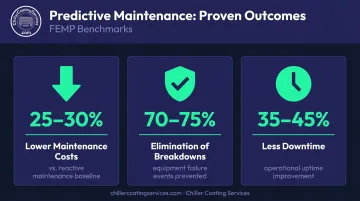
General facility O&M benchmarks from FEMP document predictive maintenance programs achieving 25–30% lower maintenance costs, 70–75% elimination of breakdowns, and 35–45% less downtime. For larger facilities operating multiple chillers, even basic data logging can pay for itself by catching a single compressor fault before it becomes an unplanned outage.
Annual professional service visits should include a review of trending data to inform the next maintenance cycle.
Major / Overhaul Maintenance
Major overhauls cover the components and conditions that routine PM doesn't reach:
- Deep coil cleaning (inside-out rinse with coil cleaner)
- Compressor oil and filter replacement
- Refrigerant system flush and recharge if needed
- Worn seals, gaskets, and belt replacement
- Electrical component rebuilds
- Tube sheet inspection and restoration
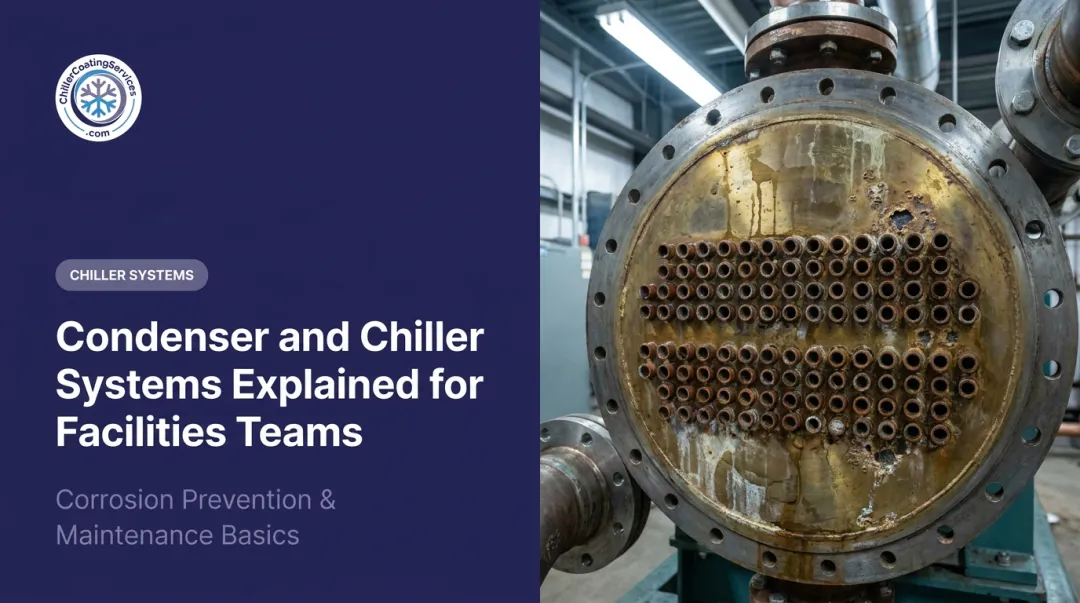
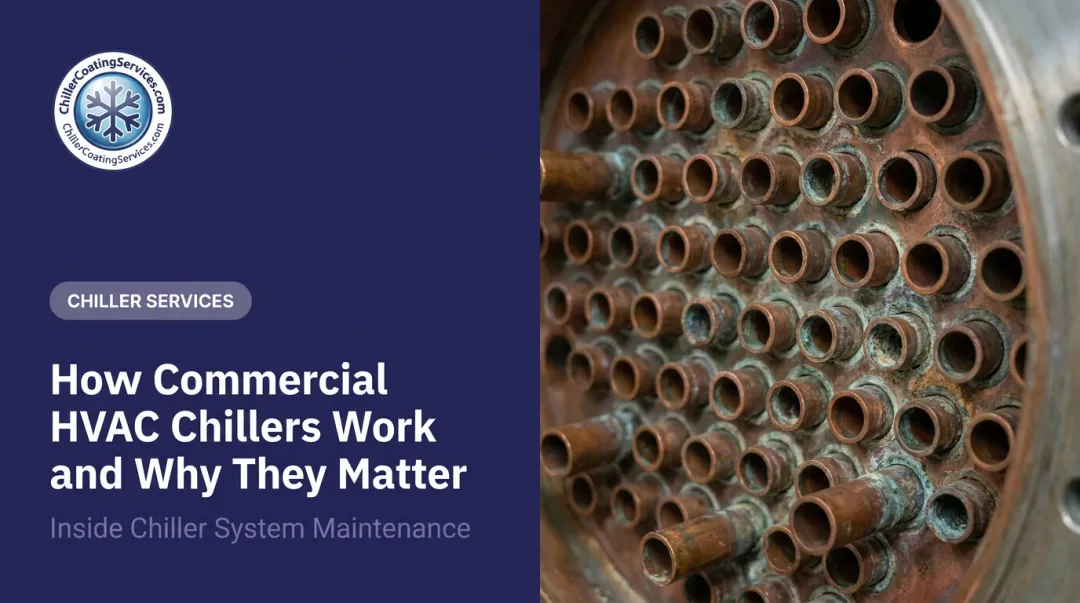
Tube sheet corrosion deserves specific attention in aging air-cooled systems. In New England facilities, water chemistry accelerates galvanic and pitting corrosion — and routine inspections frequently miss the cumulative damage.
Galvanic corrosion at tube-to-tube-sheet junctions, pitting from dissolved oxygen and biofilm activity, and erosion at high-velocity inlet zones all degrade joint integrity over time.
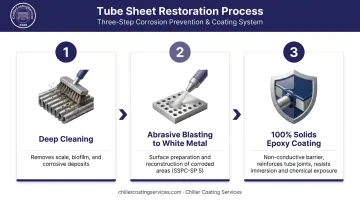
Chiller Coating Services addresses this through a structured three-step restoration process used on chiller systems throughout New England and New York:
- Deep cleaning: removes scale, biofilm, and corrosive deposits to expose sound metal
- Contained abrasive blasting to white metal finish (SSPC-SP 5 / NACE No. 1 equivalent), including reconstruction of severely corroded areas where metal loss has occurred — coating over structurally compromised metal fails prematurely
- 100% solids epoxy coating application — creates a non-conductive barrier that eliminates electrolytic pathways between dissimilar metals, reinforces tube-to-tube-sheet joints (with documented push-out strength increases of over 1,000 pounds in some cases), and resists long-term immersion, chemical exposure, and fouling
Major overhaul is typically warranted every 5–10 years depending on operating hours and environment, or when performance testing indicates the unit can no longer meet design capacity without excessive energy input.
Warning Signs Your Air-Cooled Chiller Needs Maintenance
These indicators warrant immediate investigation — not a note in next quarter's maintenance log. Waiting costs more than acting early.
Performance and Efficiency Decline
Watch for these patterns:
- Chilled water supply temperatures consistently above setpoint
- Longer run times to meet the same cooling load
- Compressor cycling more frequently than normal
- System tripping the high-pressure limit
All point to restricted heat rejection, low refrigerant charge, or fouled coils. Track energy consumption per ton of cooling as your baseline metric. A meaningful increase without a corresponding rise in ambient temperature or building load signals overdue maintenance. ASHRAE Standard 180 requires annual performance comparison against design or baseline figures for exactly this reason.
Abnormal Sounds, Vibration, or Visible Wear
Specific red flags to investigate immediately:
- Unusual rattling or grinding from fan assemblies — bearing wear or debris contact
- Refrigerant hissing near fittings — active leak
- Visible corrosion or pitting on coil fins or tube sheets — even minor surface pitting can compromise tube-to-tube-sheet joint integrity over time
- Oil stains near refrigerant connections — potential refrigerant or oil leak
- Frayed or discolored electrical wiring — fire and fault risk
On tube sheets specifically, look for:
- Dark pitted surface texture or rust and scale accumulation
- Obstructed tube openings
- Crevice corrosion patterns at the joint interface
Early-stage pitting is treatable with coating. Once metal loss is measurable, reconstruction is required before coating can be applied — making early identification directly cost-relevant.
Increased Energy Use and Recurring Faults
A chiller drawing noticeably more power than its historical baseline for the same cooling output signals one of three root causes:
- Internal fouling reducing heat transfer efficiency
- Refrigerant undercharge lowering system capacity
- A failing component forcing the compressor to overwork
Recurring fault codes deserve equal attention. A chiller that trips, resets, and restarts — even without staying down — is running under stress from an unresolved problem. The same alarm appearing across multiple cycles is never a nuisance trip.
Air-Cooled Chiller Maintenance Schedule
Maintenance frequency should reflect operating profile. A hospital or data center chiller running year-round needs more frequent attention than one used only during summer cooling season at a school. Use the manufacturer's manual as your baseline, then adjust for local environment and usage intensity.
Maintenance Frequency by Tier
| Interval | Key Tasks |
|---|---|
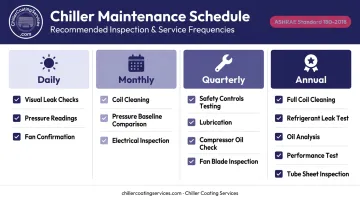
| Daily / Per-Shift | Visual inspection for leaks or unusual sounds; verify temperature and pressure readings within normal range; confirm fan motors running |
| Monthly | Inspect and clean condenser coils of surface debris (dust, cottonwood seeds, leaves); check refrigerant suction and discharge pressures against baseline; inspect electrical connections; clean air filters |
| Quarterly | Test safety controls and sensors; lubricate fan motor bearings and moving parts; check compressor oil level and condition; inspect fan blades for damage or imbalance; tighten fittings and fasteners |
| Annual (Professional) | Comprehensive coil cleaning (inside-out rinse with coil cleaner); full refrigerant system check including leak test; oil analysis on applicable compressors; full-load performance test; review of PM trending data; tube sheet inspection with coating or restoration as needed |
ASHRAE Standard 180-2018 explicitly covers air-cooled chillers with quarterly, semiannual, and annual task requirements — including quarterly condenser coil inspection, semiannual VFD and controls check, and annual water-side heat exchanger inspection for scale and corrosion. It also allows frequency adjustment based on findings: increase frequency after unacceptable conditions in two successive inspections; reduce after acceptable conditions in three successive inspections.
One additional point from DOE/FEMP: outdoor air-cooled coils in dirty environments may require cleaning two or three times during a cooling season, not just at season start. Environment matters as much as schedule.
Seasonal Adjustments for New England Facilities
In New England climates where chillers shut down during winter months, add two inspection points to the calendar:
- Pre-startup spring inspection: Refrigerant levels, electrical connections, fan assemblies, and tube sheet condition — before the cooling season begins
- Post-season fall inspection: Full condition assessment after the season, so any deterioration from the operating season can be addressed before it worsens over winter
Fall inspections frequently reveal tube sheet damage from galvanic corrosion that built up during the cooling season, making it the natural trigger for tube sheet assessment and coating work.
For schools and universities, summer break provides a near-perfect mobilization window. Chiller Coating Services schedules hospital work around low-load shoulder seasons, with coordination adapted to clinical operations — including infection-control protocols and biomedical engineering requirements.
Conclusion
Air-cooled chiller maintenance isn't optional — it's the primary lever facility managers control over long-term operating costs, equipment reliability, and capital planning timelines. A well-maintained chiller is a predictable expense. A neglected one sets its own replacement schedule — usually at the worst possible time.
Effective chiller management comes down to three layers working together:
- Routine preventive tasks maintain baseline performance between service intervals
- Periodic professional inspections catch what in-house PM can't see
- Targeted restoration work — including tube sheet assessment and protective coating — preserves the full value of the equipment over its operating life
Tube sheet corrosion is often the last thing a facility manager thinks about and the first thing that causes a serious problem. Addressing it during a planned maintenance window — on your schedule, at coating cost — avoids the emergency intervention scenario entirely. That's the difference between a $5,000 planned service and a six-figure emergency replacement under load.
Frequently Asked Questions
What is the preventive maintenance schedule for air-cooled chillers?
Preventive maintenance for air-cooled chillers follows a tiered schedule: daily visual checks, monthly coil cleaning and pressure checks, quarterly lubrication and safety testing, and a comprehensive annual professional inspection. ASHRAE Standard 180-2018 defines these intervals explicitly for air-cooled equipment, with frequency increasing for units in continuous or high-demand operation.
What is the life expectancy of an air-cooled chiller?
ASHRAE's service life database shows air-cooled reciprocating chillers in service with a median age of 28.5 years. Consistent maintenance pushes equipment toward the upper end of its category's range; deferred maintenance shortens it. Addressing corrosion at the tube sheet level — through coating or reconstruction — reduces the failures that most often force early retirement.
What are the most common causes of air-cooled chiller failure?
The most common causes include:
- Fouled or damaged condenser coils restricting heat rejection
- Refrigerant leaks causing low charge
- Electrical component failures (loose connections, worn contactors)
- Corrosion or fouling of internal heat exchanger surfaces, including tube sheet degradation from galvanic corrosion, pitting, and inlet erosion — often overlooked until a leak develops
How often should condenser coils on an air-cooled chiller be cleaned?
Condenser coils should be inspected monthly and cleaned at least once per year (two to three times per season in dusty or debris-heavy environments). ASHRAE Standard 180 requires quarterly inspection and cleaning as needed. Use coil cleaner and rinse from the inside out to protect fin integrity.
Can air-cooled chiller maintenance be performed in-house, or does it require a professional?
Routine tasks (visual checks, surface coil cleaning, log review, filter cleaning) can be handled by trained in-house staff. Refrigerant system work, oil analysis, electrical safety testing, and tube sheet inspection or coating require qualified professionals, as do specialized processes like contained abrasive blasting and corrosion reconstruction that depend on proprietary equipment and materials.
What happens if air-cooled chiller maintenance is neglected?
Neglect produces escalating consequences: reduced efficiency and higher energy bills first, then component failures and unplanned downtime, and ultimately premature equipment replacement — each stage more expensive than the last, and all more costly than consistent preventive maintenance.