For facilities managers and engineers responsible for commercial or industrial cooling systems, understanding what drives surface corrosion — and what stops it — is directly tied to uptime, energy costs, and capital planning. This article breaks down the four primary causes, what happens when corrosion is ignored, and how to build a prevention strategy that works.
Key Takeaways
- Surface corrosion in chillers stems from four controllable causes: pH imbalance, dissolved oxygen, dissimilar metal contact, and chloride contamination
- Tube sheets, water boxes, and heat exchanger shells face the highest exposure risk
- Trane specifies pH 7.5–9.0 and chloride ≤125 mg/L for chilled-water loops — drifting outside these ranges accelerates attack
- Corroded heat transfer surfaces reduce thermal conductivity, driving up energy consumption and operating costs
- Combining protective coatings, water treatment, and regular inspections extends equipment service life and prevents costly failures
Common Causes of Surface Corrosion in Chiller Systems
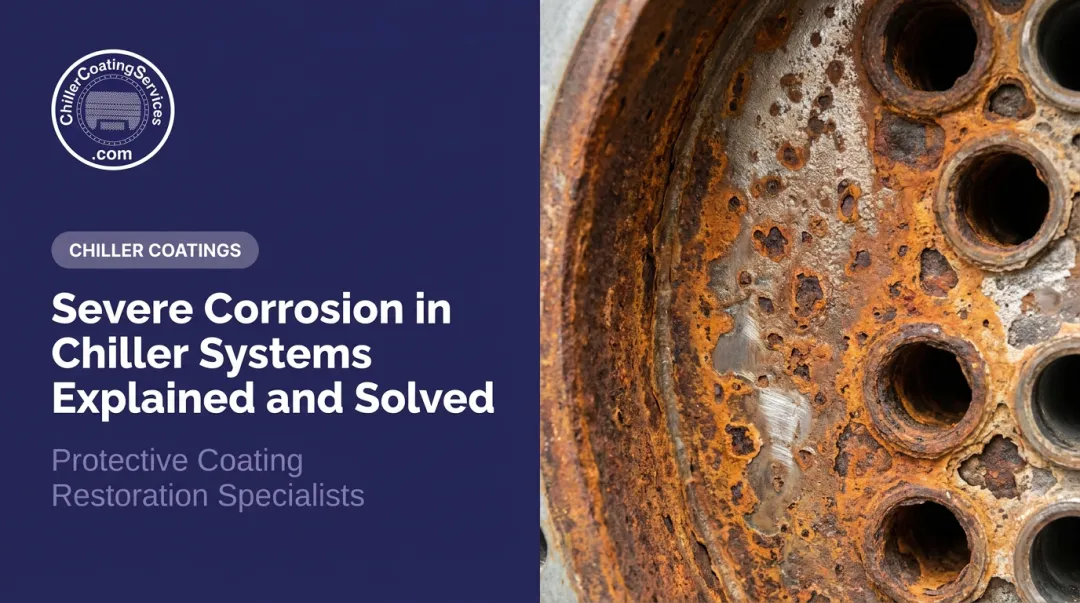
Surface corrosion in a chiller context means the uniform or near-uniform degradation of metal surfaces — tube sheets, water boxes, and shell interiors — caused by direct chemical or electrochemical attack from the water-side environment. It rarely has a single cause. Most cases involve two or more interacting factors at once.
Unbalanced Water Chemistry (pH Imbalance)
Water pH is the most controllable corrosion variable in any chiller system, yet it's frequently overlooked until inhibitor concentrations have already drifted out of range.
When water is too acidic, it aggressively dissolves the passive oxide layer protecting metal surfaces. According to Trane's water quality guidance, pH below 7.5 can dissolve copper's protective oxide film and allow chloride and sulfate ions to attack directly.
Overly alkaline water creates a different problem: it promotes scale formation, and scale that flakes off exposes fresh metal to attack.
Common scenarios where pH becomes problematic:
- Chillers operating without an active water treatment program
- Systems refilled with untreated municipal water after seasonal shutdowns
- Inhibitor dosing that has drifted out of range over time without detection
Dissolved Oxygen in Chiller Water
Dissolved oxygen drives oxidation reactions at metal surfaces — forming iron oxides on steel components and copper oxides on copper tube sheets. The NIH identifies dissolved oxygen and oxygen-bearing untreated makeup water as direct causes of flash rusting in closed-loop water systems — the same piping and heat exchanger environments found in chiller installations.
Three conditions consistently amplify oxygen exposure:
- Repeated drain-and-refill cycles that reintroduce oxygenated water each time
- Poor system sealing that allows ongoing air ingress
- Chillers left idle for extended periods with standing water inside
Dissimilar Metal Contact (Galvanic Corrosion)
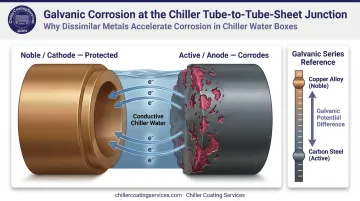
When two different metals are in electrical contact through a conductive liquid like chiller water, a galvanic cell forms. The less noble metal corrodes preferentially. In chillers, the classic pairing is copper alloy tubes running through carbon steel or cast iron tube sheets.
ASHRAE's galvanic series guidance places copper alloys toward the noble end and carbon steel well into the active (anodic) zone. That means the steel corrodes while the copper is protected. ASHRAE recommends using the same construction material for tubes, tube sheets, and water heads where possible. Where that isn't practical, compatible materials, coatings, sacrificial anodes, or electrical isolation should be specified.
Where galvanic corrosion commonly develops:
- Tube-to-tube-sheet joints where insulation has worn away or was never installed
- Mixed-metal piping connections added during maintenance
- Systems where replacement components introduced a different alloy than the original design
Chloride and Chemical Contamination
Chloride ions aggressively break down the protective oxide layer on steel and aluminum surfaces, creating active corrosion sites that spread. Trane's guidance for chilled-water loops specifies a maximum chloride concentration of 125 mg/L — above that threshold, attack on copper and steel surfaces accelerates significantly.
High-risk sources include:
- Municipal water supplies in coastal or urban areas with elevated chloride levels
- Biocide or scale inhibitor overdosing that shifts water chemistry unexpectedly
- Open cooling circuits where airborne chlorides enter from industrial or marine environments
What Happens If Surface Corrosion Is Ignored
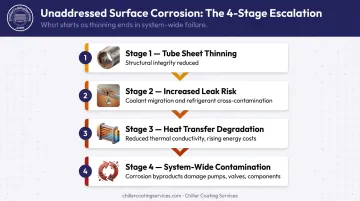
Unaddressed surface corrosion accelerates over time. Here's the progression facilities teams typically see:
- Tube sheet thinning — Metal loss reduces structural integrity and weakens tube-to-tube-sheet joint connections
- Increased leak risk — Deteriorated joints create pathways for coolant migration and, eventually, refrigerant-water cross-contamination
- Heat transfer degradation — Corroded, roughened surfaces reduce thermal conductivity and accumulate fouling deposits
- System-wide contamination — Corrosion byproducts circulate through chiller water, accelerating wear on pumps, valves, and other wetted components
The financial consequences follow the same arc. Reactive repairs — emergency mobilization, tube bundle replacement, or premature chiller retirement — cost far more than the structured prevention that could have stopped corrosion earlier.
YORK's operating guidance flags a condenser approach temperature more than 4°F above the new-unit baseline as a direct indicator of fouled or degraded tubes. That threshold is a measurable early warning — one that gives facilities teams room to act before repairs become emergencies.
Warning Signs of a Surface Corrosion Problem
Knowing what to look for during routine checks makes early detection straightforward:
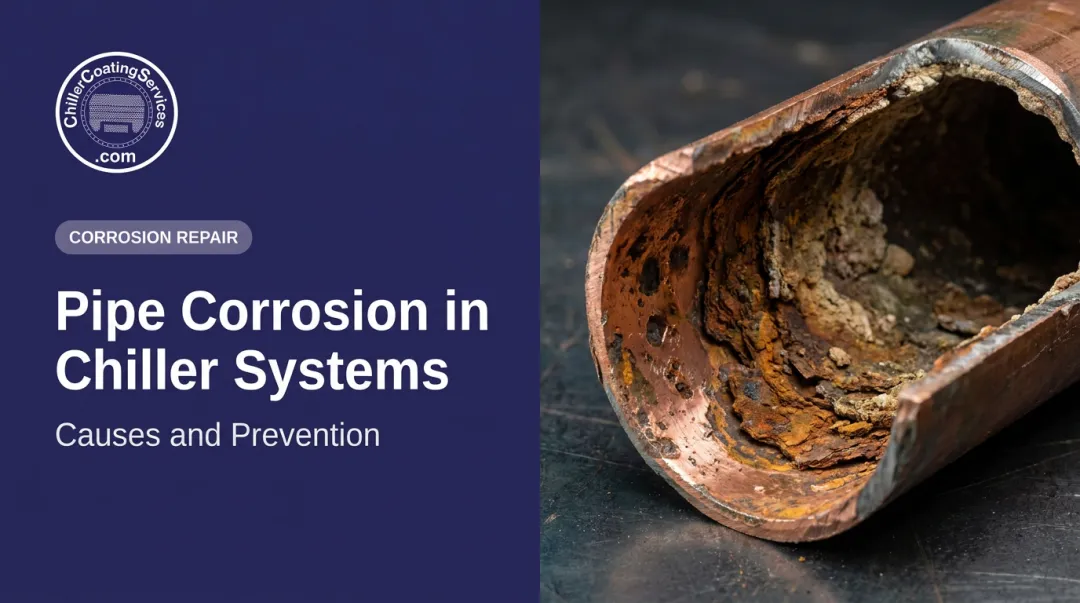
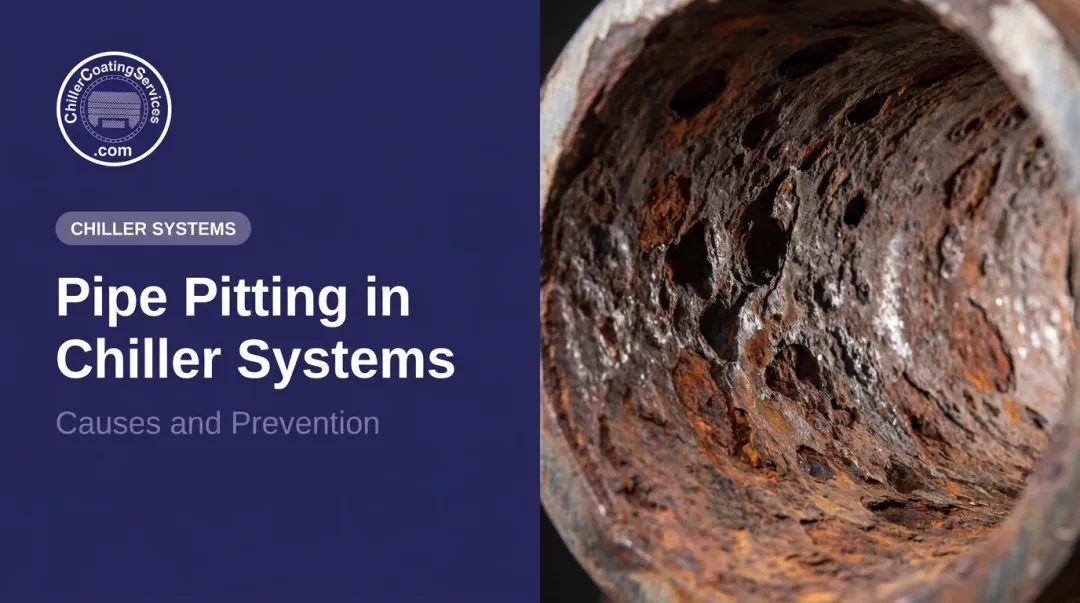
- Visible discoloration, roughening, or pitting on tube sheet faces or water box surfaces — rust-colored staining on steel, greenish deposits on copper
- Unexplained decline in cooling efficiency or increased energy consumption, indicating fouled heat transfer surfaces
- Rapid depletion of corrosion inhibitors in water samples, cloudy or discolored chiller water, or elevated metal ion concentrations (iron, copper) in water analysis results
How to Prevent Surface Corrosion in Chiller Systems
No single measure stops corrosion on its own. Effective control combines water chemistry management, physical surface protection, and routine monitoring — each layer reinforcing the others.
Water Treatment and Chemistry Control
An active water treatment program is the foundation. At minimum, it should:
- Maintain pH within OEM-specified ranges — Trane's chilled-loop specification is pH 7.5–9.0; systems containing aluminum require a tighter window of pH 8.2–8.5
- Control dissolved oxygen using chemical oxygen scavengers such as sodium sulfite or erythorbate
- Maintain corrosion inhibitor concentrations (molybdate, nitrite, or azole-based formulations) at levels confirmed by regular water sampling
- Keep chloride concentrations below the 125 mg/L threshold for standard chilled-water equipment
Water sampling should occur at minimum monthly — more frequently in systems with high makeup water demand or after any significant system event such as a refill, shutdown, or chemical treatment change.
Protective Coatings for Tube Sheets and Water Boxes
Protective coatings create a physical barrier between metal surfaces and the corrosive water-side environment. When properly applied, they also address galvanic corrosion by electrically isolating dissimilar metals at the tube-to-tube-sheet junction.
Chiller Coating Services applies a 100% solids epoxy coating system to tube sheets, tube ends, and water box interiors following a three-step process:
- Deep cleaning — Removal of biofilm, scale, and corrosion deposits to expose sound metal
- Contained abrasive blasting to white metal finish — Equivalent to SSPC-SP 5 / NACE No. 1, removing all rust, mill scale, and contaminants; severely corroded areas are reconstructed at this stage to restore metal thickness before coating is applied
- 100% solids coating application — Applied at approximately 10 mils thickness, with no solvent flash-off, no shrinkage, and maximum film build per coat
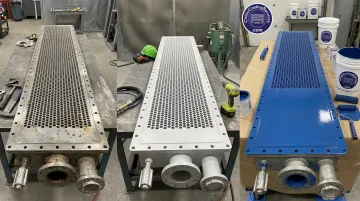
The cured coating is non-conductive, eliminating the electrolytic pathway between dissimilar metals and interrupting galvanic corrosion at the tube-to-tube-sheet joint. Documented outcomes include push-out strength gains of over 1,000 pounds in some cases, improving joint integrity and reducing leak risk.
Quick-cure technology means the service fits planned outage windows — fall or spring shoulder seasons for most facilities, summer break for schools, or single-chiller-at-a-time sequencing for data centers that need to preserve cooling redundancy.
Routine Inspection and Isolation of Dissimilar Metals
Coatings and water treatment slow corrosion — but regular inspection catches what chemistry and barriers miss. Manufacturer-recommended inspection tasks by frequency:
Inspection cadence recommended by manufacturers:
| Frequency | Task |
|---|---|
| Daily | Monitor condenser and evaporator approach temperatures; flag deviations |
| Monthly | Water sampling for pH, inhibitor levels, chloride, and metal ions |
| Annually | Visual inspection of tube sheets, water boxes; brush-clean surfaces |
| Every 5 years | Condenser tube scan service to assess internal tube condition |
Where system design brings dissimilar metals into contact, use dielectric fittings, insulating gaskets, or sacrificial anode systems to interrupt the galvanic circuit. Verify isolation integrity during annual inspections — wear and maintenance activity can compromise fittings over time.
Tips for Long-Term Prevention and Control
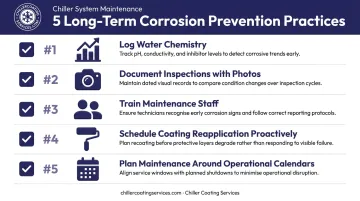
Corrosion doesn't develop overnight, and neither does an effective prevention program. These practices keep small problems from compounding into costly failures:
- Log water chemistry results consistently — trends matter more than any single reading; a steady decline in inhibitor concentration is more actionable than one low result
- Document inspection findings with photographs — visual records allow year-over-year comparison of corrosion progression and support coating reapplication decisions before performance declines
- Train maintenance staff on early visual warning signs and correct chemical dosing procedures — human error in inhibitor dosing and delayed reporting of visible discoloration are among the most avoidable causes of accelerated corrosion
- Schedule coating reapplication proactively using inspection records rather than waiting for efficiency losses or leaks to prompt action
- Plan maintenance around operational calendars — summer breaks, shoulder seasons, and scheduled plant outages are the right times to mobilize coating services, not during peak cooling demand
Frequently Asked Questions
What is surface corrosion?
Surface corrosion is the uniform or near-uniform degradation of a metal's surface through chemical or electrochemical reaction with its environment, typically appearing as roughening, etching, pitting, or powdery deposits. In chiller systems, it most commonly affects tube sheets, water boxes, and shell interiors.
What are the four conditions for corrosion to occur?
Corrosion requires four elements: an anode, a cathode, an electrolyte (such as chiller water), and a metallic path connecting the two metals. Removing any one of them stops the reaction — which is why non-conductive coatings and dielectric isolation are effective prevention strategies.
What parts of a chiller system are most susceptible to surface corrosion?
Tube sheets, water boxes, evaporator and condenser shells, and tube-to-tube-sheet joints carry the highest risk. Continuous contact with chiller water — combined with dissimilar metal interfaces in many designs — creates concentrated points of galvanic activity.
How does water chemistry affect corrosion in chiller systems?
Improper pH, elevated chloride levels, dissolved oxygen, and depleted inhibitors each accelerate degradation through distinct mechanisms. Staying within OEM-specified ranges — Trane's guidelines call for pH 7.5–9.0 and ≤125 mg/L chloride in chilled-water loops — is among the most cost-effective controls available.
Can surface corrosion in chillers reduce system efficiency?
Yes. Corroded and roughened heat transfer surfaces reduce thermal conductivity, increase fouling accumulation, and force the chiller to consume more energy to meet the same cooling load. YORK and Carrier both use condenser approach temperature elevation as a field indicator of this degradation — a 4°F increase above the new-unit baseline is a recognized warning threshold.
When should chiller tube sheets be professionally inspected for corrosion?
At minimum annually, with additional inspections after any unplanned shutdown, water system event, or significant shift in water quality readings. Catching corrosion early typically means a coating repair rather than a tube bundle replacement — a significant difference in cost and downtime.