For facilities managers and engineers responsible for HVAC reliability in hospitals, schools, office buildings, and data centers, understanding this failure mode matters — not just academically, but operationally. Left unaddressed, cavitation pitting accelerates component degradation, drives unplanned downtime, and can compromise an entire cooling system. The U.S. Department of Energy estimates median replacement costs for water-cooled chillers at over $550,000 per unit — a figure that makes early prevention far more attractive than reactive repair.
This article breaks down the root causes of cavitation pitting, what happens when it goes unaddressed, how to recognize it early, and the layered prevention strategies that keep chiller equipment running longer.
Key Takeaways
- Vapor bubbles implode against metal surfaces when local pressure drops below vapor pressure, causing cavitation pitting
- The four primary causes are low suction pressure, inlet turbulence, poor water treatment, and worn components
- Left untreated, pitting causes tube failure, refrigerant contamination, and compressor damage
- Catch it early through audible changes, efficiency monitoring, and tube sheet inspections
- Prevention relies on pressure management, flow control, water treatment, and protective coatings
Common Causes of Cavitation Pitting in Chillers
Cavitation pitting begins with a pressure event. When refrigerant or coolant pressure drops locally below vapor pressure, the liquid flashes into vapor-filled bubbles. Those bubbles collapse milliseconds later against a nearby metal surface, releasing intense localized shock forces that punch microscopic craters into tube sheets, evaporator tube walls, and tube inlets.
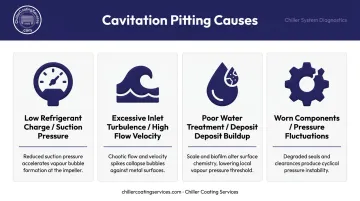
Repeated thousands of times per hour, this process becomes structurally destructive. Four root conditions drive it in commercial chiller systems.
Low Refrigerant Charge and Inadequate Suction Pressure
An undercharged refrigerant system creates a low-pressure environment at or near the evaporator inlet where refrigerant flashes prematurely — before reaching the designed heat exchange zone. Common scenarios include:
- Refrigerant leaks that go undetected between maintenance cycles
- Improperly set or failed expansion valves
- Operating a chiller at partial loads outside its designed operating envelope
Trane's RTAC Plus chiller manuals document model-specific "Very Low Evaporator Refrigerant Pressure" shutdowns at thresholds as low as 10 psia — illustrating how manufacturers treat low suction pressure as a system-protection event, not just a performance issue.
Excessive Inlet Turbulence and High Flow Velocity
Turbulent flow is one of the most direct triggers for cavitation at tube sheet surfaces. Abrupt changes in flow direction, undersized piping, or improperly configured inlet geometry create zones where local pressure drops sharply, nucleating bubbles at tube entry points.
Johnson Controls documents a centrifugal chiller evaporator tube velocity range of 3 to 12 ft/s at 100% chilled-water load, with velocities above 12 ft/s linked directly to tube erosion. Typical field triggers include:
- Close-coupled elbows installed immediately upstream of the chiller
- Oversized circulation pumps pushing flow beyond the unit's design parameters
- Uneven water distribution across the evaporator tube bundle
Poor Water Treatment and Deposit Buildup
Scale, biofilm, and mineral deposits on tube and tube sheet surfaces don't just impair heat transfer — they disrupt laminar flow, creating localized turbulence and pressure differentials that initiate cavitation. Trane's published data shows that a 0.6 mm scale layer reduces heat transfer efficiency by 34% and increases energy consumption by 21%.
In New England, regional water chemistry — combined with seasonal load swings and aging pre-2000 building stock — makes tube sheet pitting and water box corrosion routine findings during scheduled maintenance. Facilities that skip water treatment audits during spring and fall shoulder seasons carry the highest exposure.
Worn or Degraded Components Causing Pressure Fluctuations
Worn expansion valves, fouled strainers, and degraded pump impellers introduce erratic pressure fluctuations that repeatedly create low-pressure conditions where vapor bubbles form and collapse. This cause is especially hard to catch in older chillers or facilities with deferred maintenance schedules — component wear accumulates gradually, often without triggering visible alarms until significant pitting has already occurred.
What Happens If Cavitation Pitting Is Ignored
Cavitation pitting follows a self-accelerating pattern. Existing pits roughen the surface, increasing local turbulence, which creates new nucleation sites for more bubbles, which cause more pitting. The damage compounds at each stage.
The escalation path typically looks like this:
- Surface pitting — microscopic craters form at tube ends and tube sheet faces
- Joint degradation — tube-to-tube-sheet joints weaken as metal erodes at the interface
- Through-wall tube failure — pits deepen until coolant penetrates the tube wall
- Refrigerant contamination — water-side/refrigerant-side cross-leaks develop, threatening the compressor
- Compressor damage or full chiller replacement — Carrier's maintenance guidance specifically warns that water leaks entering the chiller can severely damage the compressor and entire system
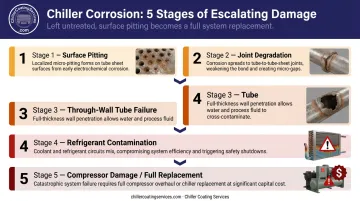
For hospitals, schools, and commercial buildings that depend on continuous cooling, reaching stage four or five means emergency shutdowns, expensive rental equipment, and replacement timelines that stretch into months.
Warning Signs of Active Cavitation Pitting
Catching the problem before it reaches those later stages depends on knowing what to look for. Cavitation rarely announces itself with an obvious failure — it builds through operational changes that attentive staff can learn to recognize:
- Audible indicators — crackling, rattling, or gravel-like sounds from the evaporator section signal vapor bubble implosion and warrant immediate inspection
- Performance degradation — inability to hold setpoints, declining heat transfer efficiency, and rising energy consumption as pitted surfaces lose thermal conductivity
- Vibration — increased vibration at the chiller frame, detectable by hand or with sensors, often accompanies active cavitation
- Visual confirmation — a sponge-like or honeycomb surface texture on tube sheet faces and tube inlets during scheduled inspection confirms cavitation damage
How to Prevent Cavitation Pitting in Chillers
No single measure eliminates all cavitation risk. Effective prevention requires addressing multiple failure pathways at once: proper commissioning, water treatment discipline, flow management, and direct surface protection working together.
Maintain Proper Refrigerant Charge and System Pressure
Verify refrigerant charge levels and expansion valve settings at every scheduled maintenance cycle. Suction pressure should never drop into the cavitation-prone range for the specific refrigerant in use. Maintaining the correct pressure differential across the evaporator prevents premature refrigerant flashing at tube inlet surfaces.
Trane's maintenance documentation for CenTraVac water-cooled chillers supports scheduled pressure/temperature logging and refrigerant leak checks as part of recurring service intervals, with model-specific guidance on frequency.
Control Water Flow Rates and Eliminate Turbulence Sources
Audit chiller inlet piping configurations for conditions that generate turbulence:
- Close-coupled elbows near chiller inlets
- Abrupt reducers or oversized components creating velocity spikes
- Flow restrictions from fouled strainers or partially closed isolation valves
Correct these with straight pipe runs, properly sized components, or flow straighteners upstream of the unit. Balance water flow evenly across the evaporator bundle and confirm that operating flow rates stay within the manufacturer's recommended velocity envelope. For many centrifugal chillers, that means staying below 12 ft/s at the tube inlet.
Carrier documents transient flow rate limits separately from steady-state design limits. Rapid flow changes (outside the 50% per minute range on some units) can themselves trigger pressure transients that initiate cavitation.
Water flow control addresses one layer of risk. Chemical conditions at tube surfaces introduce another.
Implement a Rigorous Water Treatment Program
A consistent water treatment program that controls scale, biological growth, pH, and corrosion inhibitor levels protects tube and tube sheet surfaces from the deposit buildup that disrupts flow and weakens metal against cavitation forces.
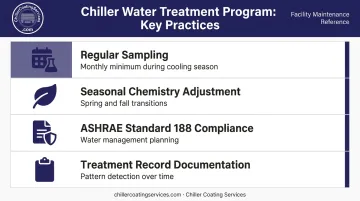
Key practices:
- Establish regular water sampling intervals, monthly at minimum during the cooling season
- Adjust treatment chemistry seasonally, particularly in spring and fall across New England when load patterns shift and makeup water chemistry changes
- Follow ASHRAE Standard 188 guidance for water management planning in building systems
- Document treatment records to support compliance audits and pattern detection over time
Water treatment and flow management reduce the conditions that cause cavitation. When tube sheets have already sustained damage, or when operating conditions can't be fully controlled, direct surface protection becomes the final line of defense.
Apply Protective Coatings to Chiller Tube Sheets
Protective coatings represent the most direct physical defense against cavitation pitting at tube sheet surfaces. Chiller Coating Services' 100% solids epoxy system addresses cavitation through several interconnected mechanisms:
| Coating Property | How It Addresses Cavitation |
|---|---|
| 100% solids / no shrinkage during cure | Maximum film density — no micro-voids that become failure initiation sites |
| Physical toughness | Absorbs and deflects micro-shock forces from bubble collapse |
| Non-conductive barrier | Eliminates galvanic corrosion that compounds cavitation pitting |
| Inlet turbulence reduction | Smooth surface geometry at tube ends reduces cavitation initiation |
| Joint reinforcement | Documented push-out strength gains of 1,000+ lbs protect the highest-risk zone |
The application process matters as much as the coating chemistry. Chiller Coating Services' three-step process begins with deep cleaning to remove biofilm, scale, and corrosion deposits, exposing the true extent of damage.
Contained abrasive blasting to SSPC-SP 5 / NACE No. 1 white metal finish follows, along with reconstruction of severely pitted or eroded areas. Only then is the 100% solids coating applied to tube sheet faces, tube ends, and water boxes.
This sequence is non-negotiable. Coating over compromised metal without reconstruction simply bridges over structural deficiencies: the coating will fail prematurely and joint deterioration will continue. Rebuilding first and coating second restores tube sheets to near-new internal condition rather than masking existing damage.
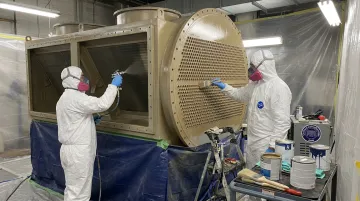
Quick-cure formulations minimize operational disruption, with work scheduled during planned maintenance windows, summer shutdowns for schools, or redundancy-aware downtime windows for hospitals and data centers.
Tips for Long-Term Prevention and Control
One-time fixes won't hold if the underlying conditions go unmonitored. These practices, built into standard operating procedures, keep cavitation from gaining a foothold:
- Schedule annual visual inspections of tube sheets and evaporator tube inlets, catching early pitting before it progresses to joint failure.
- Train operators to recognize the audible and performance-based warning signs so operators escalate anomalies rather than dismiss them as normal variation.
- Maintain a documented maintenance log recording refrigerant charge levels, water chemistry readings, vibration trends, and inspection findings. Consistent records make it easier to spot patterns and decide when recoating or remediation is warranted.
- Use vibration sensors and pressure data logging at the chiller to detect early cavitation activity between visual inspectionsso problems surface before visible damage accumulates.
- Coordinate coating inspection with seasonal transitions. Fall maintenance is a natural trigger point for tube sheet assessment, especially in New England facilities where summer peak loads put the most stress on equipment.
Conclusion
Cavitation pitting in chillers has clearly identifiable causes — suction pressure instability, turbulent inlet flow, poor water treatment, and worn system components — and each cause has a corresponding, actionable prevention strategy. The damage doesn't appear overnight, but it progresses steadily and accelerates once established.
Facilities managers and engineers who invest in proactive measures — regular maintenance, water treatment discipline, flow management, and professional surface protection — reduce the risk of unplanned shutdowns and extend chiller service life. If pitting has already taken hold, surface restoration and protective coating applied to tube sheets and water boxes can halt progression and rebuild structural integrity before replacement becomes the only option.
Frequently Asked Questions
What does cavitation damage look like?
Cavitation damage appears as small, rough, cratered pits on metal surfaces — often described as a sponge-like or honeycomb texture. Damage concentrates at areas of highest flow turbulence, particularly tube sheet faces and evaporator tube inlets. Unlike smooth chemical corrosion, cavitation pitting has a distinctively rough, directional pattern tied to flow zones.
Can cavitation cause pitting?
Yes, cavitation is a direct cause of pitting. When vapor bubbles collapse against metal surfaces, they generate localized shock waves and microjets that strip metal away, creating the characteristic craters that define cavitation damage. This mechanism is well-documented in peer-reviewed tribology research on erosion pit morphology.
What is the difference between cavitation and pitting?
Cavitation is the process — bubble formation and violent implosion caused by local pressure dropping below vapor pressure. Pitting is the resulting surface damage: the visible craters left behind. Pitting can also result from chemical corrosion, but cavitation pitting has a rougher, more directional pattern concentrated in high-velocity flow zones.
How do you detect cavitation in a chiller before it causes serious damage?
Listen for crackling or rattling sounds near the evaporator section, and monitor for unexplained efficiency drops or rising energy consumption. During planned maintenance, visual inspection of tube sheets and inlet surfaces is essential. Eddy current testing (Trane recommends every 3 years for CenTraVac units) and borescope examination provide the most reliable subsurface detection.
Can a pitted chiller tube sheet be repaired, or does it need full replacement?
In many cases, pitted tube sheets can be restored rather than replaced. Surface reconstruction rebuilds lost metal, and protective coating then armors the area against further attack. Viability depends on remaining base metal — an on-site assessment determines whether restoration or full replacement is the right call.
How often should chiller tube sheets be inspected for cavitation pitting?
Annual visual inspection is the minimum standard for routine chiller maintenance. More frequent checks are warranted for high-load systems, units with water treatment lapses, or aging equipment where component wear increases pressure instability risk. Fall shoulder-season outages are a natural inspection window for New England facilities.