Introduction
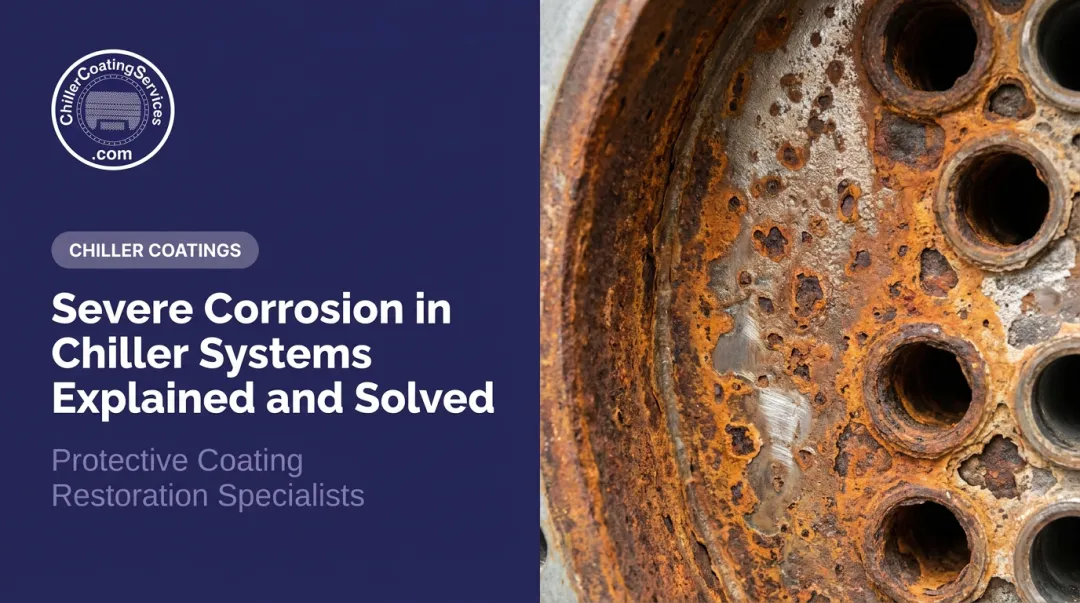
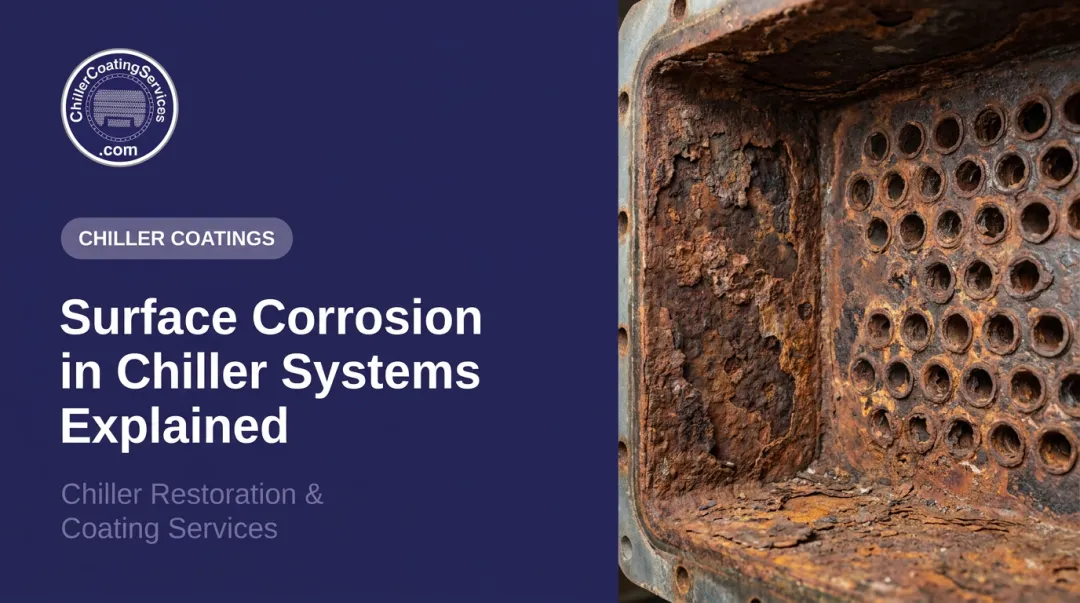
Chiller tube sheets fail quietly. Corrosion works beneath the surface — at tube-to-tube-sheet joints, along the tube sheet face, at inlet areas where turbulent water hits bare metal — and the damage accumulates well before any leak or efficiency loss becomes visible. By the time failure is obvious, the repair options are expensive.
Non-conductive epoxy coatings address this problem at its source. Applied to chiller tube sheets, these coatings create an electrically insulating barrier that interrupts the galvanic reactions between dissimilar metals, blocks moisture and chemical attack, and protects joint integrity for years of continuous immersion service.
For facilities managers and plant engineers, non-conductive epoxy coatings are widely referenced in chiller maintenance conversations — but rarely explained at the level that actually helps decision-makers. This article covers how these coatings work, when to use them, and what separates a successful application from one that fails in the first season.
Key Takeaways
- Non-conductive epoxy coatings electrically isolate chiller tube sheets, blocking the galvanic reactions that drive corrosion between dissimilar metals
- Standard epoxy resin is inherently non-conductive — its insulating properties come from its molecular chemistry, not added fillers
- Surface preparation is the most critical variable — inadequate blasting causes premature coating failure regardless of coating quality
- Professionally applied systems can increase tube-to-tube-sheet push-out strength by over 1,000 lb
- Coating is not always appropriate without prior repair — active leaks, severe pitting, or structural metal loss require reconstruction first
What Is Non-Conductive Epoxy Coating?
A non-conductive epoxy coating is a two-part thermosetting polymer system — resin plus hardener — that cures into a hard, chemically inert, electrically insulating film. When the two components mix, they undergo a crosslinking reaction that builds a dense three-dimensional polymer network.
That network resists electron flow, making the cured film an effective electrical insulator.
The term "non-conductive epoxy" is sometimes treated as if it describes a special additive or filler — it doesn't. Standard epoxy resin is non-conductive by its base chemistry. Conductive epoxy is the specialized formulation — it requires the addition of metal or carbon particles to create electrical conductivity. In chiller applications, that distinction matters: the goal is to block electrical conduction between dissimilar metals, not enable it.
How It Differs From General Industrial Coatings
Not every epoxy product is appropriate for chiller tube sheet service. Coatings used in this application must be:
- Rated for continuous water-side immersion, not just splash or intermittent contact
- Resistant to chiller water chemistry, including dissolved oxygen, scale-control treatments, and biocides
- Able to bond reliably to copper alloys, carbon steel, and cast iron under demanding service conditions
- Formulated at 100% solids — no solvents means no film shrinkage, no VOC emissions, and maximum cured film thickness
General-purpose industrial epoxy paints — typically 50–80% solids — produce thinner cured films, shrink as solvents flash off, and are not engineered for the specific chemical environment inside a chiller. In immersion service, they delaminate — and the corrosion that develops underneath is invisible until the damage is already extensive.
Why Chiller Systems Need Non-Conductive Epoxy Coatings
The Galvanic Corrosion Problem
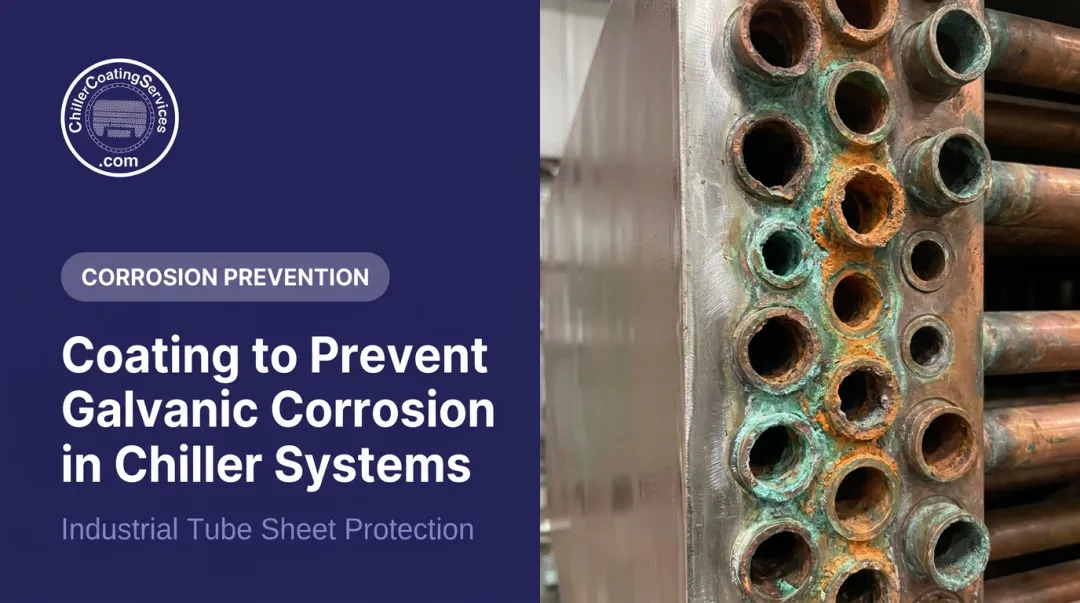
Chiller tube sheets and the tubes themselves are typically made from different metals — steel or cast iron tube sheets paired with copper alloy tubes is a common configuration. When process water bridges these two metals, it creates an electrolytic pathway. Electrons flow from the less noble metal to the more noble one, and the less noble metal corrodes preferentially.
According to AMPP, copper can significantly accelerate corrosion of steel in warm or hot water systems — precisely the conditions present in chiller water circuits. Galvanic corrosion requires three things: dissimilar metals, electrical contact, and an electrolyte. A chiller tube sheet provides all three.
A non-conductive coating interrupts the circuit. By placing an electrically insulating layer over the tube sheet face, it removes the electrochemical pathway between the two metals. The coating doesn't just protect the metal — it eliminates the mechanism driving the attack.
What Happens Without Protection
In uncoated chiller systems, degradation follows a predictable pattern:
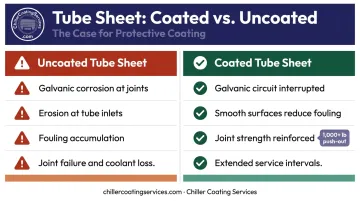
- Corrosion at tube-to-tube-sheet joints: galvanic and pitting attack undermines joint integrity over time
- Erosion at tube inlets: high-velocity water at the tube entrance progressively removes metal from inlet edges
- Fouling accumulation: rough corroded surfaces promote scale and biological fouling, reducing heat transfer
- Joint failure: cross-leaks develop between the water side and refrigerant side, contaminating the system and reducing capacity
The result is coolant loss, reduced thermal efficiency, and — in the worst cases — full tube sheet replacement or chiller retirement. ASHRAE's research on fouling in condenser tubes confirms that waterside fouling measurably degrades heat-transfer performance in these systems.
Structural and Efficiency Benefits
Protection from corrosion is the primary goal, but a properly applied coating delivers additional operational benefits:
- Reduces inlet turbulence and fouling through smoother surfaces, improving flow efficiency and heat transfer
- Reinforces tube-to-tube-sheet joints structurally — Chiller Coating Services has documented push-out strength increases exceeding 1,000 lb in some cases
- Extends intervals between service visits by reducing surface degradation
- Delays or eliminates the need for tube sheet replacement
Facilities where chiller downtime carries high operational cost — hospitals, data centers, pharmaceutical manufacturing plants — increasingly adopt tube sheet coating as preventive maintenance rather than reactive repair.
How the Non-Conductive Epoxy Coating Process Works
The coating process is not surface painting. It is a precision operation where the quality of every step directly determines how long the coating performs. Deviation in surface preparation, mixing ratios, film thickness, or cure schedule creates defects that shorten service life or cause premature failure.
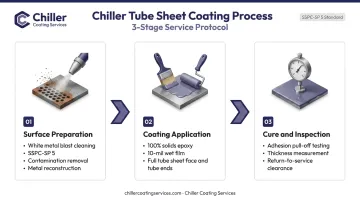
Chiller Coating Services executes this as a three-step process — deep cleaning, contained abrasive blasting with reconstruction, and 100% solids coating application — performed on-site during planned chiller downtime.
Step 1: Surface Preparation
Surface preparation is the most critical step. AMPP defines white metal blast cleaning (SSPC-SP 5 / NACE No. 1) as complete removal of all visible mill scale, rust, existing coatings, oxides, corrosion products, and contaminants. It is the highest level of abrasive blast cleaning in the industry.
Adhesion depends entirely on the quality of the substrate beneath the coating. Any remaining contamination — rust, scale, biofilm, or residual moisture — creates a weak interface where delamination starts. A coating applied over marginally prepared steel fails within months, costing far more in re-application and downtime than proper surface prep would have.
Chiller Coating Services uses contained abrasive blasting to achieve the white metal finish on-site. The containment system controls dust, debris, and abrasive media — critical in occupied commercial and industrial facilities. Where chemical or environmental constraints rule out dry abrasive blasting, water blasting is used as an alternative.
Where corrosion has caused significant metal loss, the crew reconstructs damaged areas during this step. Coating over structurally compromised metal seals in the problem rather than solving it. The substrate must be sound before any protective coating goes on.
Step 2: Coating Application
The 100% solids two-part epoxy is mixed to the manufacturer's specified ratio and applied to the prepared surface at the required wet film thickness — typically around 10 mils for chiller service. Professional applicators cover:
- The full tube sheet face
- All tube ends and the tube-to-tube-sheet joint interface
- Water box interiors, including inlet and outlet nozzles
Because 100% solids formulations contain no solvents, the applied volume equals the cured volume. There is no shrinkage and no VOC emission. Every mil applied remains as a mil of cured protection — unlike solvent-based systems, where film shrinkage after evaporation reduces the actual cured thickness below the applied measurement.
After application, coating integrity is verified through adhesion pull-off testing, thickness measurement using ultrasonic or magnetic gauges, and visual inspection across all coated surfaces.
Step 3: Curing and Return to Service
Curing is the chemical crosslinking process that builds hardness, chemical resistance, and structural integrity in the cured film. Time to full cure depends on the formulation, applied film thickness, and ambient temperature — and each one affects how quickly the coating reaches its minimum service threshold.
Chiller Coating Services offers quick-cure coating formulations that significantly reduce the downtime window compared to traditional systems. The chiller should not return to service until the coating reaches its minimum cure threshold, which is formulation-specific. Returning to service too early risks mechanical damage to the partially cured film and compromises long-term performance.
Key Factors That Affect Coating Performance
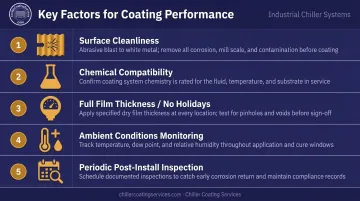
Even a correctly specified coating will underperform if site conditions, application variables, or post-installation factors work against it. The primary performance factors are:
- Achieve white-metal surface cleanliness before application — contamination or an insufficient blast profile prevents adhesion, and the coating is only as good as the surface beneath it
- Verify chemical resistance against your actual water treatment program — high chloride levels, acidic pH, or aggressive treatment chemicals will attack coatings not formulated for those specific conditions
- Apply full specified film thickness with zero holidays — thin spots or pinholes create entry points for corrosion to initiate and spread beneath the coating
- Monitor ambient conditions throughout the project — temperature, humidity, and dew point all affect cure chemistry and adhesion
- Schedule periodic inspections post-installation to catch edge erosion or mechanical damage before it progresses to larger areas
Common Issues and Misconceptions
Any Epoxy Won't Work
The most common misconception is that any epoxy coating will protect a chiller tube sheet. In reality, coatings must be formulated specifically for long-term immersion service, resistant to the facility's actual water chemistry, and compatible with the base metal. General-purpose epoxy paints lack these properties. When they delaminate — and they will — corrosion accelerates beneath the coating surface, where it goes undetected until damage is severe.
Surface Preparation Is Non-Negotiable
Teams often underestimate or shortcut surface preparation because it is time-consuming and adds cost to a project. This is the wrong calculation. A coating applied over inadequately prepared steel will fail in months. The cost of re-mobilization, re-blasting, and re-application — plus the operational disruption — far exceeds the cost of doing the preparation correctly the first time.
When Coating Alone Is Not Enough
Non-conductive epoxy coatings are not appropriate for every situation. Conditions requiring assessment before coating include:
- Active through-tube-sheet leaks — coating over an active leak seals nothing
- Severe pitting with significant metal loss — coating cannot bridge substantial structural deficiencies; metal reconstruction must precede coating
- Compromised tube-to-tube-sheet joint integrity — structural integrity must be rebuilt before surface protection applies
A qualified technician should always perform an on-site assessment before any coating project begins. Chiller Coating Services performs this assessment before any work begins — evaluating pit depth, joint integrity, corrosion mapping, and water box condition — to determine whether coating, reconstruction plus coating, or a different approach is appropriate for the specific system.
Conclusion
Non-conductive epoxy coatings do one thing that no other maintenance intervention accomplishes as effectively: they remove the electrochemical pathway that drives galvanic corrosion between dissimilar metals in a chiller system. Combined with protection against erosion, fouling, and chemical attack — and the structural reinforcement they provide at tube-to-tube-sheet joints — a properly applied coating extends equipment service life with minimal downtime when the process is executed correctly.
For facilities managers and engineers, three variables separate a system that lasts decades from one that fails before the first inspection:
- Coating selection — the right formulation for the metals and water chemistry in play
- Surface preparation standard — white metal finish (SSPC-SP 5) is the baseline for adhesion that holds
- Applicator experience — proper execution of each step determines whether the coating protects or fails prematurely
Chiller Coating Services has been providing tube sheet coating, repair, and restoration services across New England and New York for over 40 years, working with hospitals, data centers, manufacturing plants, universities, and commercial facilities. For a free on-site assessment, contact them at (877) 427-0090 or through chillercoatingservices.com/contact.
Frequently Asked Questions
Is epoxy non-conductive?
Standard cured epoxy resin is non-conductive by nature — its molecular structure resists electron flow, making it an electrical insulator. The specific electrical properties of any coating should be supported by test data under ASTM D149 or D257, as performance varies by formulation. The base chemistry, however, is insulating by nature.
Is there a conductive epoxy?
Yes. Conductive epoxy is a separate formulation that adds conductive fillers — silver, copper, or carbon particles — to create electrical conductivity through the epoxy matrix. In chiller systems, the goal is the opposite: non-conductive coatings are used specifically to block electrical conduction between dissimilar metals.
What glue is non-conductive?
Most standard epoxy adhesives, silicones, and urethane-based adhesives are non-conductive. For chiller tube sheet applications, however, standard adhesive glues are not appropriate — the application requires specifically formulated 100% solids epoxy coatings, engineered for chemical resistance, metal adhesion, and long-term immersion service.
What happens if a chiller tube sheet is not coated?
Uncoated tube sheets are vulnerable to galvanic corrosion, erosion at tube inlets, and fouling accumulation. Over time, this leads to loss of tube-to-tube-sheet joint integrity, reduced thermal efficiency, potential coolant contamination, and ultimately costly tube sheet repair or replacement.
How long does a non-conductive epoxy coating last on a chiller tube sheet?
Service life depends on surface preparation quality, coating formulation, water chemistry, and operating conditions. Professionally applied, properly formulated systems can last many years in continuous immersion service. The manufacturer's data for the specific coating system and your facility's water chemistry are the relevant benchmarks.
Can non-conductive epoxy coatings be applied without a full system shutdown?
No — the coating process requires access to the tube sheet, meaning the chiller must be taken offline for surface preparation, application, and cure. Quick-cure formulations are available that significantly reduce the downtime window, making it practical within planned maintenance windows.