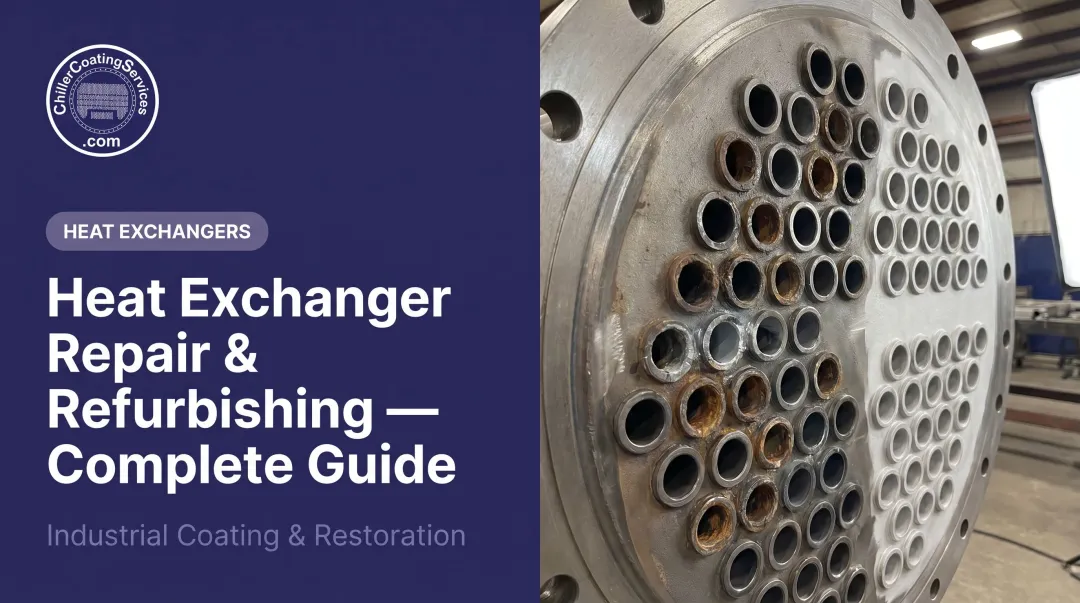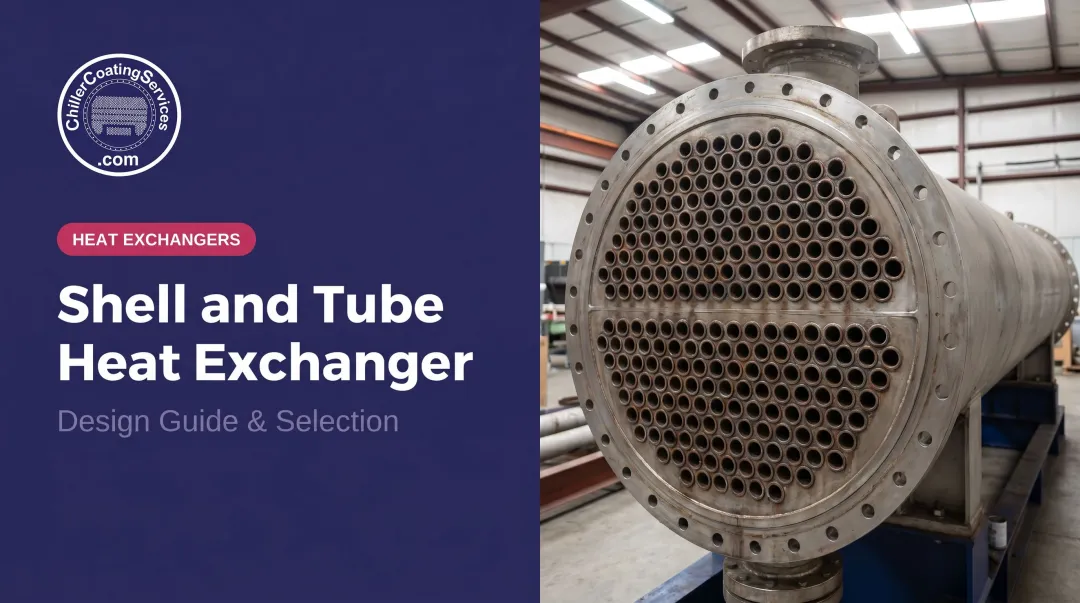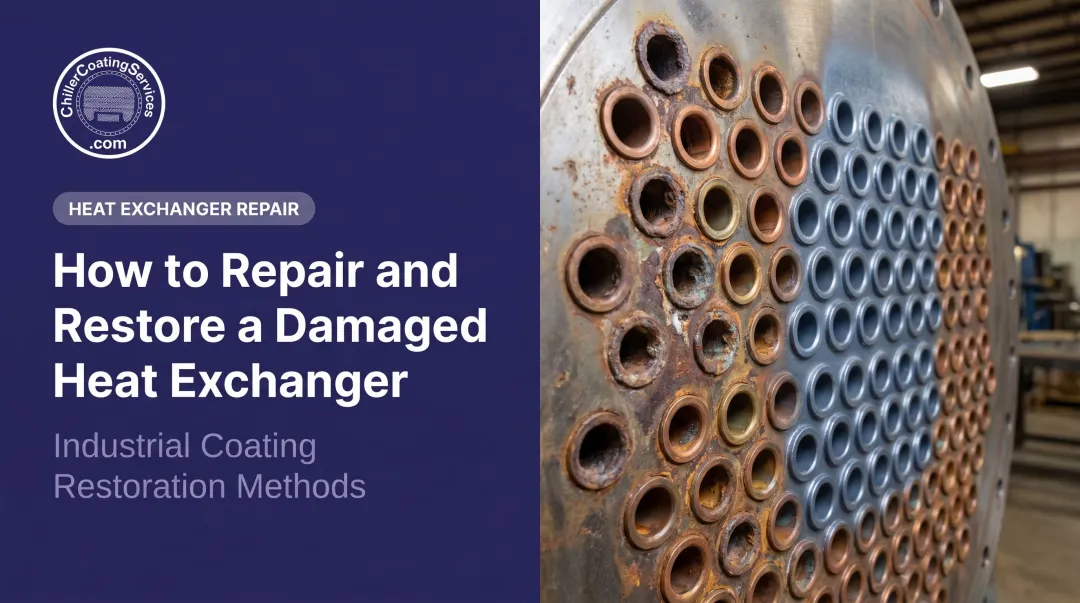
The challenge is that heat exchanger repair costs vary enormously. A simple tube plugging job might run a few hundred dollars. A full industrial retubing can reach $50,000 or more. The gap between those numbers is wide enough that poor repair decisions — in either direction — can cost facilities significantly more than the repair itself.
This guide breaks down repair cost ranges by repair type, identifies what drives costs up or down, and helps facilities managers and engineers decide when repair makes financial sense versus full replacement.
Key Takeaways
- Minor repairs (tube plugging, basic cleaning) typically range from $500–$2,000; major industrial overhauls can reach $50,000+
- Labor usually represents the largest cost component — often exceeding material costs in complex jobs
- The 50% rule: if repair costs exceed 50–60% of replacement value, evaluate replacement seriously
- Proactive maintenance costs $9/hp/year (predictive) vs. $18/hp/year (reactive), roughly half the cost of reactive repairs
- Tube sheet coating targets root-cause corrosion and extends service life — a high-value mid-range repair that often pays for itself in reduced downtime
How Much Does Heat Exchanger Repair Cost? A Pricing Overview
No single price applies to heat exchanger repair. The range spans from a straightforward field repair completed in hours to a multi-week industrial overhaul involving custom-sourced materials and specialized labor.
Two budgeting mistakes are common here. First, assuming all repairs are inexpensive because a contractor quoted a low number for a minor fix. Second, defaulting to full replacement without exploring mid-range restoration options that can extend equipment life at a fraction of the replacement cost.
Minor Repair: Tube Plugging, Leak Sealing, Basic Cleaning
Typical range: $500–$2,000 (field repair; larger-scale chemical cleaning billed separately by scope)
Minor repairs cover isolated tube failures — plugging a leaking tube, sealing a minor joint leak, or performing basic descaling on a lightly fouled unit. Tube plugging, for example, uses mechanical plugs rated to high pressures that isolate a failed tube without requiring full disassembly or welding.
What this covers:
- Isolated tube leaks in otherwise sound equipment
- Light to moderate fouling with no structural corrosion
- Pressure testing to confirm integrity after repair
What it does not cover:
- Widespread corrosion or erosion reaching the tube sheet
- Structural joint degradation
- Tube sheet pitting or galvanic corrosion damage
Best for: Facilities with relatively new equipment experiencing isolated failures, where underlying corrosion is not a factor.
Mid-Range Repair: Tube Sheet Coating, Restoration, Partial Retubing
Typical range: $2,000–$15,000 (varies significantly by unit size, damage extent, and surface preparation required)
This tier addresses the root cause of degradation, not just its symptoms. Mid-range repairs include tube sheet coating and surface restoration, partial retubing, and chemical cleaning for corrosion or erosion damage. A 2020 public-sector contract for chemical cleaning of six digester heat exchanger halves came in at $38,724 total ($6,454 per half), which shows how quickly industrial-scale cleaning scopes can escalate.
Tube sheet coating is the standout option in this tier. A professionally applied coating system using a 100% solids formulation over surfaces blasted to a white metal finish addresses pitting corrosion, galvanic corrosion, erosion, and tube-to-tube sheet joint degradation in a single service event.
Chiller Coating Services offers a three-step restoration process (deep cleaning, abrasive blasting, and advanced coating application) that can increase tube-to-tube sheet push-out strength by over 1,000 pounds in some cases, protecting against both corrosion and coolant contamination.
Best for: Aging equipment showing tube-to-tube sheet joint degradation, pitting, erosion, or galvanic corrosion — particularly where the shell and core structure remain serviceable.
Major Repair / Full Overhaul: Full Retubing, Structural Refurbishment
Typical range: $15,000–$50,000+ (quote-dependent; custom-part sourcing and labor complexity are the primary escalators)
Full retubing, tube sheet replacement, or comprehensive structural refurbishment applies when tube bundle degradation is extensive but the shell or housing is still structurally sound. At this tier, material costs for high-spec tube alloys (cupronickel, titanium, duplex stainless) and skilled labor for bundle removal, re-rolling, and pressure testing drive the final invoice.
Exact pricing is highly quote-dependent — unit geometry, material specifications, and site access conditions make universal pricing impossible to publish reliably. Get multiple quotes and ensure each covers the same scope before comparing.
Best for: Heat exchangers with extensive tube bundle damage where shell integrity justifies the repair investment over full replacement.
Key Factors That Affect Heat Exchanger Repair Cost
Even two seemingly similar repair jobs can differ substantially in price. The variables below are what separate a $3,000 job from a $30,000 one.
Type and Configuration
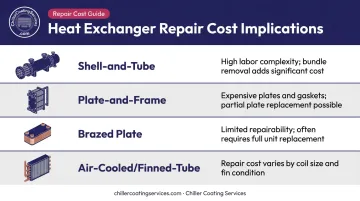
Heat exchanger configuration directly affects repair labor and parts costs:
| Type | Repair Cost Implication |
|---|---|
| Shell-and-tube | High labor complexity; bundle removal and reassembly adds cost |
| Plate-and-frame | Plates and gaskets can be expensive to source; clamped designs allow partial plate replacement |
| Brazed plate | Limited repairability — leaks often require full unit replacement |
| Air-cooled / finned-tube | Fin damage and coil replacement pricing varies by coil size |
Extent and Type of Damage
A 2020 ScienceDirect review identifies the primary heat exchanger failure mechanisms as corrosion, erosion, fatigue, and mechanical failure. How these present determines repair cost:
- Surface fouling — cheapest to address; chemical cleaning or mechanical tube cleaning
- Pitting corrosion — requires surface preparation and protective coating; mid-range cost
- Galvanic corrosion at tube-to-tube sheet joints — coating and restoration; mid-range
- Structural tube sheet damage — most expensive; may require reconstruction or replacement
- Erosion from high-velocity flow — coating addresses early-stage damage; advanced erosion may require retubing
Fouling alone affects more than 90% of industrial heat exchangers, and its energy impact is significant — automatic tube cleaning reduced chiller electrical consumption by 24.5–26.5% in four commercial building case studies. Addressing fouling early keeps repair costs at the low end of the spectrum.
Size, Capacity, and Material Specifications
Physical scale multiplies every cost line item. A large industrial chiller serving a hospital or manufacturing plant will cost far more to retube or coat than a smaller commercial office unit — more tubes, larger surface area, longer labor hours.
Material specifications add another layer of cost. Heat exchangers using titanium, cupronickel 70/30, or high-grade duplex stainless require matched tube materials and compatible coatings during repair. Using mismatched materials accelerates galvanic corrosion — material compatibility is a technical requirement, not a preference.
Access, Location, and Downtime Constraints
Site conditions can add 20–40% to a repair budget in complex cases:
- Basement mechanical rooms and confined spaces require specialized equipment and additional safety protocols
- High-rise plant rooms add mobilization complexity
- Time-sensitive facilities (hospitals, data centers, manufacturing lines) may require after-hours or weekend scheduling, carrying labor premiums
Quick-cure coating technologies reduce the downtime window considerably, which matters most for facilities where even a 24-hour shutdown carries significant operational cost.
Full Cost Breakdown: What You're Actually Paying For
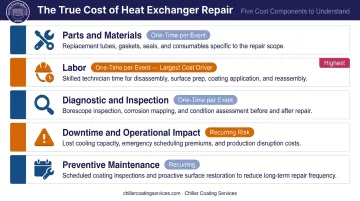
The repair invoice captures only part of the financial picture. A complete cost accounting includes:
| Cost Component | Type | Notes |
|---|---|---|
| Parts and materials | One-time | Tubes, gaskets, coatings, sealants — varies by material spec |
| Labor | One-time | Inspection, surface prep, application, reassembly, testing |
| Diagnostic and inspection | One-time per event | Pressure testing, eddy current tube inspection, visual inspection |
| Downtime and operational impact | Recurring risk | Often the largest hidden cost in hospitals, data centers, manufacturing |
| Preventive maintenance | Recurring | Follow-on coating maintenance, inspection cycles |
Labor is where costs compound fastest. Industrial coating lifecycle data indicates labor represents 75–80% of coating costs for new steelwork, and maintenance coating of corroded steel can cost 5–10x an equivalent job on new surfaces.
Surface preparation alone — specifically abrasive blasting to a white metal finish — can account for up to 40% of total recoating project cost, according to Graco's surface preparation guidance.
Skimping on surface preparation doesn't lower total cost. It pushes it forward, and the deferred bill is typically larger.
Repair vs. Replacement: How to Decide
Defaulting to replacement without evaluating repair options is one of the most common — and expensive — decisions facilities managers make. A structured framework makes this decision more defensible.
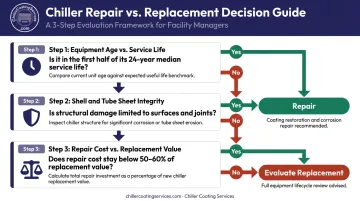
The Three-Variable Framework
1. Equipment age relative to expected service life
ASHRAE's service life database puts shell-and-tube heat exchangers at a 24-year median life, with BOMA data supporting a 13–25 year range depending on application. A unit in the first half of its service life is almost always worth repairing. A unit at 20+ years with multiple failure points warrants a different calculation.
2. Structural integrity of the shell and tube sheet
If the shell is sound and damage is limited to tube surfaces, joints, or surface corrosion — coating and restoration are viable. If the tube sheet itself has lost structural integrity or the shell shows cracking, repair economics change significantly.
3. Repair cost as a percentage of replacement cost
The 50% rule from asset management practice is the most widely cited benchmark: if repair costs exceed 50–60% of replacement value, replacement warrants serious consideration. Below that threshold, repair almost always wins on total cost.
The False Economy of Cheap Patch Repairs
Choosing the lowest-cost repair without addressing the underlying corrosion mechanism almost guarantees a repeat failure. A tube plug or surface patch that leaves galvanic corrosion active at the tube sheet will fail again — typically within one or two cooling seasons. The second repair stacks on top of the first, and neither addressed the root cause.
Proper tube sheet coating — the kind that involves white metal blast preparation and a 100% solids coating system — addresses the mechanism, not just the symptom.
Chiller Coating Services' restoration process includes reconstruction of severely corroded areas before coating. The result is a surface that resists future corrosion and reinforces joint strength, rather than simply covering existing damage.
Warranty Status and Aging Equipment
If the unit is still under a manufacturer's parts warranty, factor that into the repair cost calculation — though note that labor is rarely covered even under active warranties.
For equipment 15+ years old with multiple concurrent failure points, full replacement may offer better total lifecycle value — particularly if newer equipment brings energy efficiency improvements that reduce ongoing operating costs.
How to Keep Heat Exchanger Repair Costs Under Control
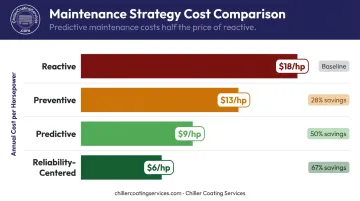
The single highest-leverage action for reducing total maintenance spend is moving from reactive to proactive. DOE/FEMP data makes this concrete:
| Maintenance Strategy | Cost per HP/Year | Relative Savings |
|---|---|---|
| Reactive | $18 | Baseline |
| Preventive | $13 | ~28% reduction |
| Predictive | $9 | ~50% reduction |
| Reliability-centered | $6 | ~67% reduction |
Deloitte's predictive maintenance analysis adds that predictive programs reduce maintenance costs 10–40%, cut downtime 30–50%, and improve equipment availability 10–20%.
The Financial Logic of Proactive Coating
Applying tube sheet coating during a scheduled maintenance window — when the unit is already offline — costs far less than emergency coating after a failure that forces unplanned downtime. Chiller Coating Services' quick-cure application process fits within a planned maintenance window, which means you avoid emergency labor premiums and get the corrosion protection in place before damage compounds.
That timing advantage translates directly to ROI: fewer emergency repairs, longer equipment service life, and no operational losses from failures that could have been prevented.
Practical Cost-Control Steps
When a repair is already needed:
- Get multiple quotes — ensure each covers identical scope before comparing prices
- Verify surface preparation standards — any coating applied over inadequately prepared surfaces will fail prematurely; confirm white metal blast or equivalent
- Ask about warranty coverage — both parts and labor; understand what's covered and for how long
- Time non-emergency repairs for planned shutdowns — after-hours and emergency mobilization carry real cost premiums
- Confirm scope includes root-cause treatment — not just symptom patching
The most common cost-escalating mistake: hiring the lowest-cost contractor who skips proper surface preparation, resulting in coating or repair failure within a season or two and requiring the job to be done again. The short-term savings get wiped out — and then some.
Frequently Asked Questions
Frequently Asked Questions
Is it worth replacing a heat exchanger?
Replacement makes sense when the unit is 15+ years old with multiple concurrent failure points, or when repair costs exceed 50–60% of replacement value. For units with localized damage on otherwise sound equipment, repair or restoration is typically the more cost-effective choice , especially when the tube sheet and shell remain structurally intact.
What is the life expectancy of a heat exchanger?
ASHRAE data supports a 24-year median for shell-and-tube units; BOMA data puts commercial shell-and-tube at 13–25 years depending on application, and plate-and-frame at 20–25 years. Regular inspections, proactive cleaning, and protective coatings are the most reliable way to reach the upper end of that range.
How do you know when a heat exchanger needs repair?
Key warning signs include reduced heat transfer efficiency, visible corrosion or pitting on tube sheets, unexplained coolant loss or fluid contamination, elevated pressure drop across the unit, or signs of leakage at tube-to-tube sheet joints. Any one of these warrants a professional inspection before the damage progresses.
Can tube sheet damage be repaired without replacing the entire heat exchanger?
Yes. In most cases, tube sheet damage from corrosion, erosion, or joint degradation can be addressed through professional coating and restoration. This restores structural integrity and surface protection without full replacement, provided the overall shell and structural frame remain sound.
What is the most cost-effective type of heat exchanger repair?
It depends on the damage type. Tube plugging is the cheapest option for isolated failures. Tube sheet coating offers the best cost-to-benefit ratio for widespread corrosion or erosion damage because it addresses root-cause degradation and extends service life rather than masking symptoms.
How long does heat exchanger repair typically take?
Timelines range from a few hours for tube plugging to several days for full retubing. Coating applications using quick-cure technology can often be completed within a single planned maintenance window.
Heat exchanger repair costs run from a few hundred dollars for minor field repairs to tens of thousands for major industrial overhauls. The right strategy depends on damage type, equipment age, and the full cost picture — including downtime and labor, not just the upfront quote.