Yet despite their critical role, many facility managers treat chillers as a black box. That gap in understanding leads to poor maintenance decisions, avoidable efficiency losses, and equipment failures that cost far more than they should. This guide explains what chillers actually do, how they work, and why certain components — particularly the tube sheet — deserve more attention than most maintenance programs give them.
Key Takeaways
- A commercial chiller cools water, not air directly — that chilled water then circulates through the building to cool individual spaces
- The refrigeration cycle has four stages: evaporation, compression, condensation, and expansion
- Air-cooled and water-cooled types suit different building sizes and infrastructure constraints
- A 0.3 mm scale film raises chiller energy use by 12.4% — fouling carries measurable operating costs
- Well-maintained chillers last 20–25 years; neglected ones often don't reach that milestone
What Is a Commercial HVAC Chiller?
A commercial HVAC chiller is a refrigeration machine that removes heat from water — not from air directly. That distinction matters. The chiller cools a water loop; that chilled water then travels through piping to air handling units throughout the building, where it absorbs heat from occupied spaces and returns to the chiller to start again.
For large commercial buildings, this approach solves a real problem. Cooling air directly through packaged rooftop units becomes spatially impractical and thermally inefficient once you're dealing with multiple floors, high internal heat loads, or complex multi-zone configurations. Chilled water systems transport thermal energy efficiently through piping, which scales in ways that ductwork cannot.
Understanding what a chiller is also means understanding what it isn't. A chiller is not a standalone air conditioner, a cooling tower, or a boiler — it is the refrigeration engine at the center of a chilled water plant. The cooling tower, when present, is separate equipment that rejects heat from the condenser side of a water-cooled chiller.
Why Chillers Dominate Large-Scale Cooling
The U.S. Department of Energy identifies chilled water systems as the standard cooling approach for buildings larger than 100,000 square feet. Their advantages over packaged alternatives include:
- Service life exceeding 20 years with proper maintenance
- Greater scalability across large, multi-zone floor plates
- Higher energy efficiency at sustained loads
- Integrates cleanly with building automation systems
The dominant operating technology is vapor compression — mechanically driven, electrically powered, and the standard in virtually all commercial HVAC applications. Absorption chillers, which use heat rather than electricity to drive cooling, represent a niche alternative suited to facilities with waste heat or cogeneration capacity.
How Does a Commercial HVAC Chiller Work?
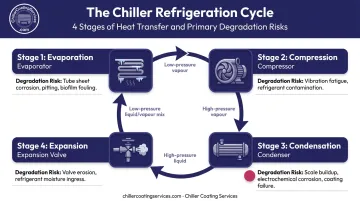
A chiller operates through a continuous closed-loop refrigeration cycle. Four sequential stages handle the work, each assigned to a dedicated component. Every component's condition affects overall system performance — a failure in any one stage cascades through the rest.
Stage 1: Evaporation — Heat Enters the Refrigerant
Warm return water from the building enters the evaporator, a shell-and-tube or plate heat exchanger. Inside, heat transfers from the water into low-pressure liquid refrigerant. As the refrigerant absorbs that heat, it evaporates into a low-temperature vapor. All chilled water cooling happens here — which is why evaporator condition has an outsized impact on system output.
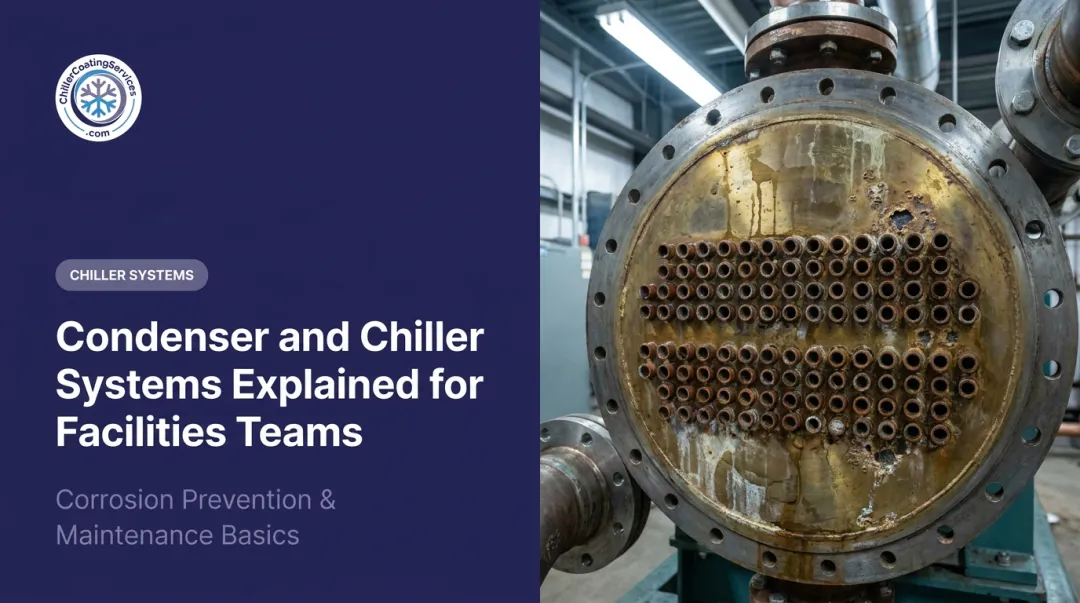
The tube sheet sits at the structural boundary between the water side and refrigerant side of the evaporator. Its condition directly determines heat transfer efficiency; corrosion or fouling here degrades performance across the entire cycle.
Stage 2: Compression — Pressure and Temperature Rise
The refrigerant vapor moves to the compressor, which raises its pressure and temperature significantly. This prepares the refrigerant to release heat on the other side of the cycle. The compressor (centrifugal, screw, or scroll depending on the system) is the most energy-intensive component and the primary driver of efficiency ratings.
Stage 3: Condensation — Heat Is Rejected
Hot, high-pressure refrigerant vapor enters the condenser, where it releases its heat either to outdoor air (air-cooled) or to a separate condenser water loop connected to a cooling tower (water-cooled). As it releases heat, the refrigerant condenses back into a liquid.
Stage 4: Expansion — Pressure Drops, Cycle Restarts
The liquid refrigerant passes through an expansion valve, which rapidly reduces its pressure and temperature. The now-cold, low-pressure refrigerant returns to the evaporator, and the cycle repeats continuously as long as cooling demand exists.
| Stage | Component | Function | What Degrades It |
|---|---|---|---|
| Evaporation | Evaporator (tube sheet) | Transfers building heat into refrigerant | Corrosion, fouling, scale buildup |
| Compression | Compressor | Raises refrigerant pressure and temperature | Wear, refrigerant contamination |
| Condensation | Condenser | Rejects heat to air or cooling tower loop | Scaling, fouling, blocked airflow |
| Expansion | Expansion valve | Drops pressure to restart the cycle | Debris, valve wear, refrigerant issues |
Types of Commercial HVAC Chillers
Air-Cooled vs. Water-Cooled
These are the two fundamental categories, and the choice between them involves tradeoffs across efficiency, infrastructure, and operating environment.
| Factor | Air-Cooled | Water-Cooled |
|---|---|---|
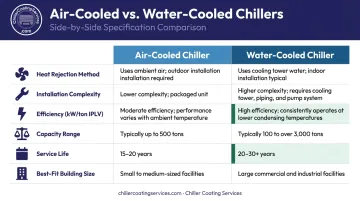
| Heat rejection method | Fans exhaust heat to outdoor air | Condenser water loop to cooling tower |
| Installation complexity | Simpler — no cooling tower required | More complex — tower, pumps, piping, water treatment |
| Typical efficiency | Lower (DOE: substantially less efficient) | Higher — better kW/ton at full and part load |
| Capacity range | Typically up to ~500–565 tons | Up to several thousand tons (centrifugal) |
| Service life | ~20 years median (ASHRAE) | ~23–25+ years median (ASHRAE) |
| Best fit | Small-to-medium buildings | Large buildings and campuses |
DOE procurement benchmarks reflect this gap: water-cooled screw/scroll chillers in the 150–299 ton range achieve around 0.540 kW/ton IPLV, while large centrifugal water-cooled units above 600 tons reach 0.500 kW/ton IPLV — significantly more efficient than air-cooled alternatives at comparable loads.
Compressor Types
Within both categories, compressor type affects capacity range, part-load efficiency, and maintenance complexity:
- Centrifugal — High-capacity, excellent at full load, best suited to large water-cooled plants
- Screw (helical rotary) — Strong part-load performance, used across mid-to-large air-cooled and water-cooled applications
- Scroll — Smaller capacities, simpler mechanically, common in air-cooled units under ~230 tons
- Reciprocating — Largely legacy technology in commercial HVAC; shorter median service life
Absorption Chillers
Absorption chillers operate without a mechanical compressor. A heat source — hot water (as low as 158°F), steam, or combustion exhaust — drives a refrigerant-absorbent cycle using water as the refrigerant and lithium bromide as the absorbent. Single-stage units achieve a COP of 0.70–0.79; two-stage units reach 1.35–1.42.
These systems make sense where waste heat or steam is already available — hospitals with cogeneration plants, power facilities, and industrial processes. In those contexts, the "free" heat source offsets the lower COP and makes absorption cooling genuinely cost-competitive.
Why Chiller Maintenance and Protection Matter
The Fouling and Corrosion Problem
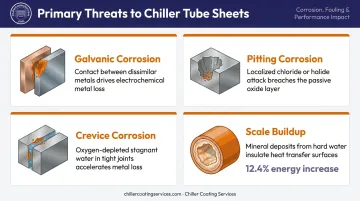
A chiller's 20+ year service life depends entirely on what happens inside its heat exchangers. The evaporator tube sheets and condenser internals face four primary threats:
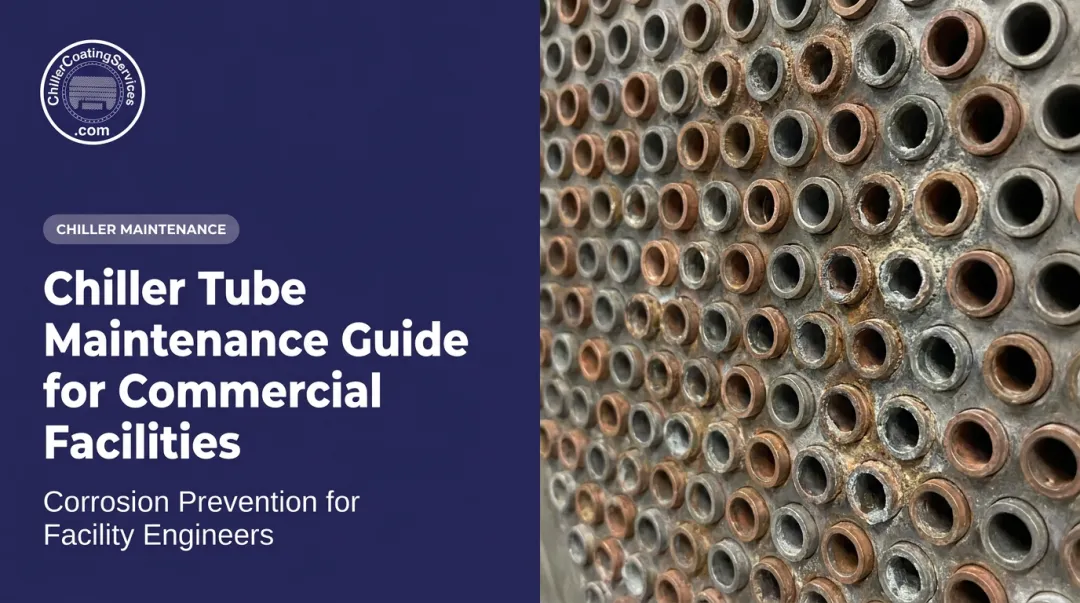
- Galvanic corrosion — Dissimilar metals at tube-to-tube-sheet junctions form electrochemical cells in circulating water, corroding the less noble metal preferentially
- Pitting corrosion — Dissolved oxygen and acidic water chemistry create localized craters that undermine tube sheet integrity and promote fouling adhesion
- Crevice corrosion — Tight geometries at tube-to-tube-sheet interfaces trap stagnant water with different chemistry than the bulk flow, causing aggressive localized attack
- Scale buildup — A 0.3 mm film of condenser scale increases chiller energy use by more than 12.4%
DOE's O&M guidance adds another dimension: every 1°F rise in condenser water temperature adds 2.5–3.5% to chiller energy consumption. Fouling that restricts heat rejection compounds that penalty continuously.
In New England specifically, regional water chemistry accelerates tube sheet pitting and water box corrosion — particularly in pre-2000 buildings with aging chiller fleets. New York's hard-water service conditions create similar chronic problems for large centrifugal chiller fleets in commercial high-rises.
Routine Maintenance That Protects Performance
A preventive maintenance program should include:
- Tube cleaning — Removes scale and biofilm that reduce heat transfer
- Water treatment — Controls scale, corrosion, and biological growth per ASHRAE Guideline 12
- Refrigerant charge verification — Maintains designed operating conditions
- Electrical and bearing inspections — Catches compressor wear before it becomes failure
- Control system verification — Ensures setpoints and safeties remain accurate
Neglecting any of these tasks compounds. Unaddressed scale becomes a persistent energy penalty; corrosion progresses to tube joint failure; joint failure risks refrigerant-water cross-contamination that can require full tube bundle replacement.
Surface Restoration When Maintenance Isn't Enough
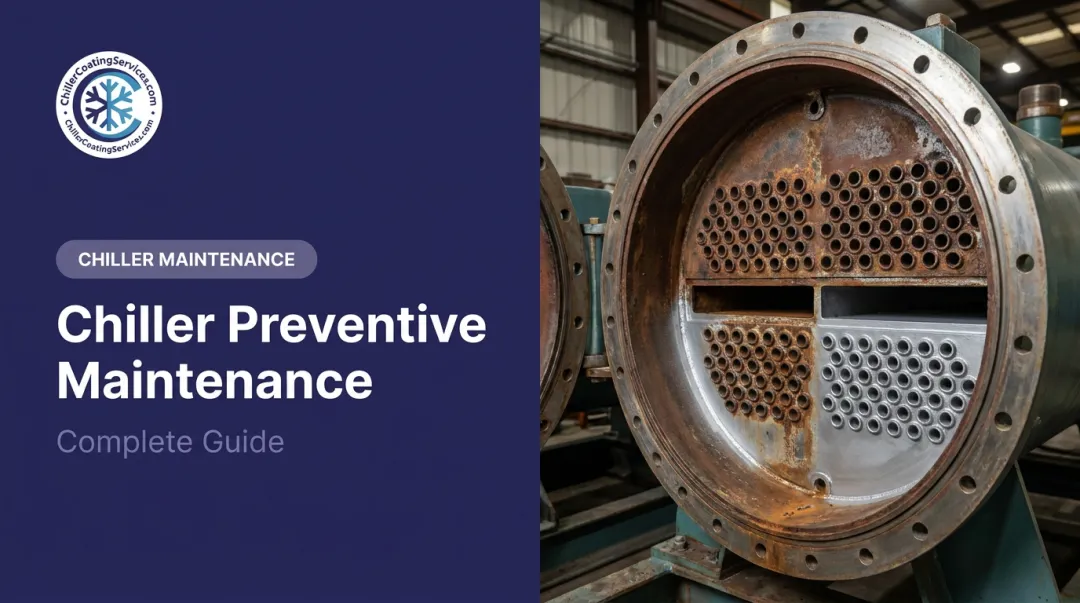
Water treatment and tube cleaning manage chemistry and deposits — but they cannot reverse structural metal loss from galvanic corrosion, pitting, or erosion. Once a tube sheet has lost material depth or tube-to-tube-sheet joints have deteriorated, no chemical treatment restores that integrity.
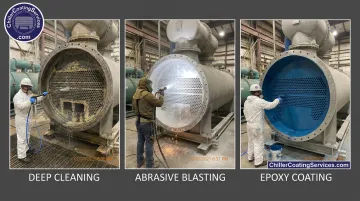
Coating-based restoration is the practical alternative to replacement. Chiller Coating Services (Franklin, NH) has performed this work across New England and New York for over 40 years, using a three-step process engineered specifically for this scenario:
- Deep cleaning — Removes biofilm, scale, and corrosion deposits from all water-side surfaces
- Contained abrasive blasting to white metal finish (SSPC-SP 5 / NACE No. 1) — The most rigorous surface preparation standard in industrial coating, requiring 100% of the visible surface to be free of all rust, oxides, and contaminants; crews reconstruct severely corroded areas at this stage
- 100% solids proprietary coating application — A non-conductive epoxy barrier applied to tube sheets, tube ends, and water box interiors that eliminates the electrolytic pathway driving galvanic corrosion, seals surfaces against pitting, reduces inlet turbulence, and in some cases increases tube-to-tube-sheet joint push-out strength by over 1,000 pounds
The non-conductive property is particularly significant. By electrically insulating dissimilar metals from one another and from the circulating water, the coating removes the electrochemical driver galvanic corrosion requires. Water treatment chemistry cannot fully accomplish this when dissimilar metals remain in direct contact.
For mission-critical facilities — hospitals coordinating around Joint Commission audit requirements, data centers operating under N+1 redundancy constraints, schools scheduling during summer break — Chiller Coating Services structures single-mobilization engagements that address tube sheets, tube ends, and water boxes in one planned outage window. Compliance documentation is provided as a standard project deliverable.
Frequently Asked Questions
What is a commercial HVAC chiller?
A commercial HVAC chiller is a refrigeration system that cools water rather than air directly. That chilled water circulates through a building's piping to air handling units, which then cool individual spaces. Chillers are the standard cooling solution in hospitals, schools, office buildings, data centers, and other large facilities.
What are the main types of commercial HVAC chillers?
The two primary types are air-cooled and water-cooled:
- Air-cooled: Uses fans to reject heat to outdoor air; simpler installation, suited for small-to-medium buildings
- Water-cooled: Uses a condenser water loop and cooling tower; more efficient and longer-lasting, suited for larger applications
Compressor type — centrifugal, screw, or scroll — is a secondary classification that affects capacity and efficiency at part-load conditions.
How much does a commercial HVAC chiller cost?
Equipment costs vary significantly by capacity, type, and configuration. A DOE estimate placed a 153-ton water-cooled VFD centrifugal chiller package at approximately $553,832 — and total ownership costs add cooling towers, pumps, piping, water treatment, and maintenance on top. Project-specific quotations are the only reliable basis for budgeting.
How long does a commercial HVAC chiller last?
ASHRAE data indicate median service lives of 20 years for air-cooled reciprocating chillers and 23 years for water-cooled centrifugal units, with some centrifugal samples exceeding 25 years. Proper water treatment, tube cleaning, component inspections, and surface protection — especially at tube sheets — are the primary factors that determine whether a chiller reaches or exceeds those benchmarks.
What maintenance does a commercial HVAC chiller require?
Key recurring tasks include tube cleaning, water treatment, refrigerant charge verification, electrical and bearing inspections, and control system checks. Skipping these allows fouling and corrosion to accumulate silently — driving down efficiency and raising the odds of an unplanned shutdown.
What is a chiller tube sheet and why does it matter?
The tube sheet is the metal plate that holds the heat exchanger tubes in place and separates the refrigerant side from the water side of the evaporator or condenser. It is highly vulnerable to galvanic corrosion, pitting, crevice attack, and erosion — all of which degrade joint integrity, reduce heat transfer efficiency, and risk coolant contamination. Left unprotected, a deteriorating tube sheet can contaminate the coolant loop and force an unplanned chiller shutdown — making it one of the highest-consequence components to neglect.