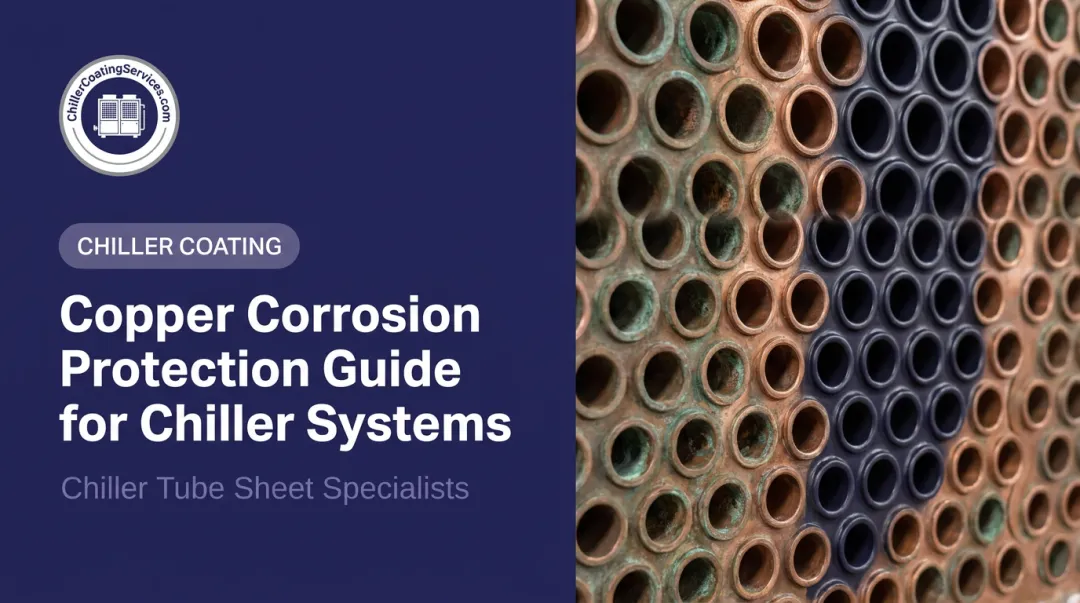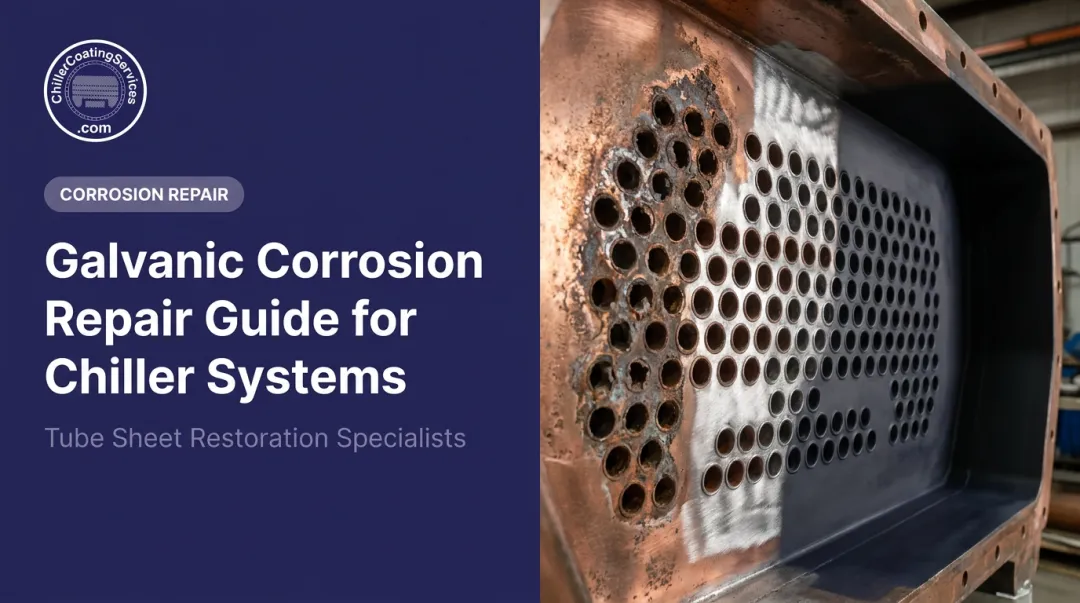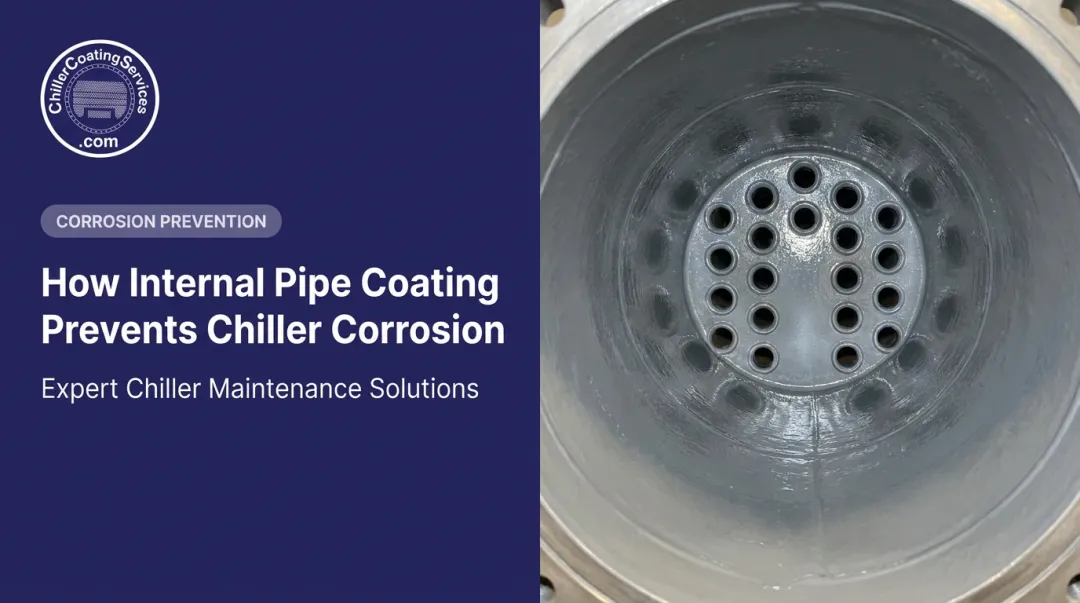
The problem is structural. Chillers inherently combine multiple metal types (copper alloy tubes, carbon steel tube sheets, cast iron water boxes) with continuous water exposure, creating the three conditions galvanic corrosion needs to thrive. Understanding how to break those conditions — and applying the right protective measures early — is what separates a 25-year chiller from one that fails at 12.
Key Takeaways
- Galvanic corrosion requires three simultaneous conditions: dissimilar metals, electrical contact, and an electrolyte — eliminate one and the reaction stops
- Tube sheets are the most vulnerable component, acting as the sacrificial anodic metal when paired with copper alloy tubes
- A breached or missing coating concentrates galvanic attack at exposed spots, accelerating localized damage
- Non-conductive tube sheet coatings applied over white metal blast-prepared surfaces are the most direct preventive measure
- Long-term protection combines coating, water chemistry management, electrical isolation, and routine inspection
Common Causes of Galvanic Corrosion in Chiller Systems
Galvanic corrosion is an electrochemical process: when two metals with different electrical potentials make contact through a conductive liquid, the less noble (anodic) metal corrodes preferentially. In chillers, that typically means the tube sheet or tube ends degrade while the more cathodic metal — usually copper alloy tubing — remains largely intact.
Chiller systems are unusually susceptible because all three required conditions are chronically present unless actively managed.
Dissimilar Metal Pairings at Tube-Sheet Joints
Johnson Controls' water-cooled chiller materials guide documents standard construction pairings where copper or copper-alloy tubes sit in direct contact with carbon steel tube sheets and water boxes — a combination that generates substantial galvanic potential differences. The tube sheet, as the anodic metal, becomes the sacrificial element in this pairing.
The tube-to-tube-sheet joint is the primary initiation site. Even a small area of bare metal at that joint corrodes rapidly in the presence of water. This is why coating coverage at the joint interface is so critical — gaps in protection concentrate galvanic activity rather than dispersing it.
Condenser Water Acting as Electrolyte
Condenser water drawn from cooling towers carries dissolved minerals, chlorides, and ionic compounds that raise its electrical conductivity. Johnson Controls specifies maximum limits for condenser water quality:
- pH: 7.0–8.8
- Concentrated-water TDS: below 2,500 ppm
- Chlorides: below 300 ppm
Exceeding these thresholds increases the electrolyte's strength and accelerates galvanic attack.
Poor water treatment compounds this further. Scale buildup, biological growth, and elevated dissolved solids all intensify the electrolytic environment. As Trane's CenTraVac operations documentation notes, untreated or improperly treated chiller water can cause corrosion, algae, and slime — conditions that worsen galvanic potential at every exposed surface.
Absence or Failure of a Protective Coating Barrier
Without a coating on the tube sheet, bare metal is continuously exposed to the electrolytic water environment. The corrosion circuit between dissimilar metals runs uninterrupted.
Existing coatings can fail through several mechanisms: inadequate surface preparation, age, chemical attack, or mechanical erosion at tube inlets. Each leaves bare metal exposed to the same electrolytic environment.
A breached coating is sometimes worse than no coating at all. A small exposed area surrounded by a large intact coating concentrates galvanic activity at the breach point — the small anode, large cathode effect — accelerating pitting precisely where the metal is already compromised.
What Happens If Galvanic Corrosion in Chillers Is Ignored
The damage follows a predictable progression:
- Tube pitting develops at the tube-to-tube-sheet joint and tube ends
- Joint integrity deteriorates, reducing push-out strength and creating leak pathways
- Water-side to refrigerant-side cross-leaks contaminate chiller oil, causing bearing pitting and compressor wear (documented by Trane)
- Chiller efficiency drops as corroded, pitted surfaces increase fouling and impair heat transfer
- Full retubing or chiller replacement becomes unavoidable
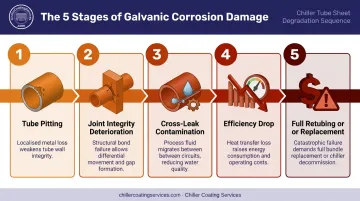
When that fifth step arrives, the cost is substantial. DOE's 2022 Schools Chiller Replacement Package estimates a 153-ton water-cooled centrifugal chiller replacement at $520,000–$594,000 across the 5th to 95th cost percentiles — and tube sheet coating typically runs a fraction of that figure.
Replacement cost is only part of the exposure. Efficiency losses accumulate well before failure: Carrier's condenser performance documentation identifies elevated condenser approach temperature — a direct result of fouled or corroded heat transfer surfaces — as evidence of poor heat transfer, leading to higher energy consumption and greater pump power requirements.
Warning Signs You May Have Galvanic Corrosion in Your Chiller
Galvanic corrosion rarely announces itself until damage is advanced — but internal inspections and water quality monitoring can surface problems before they escalate. Watch for:
- Visible pitting, discoloration, or powdery deposits on tube sheet surfaces or tube ends during internal inspection
- Unexplained drops in chiller efficiency or rising energy consumption with no change in load — often caused by fouled or corroded heat transfer surfaces
- Discolored or contaminated condenser/chilled water, or elevated dissolved metal readings in water quality tests, indicating active metal loss from system components
How to Prevent Galvanic Corrosion in Chiller Systems
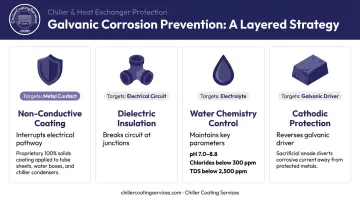
The most effective prevention is layered: a primary physical barrier (coating), electrical isolation at dissimilar metal junctions, water chemistry control, and cathodic protection where conditions warrant it. Each layer targets one or more of the three required conditions for galvanic corrosion.
Apply a Non-Conductive Tube Sheet Coating
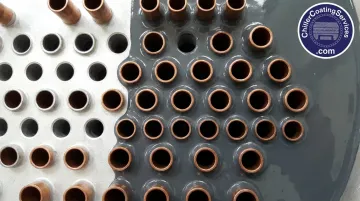
Applying a non-conductive epoxy coating to the tube sheet is the most direct intervention. The coating interrupts electrical conduction between dissimilar metals, seals the metal surface from electrolyte contact, and eliminates the direct corrosion pathway at the tube-to-tube-sheet joint.
Surface preparation is not optional — it is what determines whether the coating lasts. Inadequate blasting leads directly to poor adhesion and premature failure. Chiller Coating Services blasts all surfaces to a white metal finish (SSPC-SP 5 / NACE No. 1) before applying their proprietary 100% solids epoxy coating system.
Unlike solvent-based coatings (50–80% solids), a 100% solids formulation produces no shrinkage during cure, maximum film build, and a structurally stronger cured layer. That also reinforces tube-to-tube-sheet joints — push-out strength gains exceeding 1,000 pounds have been documented in some applications.
When to implement coating:
- During scheduled maintenance shutdowns (fall/spring shoulder seasons are ideal)
- When fall inspection reveals corrosion requiring immediate repair
- Proactively on chillers approaching mid-life or showing early efficiency decline
- As part of emergency repair when corrosion is discovered unexpectedly
Where severely corroded areas are found, reconstruction of the damaged metal precedes coating application — coating alone cannot protect a tube sheet that has lost structural material.
Use Dielectric Insulation at Metal Junctions
Where dissimilar metals connect at pipe joints, flanges, or fittings, dielectric fittings, non-conductive gaskets, or insulating sleeves break the electrical circuit. AMPP confirms that electrically insulating joints eliminates the galvanic circuit at those connection points.
This measure is most practical during system design or major overhauls. Important: electrical isolation alone is insufficient if water can still bridge the metals — it must work alongside coating and water chemistry management.
Manage Condenser and Chilled Water Chemistry
Water chemistry management directly lowers the electrolytic driving force for galvanic corrosion. Key practices:
- Maintain pH within 7.0–8.8 per Johnson Controls' condenser water limits
- Control chlorides below 300 ppm and total dissolved solids below 2,500 ppm in concentrated water
- Apply corrosion inhibitors formulated for chiller systems — research in simulated cooling water shows molybdate inhibition is effective at pH 6 or above, with stronger combined results when combined with nitrite treatment
- Monitor regularly as cooling tower chemistry shifts seasonally with evaporation, makeup water changes, and biological activity
Inhibitors form a thin protective film on metal surfaces, providing a chemical backup in areas where coating coverage is incomplete.
Implement Cathodic Protection Where Applicable
Sacrificial zinc or magnesium anodes installed in the water box make the tube sheet behave as the cathode rather than the anode, stopping the galvanic reaction at the source. Trane documents this approach, noting that anode replacement frequency ranges from 2–3 months to 2–3 years depending on water chemistry conditions — inspection within the first few months establishes the right interval.
Cathodic protection is best used as a supplemental measure in systems with aggressive water chemistry or limited coating access. It works synergistically with tube sheet coating but is not a replacement for it.
Tips for Long-Term Prevention and Control
Sustained prevention requires more than a one-time coating application. Consistent monitoring, documentation, and professional oversight are what separate facilities that manage galvanic corrosion from those that react to it.
Long-term best practices include:
- Inspect tube sheets, water boxes, and tube ends annually or biennially — Trane recommends eddy-current tube testing every three years (more frequently for critical-process equipment), with a first coating inspection within one to three months of installation in corrosive water conditions
- Track water quality with trend analysis; sudden shifts in pH, conductivity, or dissolved metal concentrations are early warning signs of accelerating corrosion
- Document all coating applications, water treatment interventions, and inspection findings — these records support Joint Commission/CMS healthcare audits, ISO/FDA/GMP manufacturing compliance, NERC utility documentation, and SOC 2 data center audits
- Schedule periodic professional assessments with experienced coating specialists to evaluate tube sheet condition and apply protective systems during planned outage windows
Chiller Coating Services serves facilities across New England and New York, offering free on-site estimates and application with minimal facility downtime. Contact us at (877) 427-0090 to schedule an evaluation.
Conclusion
Galvanic corrosion in chiller systems has well-understood causes — dissimilar metals, an electrolytic water environment, and an unbroken electrical circuit — and each condition can be directly addressed:
- Non-conductive tube sheet coatings interrupt the electrochemical pathway at its source
- Dielectric insulation removes electrical contact at metal junctions
- Water chemistry management reduces electrolyte conductivity
- Cathodic protection reverses the galvanic driver in high-risk applications
The financial case is straightforward: tube sheet coating applied during a planned maintenance window costs a fraction of retubing or full chiller replacement. It extends equipment service life, protects coolant quality, maintains thermal efficiency, and lowers total cost of ownership. For facilities managers and engineers across New England and New York, that return justifies the investment many times over.
Frequently Asked Questions
What can prevent galvanic corrosion?
Galvanic corrosion is prevented by eliminating at least one of its three required conditions — dissimilar metal contact, an electrolyte, or an electrical pathway. Effective measures include non-conductive tube sheet coatings, dielectric insulation at metal junctions, water chemistry treatment, and sacrificial anodes. Addressing all three conditions together provides the most reliable long-term protection.
What coating prevents galvanic corrosion?
Non-conductive barrier coatings — specifically 100% solids epoxy systems applied to tube sheets — are the most effective option. They interrupt the electrical conduction pathway between dissimilar metals and seal the metal surface from electrolyte contact. Surface preparation to white metal blast standard (SSPC-SP 5 / NACE No. 1) is essential for the coating to perform as intended.
How does galvanic corrosion affect chiller efficiency?
Galvanic corrosion causes pitting and surface roughness on tube sheets and tube ends, which accelerates fouling, impairs heat transfer across tube surfaces, and raises energy consumption. Carrier's maintenance documentation identifies elevated condenser approach temperature — a direct fouling indicator — as evidence of reduced heat transfer performance and higher operating costs.
What are the early warning signs of galvanic corrosion in a chiller?
Early indicators include visible pitting or discoloration on tube sheet surfaces during inspection, unexplained drops in chiller efficiency with no change in load, and elevated dissolved metal levels or water discoloration in routine water quality testing. Any of these should prompt a professional internal inspection.
How long does a tube sheet coating last?
Service life depends on coating quality, surface preparation, and water chemistry. Professionally applied 100% solids coatings over white metal blast-prepared surfaces consistently deliver the longest service life. Exact duration varies by facility conditions — an on-site assessment provides the most accurate projection for your system.
Is tube sheet coating worth the investment?
Yes. Tube sheet coating prevents expensive retubing or chiller replacement, reduces fouling and maintenance costs, and extends equipment service life — with minimal downtime when quick-cure systems are used. With water-cooled centrifugal chiller replacement costs running into the hundreds of thousands of dollars, preventive coating is one of the clearest cost-avoidance investments available in chiller maintenance.