The problem compounds quietly. As scale and debris accumulate in the narrow plate channels, thermal conductivity drops. Energy consumption climbs. Then comes the pressure drop that prompts an emergency call — and a repair bill that dwarfs what routine maintenance would have cost.
This guide covers why PHE maintenance matters, the four main maintenance types, the warning signs that demand attention, and a practical scheduling framework you can put to work immediately.
Key Takeaways
- Monitor pressure drop across the unit daily; it's your most reliable early warning signal.
- Clean-in-Place (CIP) is the preferred first-line cleaning method; it requires no disassembly and minimises downtime.
- Verify chemical cleaning agents for compatibility with your plate and gasket materials before use.
- Gaskets, plate pack tightness, carrying bars, and guide bars all require inspection at every scheduled maintenance event.
- Preventive maintenance consistently costs less than reactive repairs, in both downtime and component replacement.
Why Plate Heat Exchanger Maintenance Matters
PHEs represent a significant capital investment. A disciplined maintenance habit protects that investment; neglect accelerates the path to premature replacement.
The Fouling Problem
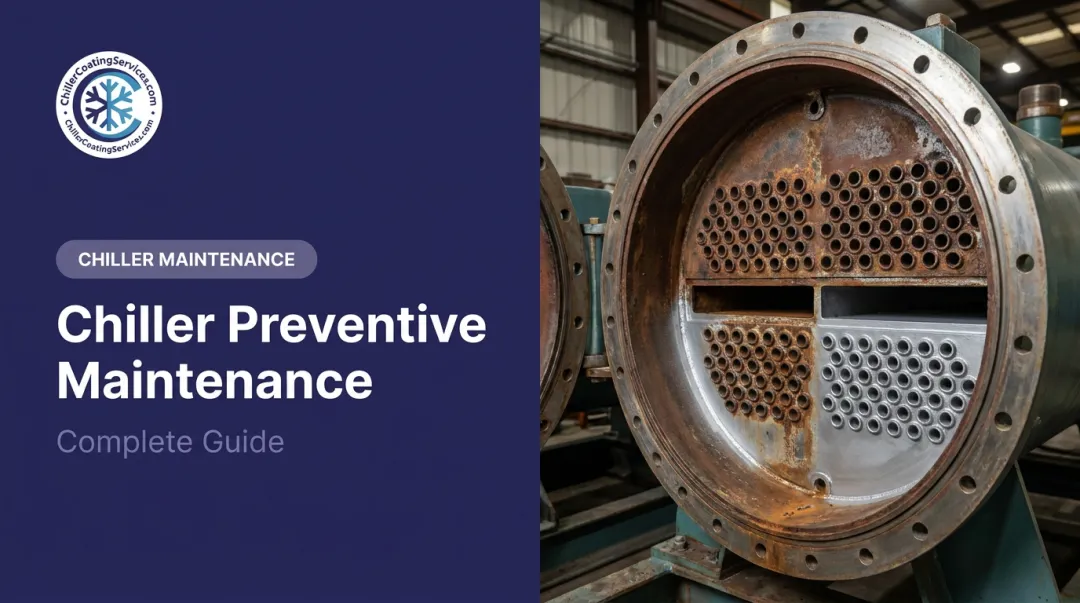
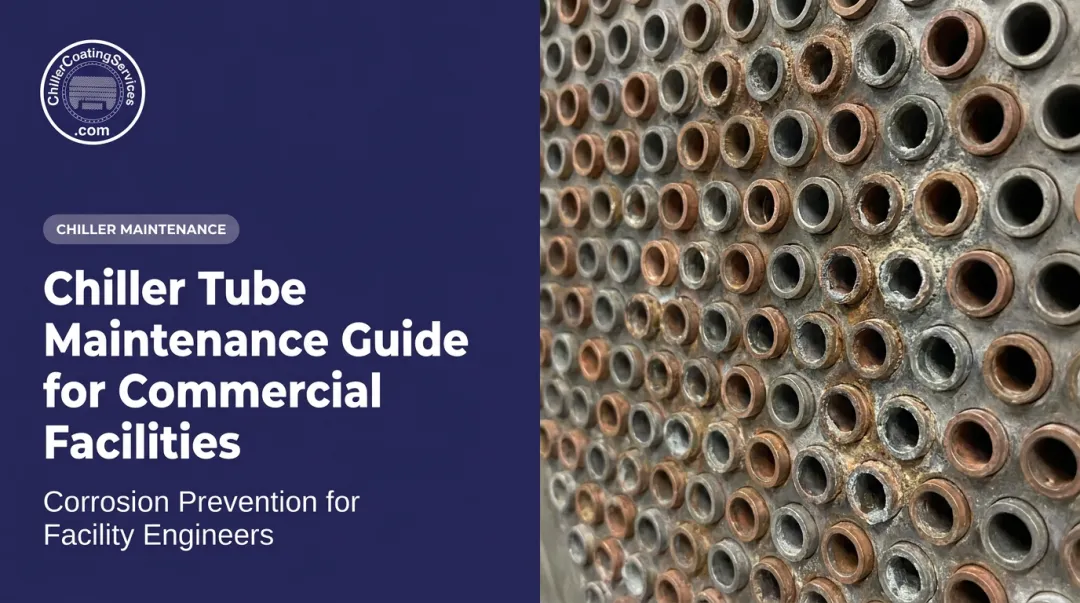
Fouling is the primary threat to PHE performance. According to U.S. Department of Energy records, industrial heat exchanger fouling costs U.S. industry an estimated $4.41 billion annually and wastes roughly 2.9 quads of energy per year. PHEs aren't immune — and their narrow plate channels mean pressure drop climbs noticeably once deposits begin forming, even when fouling rates are lower than in shell-and-tube units.
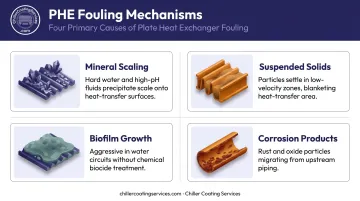
The fouling mechanisms that matter most in practice:
- Mineral scaling driven by hard water or high-pH fluids
- Suspended solids that settle and pack in low-velocity zones
- Biofilm growth, which is particularly aggressive in water circuits without adequate chemical treatment
- Corrosion products migrating from upstream piping or the exchanger itself
Alfa Laval notes that foulants age over time through dehydration, polymerization, and thermal stress — hardening into deposits that become progressively harder to remove. Early intervention costs a fraction of what reactive cleaning or component replacement demands once performance has already dropped.
Lifespan and Safety Implications
One Alfa Laval condition audit case involved gasketed PHEs at a petrochemical plant that had run for 11 years without requiring maintenance — and were still in serviceable condition once assessed. Neglected units, by contrast, face premature gasket failure, plate pitting, and eventual decommissioning.
In regulated environments, the stakes extend beyond equipment cost. The FDA's Pasteurized Milk Ordinance explicitly references plate-type heat exchangers in Grade A milk processing. Hospitals must maintain utility systems to manage patient safety risk under Joint Commission and CMS requirements.
Failing gaskets can cause fluid cross-contamination. A degraded exchanger that can't reach target process temperatures is a compliance failure, not just a mechanical one.
Types of Plate Heat Exchanger Maintenance
PHE maintenance covers several distinct approaches. Each type serves a different purpose and is triggered by different conditions.
Routine Preventive Maintenance
Routine preventive maintenance runs on a fixed schedule, regardless of apparent performance. The goal is catching developing problems before they affect output.
Core tasks at each scheduled interval:
- Verify plate pack tightness against the manufacturer's specified dimension (not torque ; dimension is the correct metric)
- Lubricate carrying and guide bars to prevent binding and wear
- Visually inspect gaskets for swelling, cracking, flattening, or debris on sealing surfaces
- Check pressure gauges at each end to confirm pressure drop is within expected limits
After cleaning, applying a protective coating to heat exchanger surfaces is a practical add-on for facilities with recurring fouling problems. A 100% solids epoxy coating creates a smooth, chemically resistant surface that reduces fouling adhesion, resists scale and biofilm accumulation, and extends intervals between intensive cleaning events — complementing routine maintenance rather than substituting for it.
Clean-in-Place (CIP) and Chemical Cleaning
CIP is the most practical form of periodic cleaning. The unit is isolated, both sides are flushed with water in the reverse direction of normal flow (per SPX/APV manufacturer guidance), and a compatible cleaning agent is then circulated via pump — without opening the plate pack.
Chemical compatibility determines which agents are safe to use. Specific manufacturer guidelines to follow:
- Chlorine-containing agents must not be used ; they attack stainless steel plates
- Hydrochloric acid must never be used with stainless steel
- Cleaning water must not exceed 330 ppm chloride ions (Alfa Laval specification)
- Rinse and drain immediately after CIP to prevent residue-related corrosion
SPX/APV example cleaning agents: sodium hydroxide (max 2.0%) for organic deposits, nitric acid (max 0.5%) for mineral scale, phosphoric acid (up to 5%) as a scale-removal alternative. Always verify the specific agent against your plate and gasket materials before use.
When CIP is sufficient vs. when it isn't: If normal pressure drop is restored after CIP, the cleaning worked. If pressure drop remains elevated, or if very little debris was flushed out, move to manual cleaning.
Corrective / Manual Cleaning
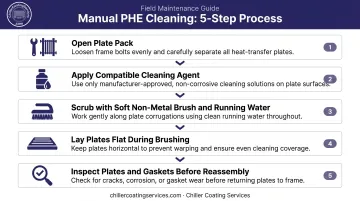
When CIP fails to restore performance, the plate pack is opened and each plate is manually treated. The correct procedure:
- Open the plate pack per manufacturer instructions
- Apply a compatible cleaning agent to loosen deposits
- Clean with a soft non-metal brush and running water or a controlled-pressure hose
- Lay plates on a flat surface during brushing
- Inspect each plate and gasket before reassembly
Critical don'ts: Never use wire brushes, metal pads, or abrasive scrubbers ; they score the plate surface. Never direct high-pressure spray directly at gaskets. Keep gasket sealing surfaces completely free of debris, since any foreign material can cause leakage on reassembly.
Major Overhaul and Predictive Maintenance
A major overhaul is warranted when:
- Gaskets show physical deterioration (cracks, brittleness, flattening beyond normal compression)
- Plates are pitted or corroded beyond what cleaning can address
- Recurring performance issues persist despite CIP and manual cleaning
Predictive maintenance turns reactive overhauls into planned ones. Tracking pressure differential trends over time and maintaining detailed maintenance logs ( make, model, plate count, plate pack dimensions, prior maintenance dates, spare parts inventory ) gives your team the data needed to schedule overhauls before they become emergencies.
How to Tell If Your Plate Heat Exchanger Needs Maintenance
PHE problems rarely appear without warning. The signals show up in your performance data, your gauges, and your maintenance log — often weeks before a failure forces the issue.
Primary Performance Indicator
Rising pressure drop is the single most reliable sign of fouling or blockage. Measure it via gauges at each end of the unit. For brazed PHEs specifically, SWEP recommends investigating when pressure drop increases 30% above expected clean-unit performance. For gasketed PHEs, consult your manufacturer's baseline performance data and flag any sustained upward trend early — a clear directional pattern is reason enough to act, even without a threshold violation.
Thermal and Flow Symptoms
- Outlet temperatures that no longer match expected values
- Failure to reach target heat transfer rates
- A growing gap between actual and specified performance
- Reduced flow rates that can't be explained by upstream conditions
Visible and Physical Warning Signs
- Leaks around gaskets or the frame
- Visible scale or corrosion on accessible external surfaces
- Unusual vibration or noise during operation
- Gaskets that appear swollen, cracked, or misaligned on visual inspection
Behavioral Patterns That Signal Overdue Maintenance
Repeated minor pressure fluctuations, more frequent manual interventions to restore flow, or temporary fixes that no longer hold are all signals that a corrective or overhaul event is overdue. When you're patching the same issue repeatedly, the underlying condition has worsened — schedule a full inspection rather than another short-term fix.
Plate Heat Exchanger Maintenance Schedule
How often you service a plate heat exchanger depends on fluid type, operating temperatures, usage intensity, and regulatory environment. A food-grade or hospital system requires more frequent intervention than a standard HVAC loop — and calendar-based schedules should always be validated against actual pressure drop trends.
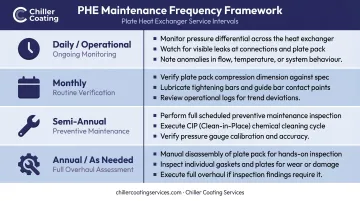
General Maintenance Frequency Framework
| Frequency | Tasks |
|---|---|
| Daily / Operational | Monitor pressure differential; watch for leaks, unusual noise, or performance anomalies |
| Monthly | Verify plate pack dimension; lubricate carrying and guide bars; review maintenance logs |
| Semi-Annual | Full preventive maintenance — visual inspection of gaskets and plates, CIP cleaning if pressure drop has increased, pressure gauge verification |
| Annual / As Needed | Manual disassembly cleaning; gasket and plate inspection; overhaul if performance data indicates deterioration |
Sector-Specific Adjustments
- High-usage or continuous-operation facilities (power plants, hospitals, pharmaceutical manufacturing): schedule semi-annual CIP and quarterly inspections, with pressure drop trend data driving any acceleration beyond that baseline
- Lower-usage or intermittent systems: annual schedules are typically sufficient, but always benchmark against actual pressure drop trends rather than calendar alone
- Regulated environments (food processing, dairy, healthcare): follow sector-specific inspection requirements and maintain documentation that satisfies your compliance framework
For high-run-time applications, operating-hours bands offer a more precise trigger than calendar intervals. SPX/APV's preventive maintenance guidance groups check frequency into three bands: daily tasks through 150 operating hours, weekly from 150–300 hours, and monthly from 300–500 hours.
Conclusion
PHE maintenance is an operational necessity. A structured schedule of routine checks, CIP cleaning, manual cleaning, and periodic overhaul costs less than emergency repairs, premature replacements, or unplanned process downtime.
Facilities managers in New England and the surrounding region can reinforce their maintenance programs with professional surface restoration and protective coating services. Chiller Coating Services has over 40 years of management experience helping schools, hospitals, power plants, and manufacturing facilities extend the life of their heat transfer equipment.
Their services cover plate, shell-and-tube, and brazed-plate heat exchangers, applying 100% solids industrial coatings that reduce fouling adhesion, resist corrosion, and lower long-term maintenance costs.
For a free on-site assessment, contact Chiller Coating Services at (877) 427-0090 or submit an inquiry at chillercoatingservices.com/contact. Service areas include Massachusetts, New Hampshire, Connecticut, Rhode Island, Maine, Vermont, and New York.
Frequently Asked Questions
How to maintain a plate heat exchanger?
Perform scheduled inspections at minimum every six months, monitoring pressure drop across the unit as your primary performance indicator. Run CIP cleaning when pressure rises above expected limits, using a chemically compatible agent circulated in reverse flow direction. If CIP doesn't restore normal performance, escalate to manual plate-by-plate cleaning or gasket replacement.
What is the 10-13 rule for plate heat exchangers?
The 10-13 rule originates from pressure equipment design contexts, not PHE fouling maintenance. No major PHE manufacturer or standards body has verified it as a universal cleaning threshold for plate heat exchangers. Use your manufacturer's baseline pressure drop data and thermal performance benchmarks instead — these give you a unit-specific and defensible trigger for intervention.
What is the life expectancy of a plate heat exchanger?
Service life varies based on maintenance quality, fluid chemistry, and operating conditions. An Alfa Laval condition audit found gasketed PHEs at a petrochemical facility still serviceable after 11 years without maintenance, though this is not a benchmark. Properly maintained units serve facilities for many years; neglected ones face premature gasket failure and plate degradation that shortens service life considerably.
How often should a plate heat exchanger be cleaned?
Cleaning frequency should be condition-based, not calendar-based. Use pressure drop readings and outlet temperature performance as your triggers. Factors that increase cleaning frequency include hard water, high operating temperatures, high pH, and biological fouling risk — fluid type and temperature are the primary drivers, not a fixed annual count.
What are the early warning signs a plate heat exchanger needs maintenance?
A rising pressure drop across the unit is the most reliable early indicator. Other signals include outlet temperatures that no longer match expected values, reduced flow rates, visible leaks around gaskets or the frame, and unusual vibration or noise during operation. Any one of these should prompt an inspection — don't wait for multiple symptoms to appear simultaneously.
What is the best cleaning method for plate heat exchangers?
CIP is the preferred first approach because it requires no disassembly, minimizes downtime, and handles most routine fouling effectively. If CIP doesn't restore normal pressure drop and thermal performance, manual plate-by-plate cleaning is required. Either way, verify chemical agent compatibility with your specific plate material and gasket type before circulation — for stainless steel plates, chloride-containing agents and hydrochloric acid are prohibited.