That's a costly mistake. Poor maintenance means higher energy bills, shortened equipment life, and the kind of emergency repair calls that happen on the hottest day of the year.
This guide covers the full picture: why preventive maintenance (PM) matters, the four main types of maintenance programs, what warning signs to watch for, and how to structure a maintenance schedule that keeps equipment running for decades.
Key Takeaways
- Chillers can last 20–30 years with proper maintenance — or fail significantly earlier without it
- Preventive maintenance programs save 12–18% compared to purely reactive approaches, per DOE data
- Fouled heat exchange surfaces, refrigerant leaks, and tube sheet corrosion are the most common drivers of efficiency loss
- Annual tube cleaning, refrigerant verification, oil analysis, and tube sheet inspection are core tasks no maintenance schedule should skip
- Tube sheet coating is frequently overlooked — yet it directly prevents corrosion, galvanic attack, and coolant contamination before they start
Why Chiller Preventive Maintenance Matters
Chillers don't just consume energy — they dominate it. In one peer-reviewed institutional building audit, chillers and associated pumps consumed 51% of total facility energy use. Even a modest decline in chiller efficiency compounds into significant operational costs across a full cooling season.
The Efficiency-Maintenance Connection
When condenser or evaporator tubes accumulate scale and fouling, thermal resistance increases. The chiller works harder to move the same amount of heat, drawing more power while delivering less cooling capacity. According to Carrier, a high condenser approach temperature compared to clean-tube values is a direct indicator of deteriorating heat transfer — a problem that's invisible until it shows up on the energy bill or in a failed setpoint.
Refrigerant leaks create a parallel problem. EPA Section 608 regulations require repair when systems containing 50 lb or more of refrigerant exceed leak-rate thresholds (10% for comfort cooling systems). Beyond compliance, leaks force the compressor to operate outside its design parameters, accelerating wear.
Lifespan and the Maintenance Dividend
According to ASHRAE service-life data, centrifugal chillers are removed from service at around 25 years. Johnson Controls reports that water-cooled chillers have a median life cycle of 20–30 years, while air-cooled units typically reach 15–20 years. That range isn't accidental — maintenance practices sit at the center of it.
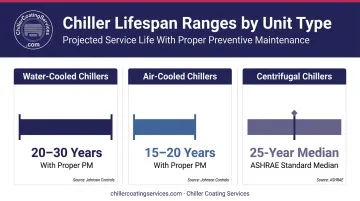
A chiller that runs a structured PM program stays within design tolerances. One that doesn't accumulates deferred damage: fouled tubes, corroded tube sheets, degraded compressor oil, and worn bearings — each one compressing that lifespan toward the lower end of the range.
Safety and Compliance
Deferred maintenance doesn't only shorten equipment life — it creates compliance and safety exposure. Under EPA Section 608, systems leaking 125% or more of their full charge in a calendar year trigger mandatory reporting requirements. Electrical faults and uncontrolled pressure buildup add separate hazard categories. Facilities that skip structured PM cycles often find themselves managing emergency shutdowns and regulatory notices at the same time.
Types of Chiller Maintenance
No single maintenance approach fits every facility. Most effective programs combine more than one type, calibrated to the chiller's age, usage, and criticality.
Routine / Preventive Maintenance
Scheduled, proactive upkeep performed on a set cadence. Daily log reviews, tube brushing, lubrication, refrigerant verification, water quality testing, and electrical inspection all fall here. The goal is catching small problems before they become expensive ones.
One task that's routinely overlooked: tube sheet inspection and protective coating. In water-cooled chillers, tube sheets are continuously exposed to oxygenated water, galvanic attack at dissimilar metal junctions, acidic anti-scale treatments, and physical erosion. Without protection, pitting and structural degradation progress silently.
Chiller Coating Services addresses this through a three-step process: deep cleaning to remove corrosive materials, contained abrasive blasting to a white metal finish for optimal adhesion, and application of a proprietary 100% solids coating system to tube sheets, tube ends, and water boxes. The coating:
- Prevents corrosion, erosion, and cavitation damage
- Adds a non-conductive layer that interrupts galvanic corrosion between dissimilar metals
- Reinforces tube-to-tube sheet joints — increasing push-out strength by over 1,000 pounds in some cases
- Reduces fouling by creating smooth surfaces for water passage
- Improves thermal efficiency without restricting flow
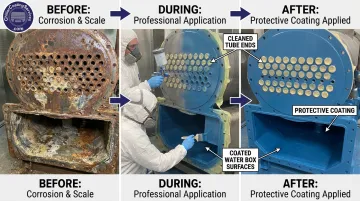
Quick-cure technology means application requires minimal facility downtime, making this a practical addition to an annual PM program rather than a disruptive overhaul.
Performed consistently, routine PM is the most cost-effective maintenance mode: it stops the $50 problem from ever reaching $50,000.
Corrective / Reactive Maintenance
Corrective maintenance is repair work triggered by failure: a worn bearing replacement, a refrigerant leak fix, a compressor issue addressed after it surfaces. Some corrective work is inevitable. The problem arises when it becomes the only strategy.
DOE/FEMP data shows that a properly functioning PM program provides 12–18% savings compared to a purely reactive approach. Unplanned failures during peak cooling season carry compounding costs: emergency service premiums, cascading damage to related components, and the operational impact of unexpected downtime in hospitals, data centers, or manufacturing lines.
Corrective maintenance is repair work triggered by failure: a worn bearing replacement, a refrigerant leak fix, a compressor issue addressed after it surfaces. Some corrective work is inevitable — the problem arises when it becomes the only strategy.
Common reactive repair scenarios include:
- Bearing replacement after abnormal vibration causes shutdown
- Refrigerant recharge following a leak that went undetected
- Compressor repairs triggered by high discharge pressure alarms
- Heat exchanger cleaning after efficiency losses hit critical thresholds
DOE/FEMP data shows that a properly functioning PM program provides 12–18% savings compared to a purely reactive approach. Unplanned failures during peak cooling season carry compounding costs: emergency service premiums, cascading damage to related components, and the operational impact of unexpected downtime in hospitals, data centers, or manufacturing lines.
Predictive / Condition-Based Maintenance
Condition-based maintenance uses real-time performance data — vibration analysis, condenser approach temperature trending, oil sample analysis, thermal scanning — to schedule maintenance only when indicators suggest it's needed.
Johnson Controls reports that connected planned service agreements reduce unplanned and emergency chiller repairs by as much as 66%, with repair timelines cut by an average of 65%. For facilities where downtime has direct patient care or production implications, predictive programs justify their investment quickly.
Remote monitoring and magnetic bearing sensor technology have made predictive programs increasingly viable for large chiller plants — particularly in hospitals, data centers, and manufacturing facilities where continuous uptime is non-negotiable.
Major / Overhaul Maintenance
Major overhauls go beyond routine PM: compressor rebuilds, full refrigerant replacement, motor rewinding, tube bundle replacement. This level of intervention is typically required every 10–15 years, after a significant failure, or when performance data signals persistent performance decline.
One consistent pattern: facilities that deferred routine PM consistently reach the overhaul threshold earlier. The compressor doesn't fail in isolation. It fails after years of degraded oil, marginal refrigerant charge, and fouled heat exchangers have pushed it well beyond its design operating range.
Warning Signs Your Chiller Needs Maintenance
Continuous monitoring isn't always in place, so recognizing early symptoms prevents minor issues from escalating into system-wide failures.
Declining Cooling Performance and Energy Efficiency
Reduced cooling output, extended run times to reach setpoints, and climbing energy consumption are three symptoms of the same underlying problem: the chiller is working harder than it should.
The condenser approach temperature is one of the most reliable diagnostic metrics. Trane defines it as the difference between the leaving condenser water temperature and the saturated refrigerant temperature. An expected range is 1–2°F for clean water-cooled systems; Trane recommends scheduling tube cleaning when approach temperatures exceed 5°F. That gap is the heat exchanger telling you it's fouled.
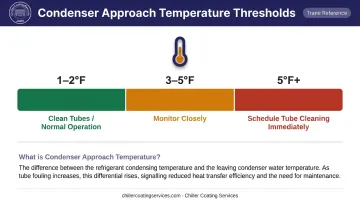
A sudden increase in energy bills without a corresponding increase in facility load is a reliable leading indicator that efficiency has degraded.
Unusual Noises, Vibration, or Operational Irregularities
Abnormal sounds (rattling, grinding, cavitation noise) and excess vibration typically point to bearing wear, compressor stress, or mechanical misalignment. These problems worsen quickly. A bearing that rattles on Monday doesn't always rattle on Friday.
Unexpected shutdowns, control system faults, and failure to reach operating setpoints signal that sensors, safety interlocks, or control systems need attention. These aren't just nuisances — they often precede more serious failures.
Visible Corrosion, Scale, or Physical Deterioration
Physical warning signs include:
- Scale buildup on tube surfaces or tube sheets
- Pitting or discoloration on metal surfaces
- Discolored condenser water
- Deteriorating pipe insulation or gaskets
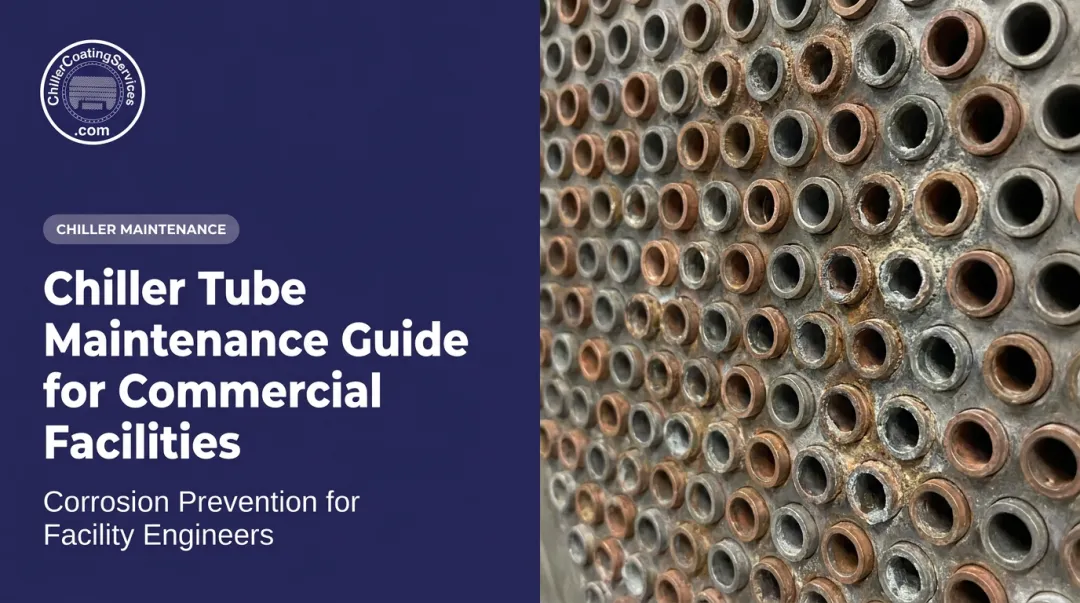
Corrosion on tube sheets deserves particular attention. What looks like surface rust can represent advanced galvanic attack at tube-to-tube sheet junctions, where dissimilar metals meet in the presence of oxygenated water.
Chiller Coating Services regularly encounters tube sheets showing severe pitting with visible holes and obstructed tube ends, particularly on the condenser side where condenser water creates an aggressive environment.
At that stage, the structural integrity of the tube-to-tube sheet joint is compromised. Protective coating alone isn't sufficient — corroded areas require reconstruction before coating can be applied.
Increased Resource Consumption and Recurring Downtime
A chiller accumulating these patterns is telling you temporary fixes aren't enough:
- Frequent manual resets with no lasting resolution
- Short cycling that prevents the system from reaching setpoints
- Repeated operator intervention for the same fault conditions
Each occurrence signals that deferred problems are compounding — not stabilizing.
Chiller Maintenance Schedule (General Guidelines)
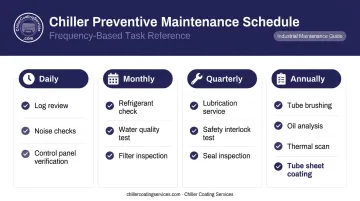
Maintenance frequency varies by chiller type, operating hours, environmental conditions, and manufacturer specifications. The table below provides general guidelines aligned with ASHRAE Standard 180 and OEM documentation.
| Frequency | Key Tasks |
|---|---|
| Daily | Review chiller log (temperatures, pressures, flow rates, fluid levels); check for unusual noises or vibration; verify control panel readings |
| Monthly | Inspect refrigerant levels; check water quality and chemical treatment; inspect belts, filters, and strainers |
| Quarterly | Lubricate bearings and moving components; test safety interlocks and alarms; inspect insulation and seals |
| Annually (pre-season) | Brush condenser and evaporator tubes; analyze compressor oil; thermally scan electrical connections; calibrate temperature and pressure controls; inspect tube sheets for corrosion and evaluate protective coating; verify refrigerant charge and purge unit operation |
Scheduling Notes
- Facilities running chillers year-round (hospitals, data centers, manufacturing plants) should perform several annual tasks on a semi-annual basis
- Coastal New England facilities — particularly along the Massachusetts, Connecticut, Rhode Island, and Maine shorelines — should schedule tube sheet inspections and water treatment reviews more frequently, given that salt-laden air and elevated humidity accelerate corrosion
- ASHRAE Standard 180 specifies that maintenance frequencies are minimum intervals and should be adjusted based on documented equipment condition and inspection results
Conclusion
Chiller preventive maintenance is an essential investment, not a discretionary line item. The difference between a chiller that runs efficiently for 25+ years and one that requires early replacement almost always comes down to the consistency and quality of its maintenance program.
A complete program combines routine scheduled tasks, condition-based monitoring, and professional surface protection — including tube sheet coating to address corrosion, galvanic attack, and erosion before they compromise structural integrity.
For facilities across New England and New York, Chiller Coating Services brings over 40 years of management experience in industrial coatings and surface restoration. Their work covers tube sheets, water boxes, and heat exchangers using proprietary coating systems and thorough surface preparation — protecting equipment service life and reducing long-term maintenance costs.
To discuss your facility's chiller maintenance needs, call (877) 427-0090 or visit them at 8 Foundry Place, Franklin, NH.
Frequently Asked Questions
How often should chillers be serviced?
Chillers should receive daily log reviews, monthly water quality and refrigerant inspections, and a comprehensive annual service before the cooling season begins. Facilities running year-round — hospitals, data centers, manufacturing plants — should treat several of those annual tasks as semi-annual ones.
What are the most common preventive maintenance activities?
Core PM activities are inspection, lubrication, cleaning, calibration, testing, adjustment, and parts replacement. For chillers, these translate to tube brushing, oil analysis, safety interlock testing, and refrigerant verification.
What does chiller preventive maintenance include?
Core tasks include tube cleaning, refrigerant charge verification, compressor oil analysis, water quality testing, electrical component inspection, lubrication of moving parts, safety system testing, and tube sheet inspection for corrosion — with professional coating considered where deterioration is present or at risk.
What happens if a chiller is not maintained?
Neglected chillers accumulate fouled heat exchangers, refrigerant leaks, and compressor wear. These issues reduce efficiency, drive up energy costs, and eventually cause unplanned failures. Equipment that could have lasted 25+ years may require major overhaul or replacement significantly earlier.
How long do chillers last with proper maintenance?
ASHRAE puts the removal age for centrifugal chillers at roughly 25 years; Johnson Controls cites a 20–30 year median life cycle for water-cooled units. Air-cooled chillers typically reach 15–20 years. Consistent PM keeps equipment at the upper end of those ranges.
What is the most common cause of chiller failure?
Tube fouling, refrigerant leaks, and compressor issues — most often stemming from deferred maintenance — are the leading failure drivers. Poor water treatment that allows scale and corrosion to build unchecked is a close contributing factor, particularly in facilities with aggressive water chemistry or coastal exposure.