For facilities managers, engineers, and property owners responsible for commercial and industrial buildings, that gap between early action and reactive repair is where budgets get consumed. This guide covers what a Corrosion Prevention and Control (CPC) program actually is, why it matters for your facility, the core components needed to build one, and the prevention strategies that deliver the most durable results.
Key Takeaways
- A CPC program is a structured, lifecycle-focused management system built around ongoing inspection, treatment, and documentation
- The NACE IMPACT study found that 15–35% of corrosion costs are preventable with available control practices
- Every 0.001-inch increase in condenser tube fouling can raise chiller power consumption by 10%
- Effective corrosion control combines protective coatings, water treatment, material selection, and regular inspection — each method reinforces the others
- Defined inspection intervals and thorough documentation distinguish a true CPC program from reactive, ad-hoc maintenance
What Is a Corrosion Prevention and Control Program?
A Corrosion Prevention and Control (CPC) program is a structured, systematic approach to identifying, managing, and reducing corrosion across a facility's equipment, infrastructure, and building systems. Its defining characteristic is a proactive, lifecycle-focused orientation — treating corrosion as an ongoing operational risk that requires continuous management.
The program has two distinct sides:
- Prevention — stopping corrosion before it initiates through material selection, protective coatings, compatible metal pairings, and environmental controls
- Control — managing corrosion that has already begun to prevent further damage, functional impairment, or structural compromise
A CPC program integrates management principles, engineering design considerations, inspection protocols, and documented repair procedures. As assets age and operating conditions shift, the program adapts — which is why effective implementation requires documented procedures, scheduled inspections, and periodic reassessment.
Where CPC Programs Apply
While CPC programs originated in military and aviation contexts, they are just as critical for commercial and industrial facilities. The equipment most vulnerable to corrosion-related degradation includes:
- Chiller tube sheets, water boxes, and heat exchangers
- HVAC air handlers
- Boilers and closed-loop piping systems
- Building structural steel and concrete-embedded metalwork
Hospitals, schools, power plants, and manufacturing facilities face particularly aggressive corrosion environments due to moisture exposure, chemical treatments, and dissimilar metal contact throughout their cooling infrastructure.
Why Corrosion Prevention Is Critical for Facilities
The Financial Reality
The FHWA/NACE benchmark study estimated direct U.S. corrosion costs at $276 billion annually — roughly 3.1% of GDP based on 1998 data. Within that figure, utilities accounted for $47.9 billion and production and manufacturing for $17.6 billion. These categories map directly to the cooling systems, heat exchangers, and process piping found in commercial and industrial facilities.
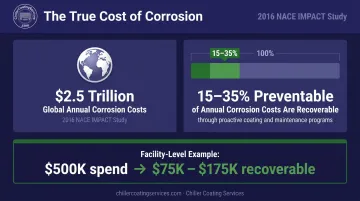
The 2016 NACE IMPACT report estimated global corrosion costs at $2.5 trillion per year and concluded that 15–35% of those costs are preventable with existing corrosion control practices. For a facility spending $500,000 annually on corrosion-related maintenance, repairs, and energy penalties, that represents $75,000–$175,000 in recoverable costs — the direct target of a well-designed CPC program.
Safety Consequences
Beyond the financial toll, corrosion failures carry serious safety consequences. The U.S. Chemical Safety Board linked the 2010 Tesoro refinery explosion in Anacortes, Washington, to high-temperature hydrogen attack damage in a heat exchanger, resulting in 7 fatalities. While that's a refinery context, the underlying failure mode — undetected corrosion damage in a heat exchanger — applies directly to industrial facilities with inadequate inspection programs.
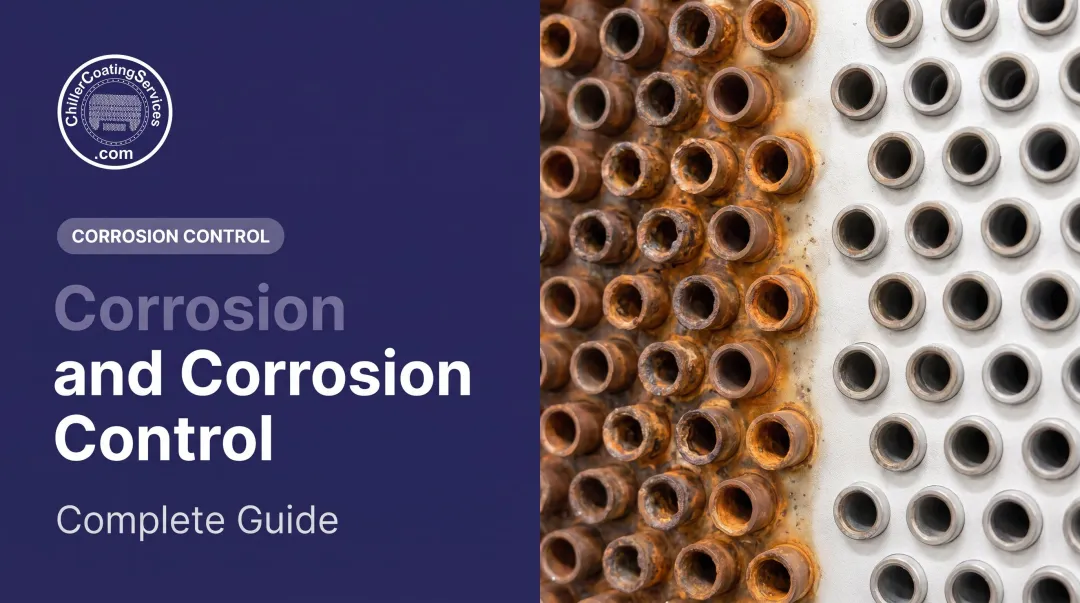
For HVAC applications, failure modes are typically economic before they become catastrophic. Corroded chiller tube sheets develop pitting, which leads to coolant leaks, reduced heat transfer, and eventual system shutdown at the worst possible time.
The Hidden Cost of Deferred Maintenance
DOE data shows that every 0.001-inch increase in condenser tube fouling raises chiller power consumption by 10%. A 400-ton chiller example demonstrated $4,739 per year in savings from side-stream filtration alone. Corrosion accelerates fouling, and fouling accelerates energy penalties — making water-side corrosion control both a maintenance and an energy management issue.
The most damaging forms of corrosion — galvanic, pitting, crevice — occur in areas not routinely inspected. That's precisely why a formal CPC program with defined inspection intervals is necessary, not optional.
Key Components of an Effective Corrosion Prevention and Control Program
Risk Assessment and Corrosion Survey
Every CPC program starts with a comprehensive assessment of all assets to:
- Identify corrosion-prone areas and document current condition
- Classify corrosion severity (surface, moderate, severe)
- Prioritize assets for immediate remediation versus ongoing monitoring
- Establish a baseline for tracking progression over time
Without this baseline, there's no way to distinguish worsening corrosion from stable conditions — or to justify capital spending on prevention.
Inspection and Monitoring Protocols
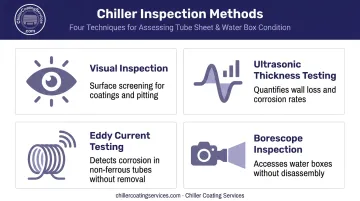
That baseline feeds directly into the inspection framework. A CPC program defines inspection frequency, methodology, and documentation requirements for each asset type. Common methods include:
- Visual inspection — first-pass screening for coating defects, surface deposits, and visible pitting
- Ultrasonic thickness testing — quantifies wall loss and calculates corrosion rates over time
- Eddy current testing — identifies corrosion, erosion, and cracking in non-ferrous heat exchanger tubes without removal
- Borescope inspection — reaches water boxes and tube ends without full disassembly
Inspection intervals should be risk-based. Safety-critical or high-value equipment warrants shorter cycles; lower-risk assets can be assessed during planned maintenance windows. API 510 guidance for pressure vessels states that internal inspection intervals should not exceed 10 years or half the remaining corrosion-rate life, whichever is shorter — a useful benchmark for applying remaining-life logic to water-side equipment.
The program should specify who conducts each inspection type and what qualifications are required.
Material Selection and Surface Protection
A well-designed CPC program specifies corrosion-resistant materials, compatible metal pairings, and appropriate surface protection strategies — for both new equipment procurement and repair decisions.
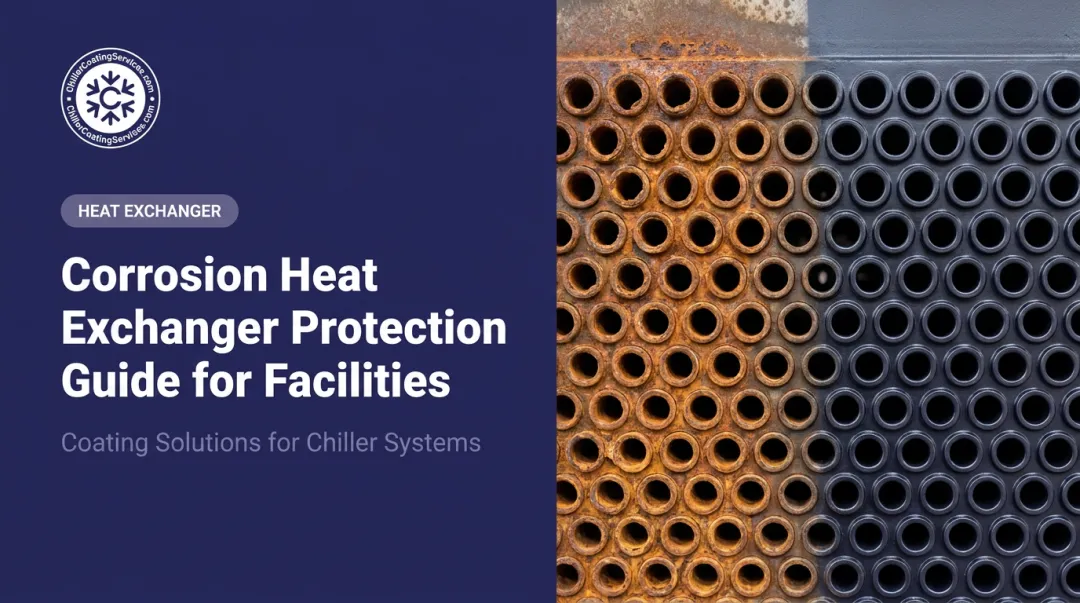
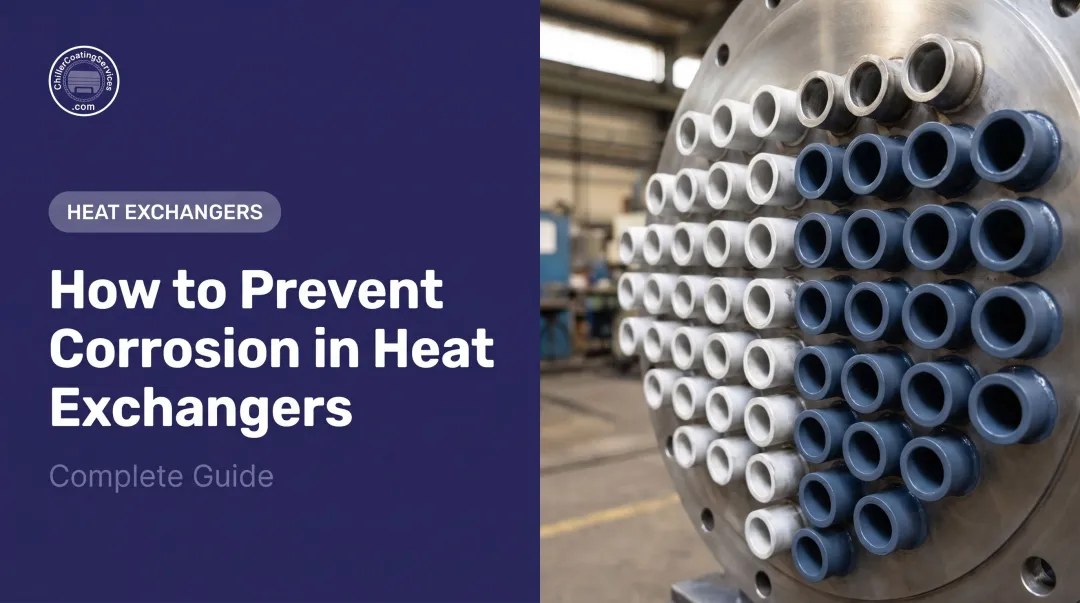
For critical equipment like chiller tube sheets, proprietary coatings engineered for long-term immersion service are a cornerstone of the strategy. Chiller Coating Services applies a 100% solids coating system to tube sheets, tube ends, and water boxes through a three-step process: deep cleaning, contained abrasive blasting to a white metal finish, and coating application.
The non-conductive coating creates a physical barrier against galvanic corrosion at tube-to-tube sheet junctions, withstands long-term immersion, and resists chemical attack from anti-scale treatments. In some cases, it increases push-out strength at tube joints by over 1,000 pounds.
Surface preparation standard: The U.S. Bureau of Reclamation's protective coatings guide identifies surface preparation as the single most critical factor in coating service life — and specifies a chloride acceptance criterion of 7 µg/cm² or less on prepared surfaces before any immersion-service coating is applied.
Corrosion Repair and Remediation Procedures
The CPC program must define standardized procedures for addressing corrosion findings, including:
- Acceptance criteria for corrosion that can be treated in place versus corrosion requiring component repair or replacement
- Approved repair methods for each asset type and corrosion severity level
- Documentation requirements for each remediation action taken
For severely corroded tube sheets, that process may include material reconstruction before any coating is applied — restoring functional geometry and structural capacity before the protective system goes on.
Documentation and Recordkeeping
Without rigorous documentation, trend data goes untracked and compliance gaps go unnoticed. Records should capture:
- Inspection findings, dates, and inspector qualifications
- Coating application details — surface preparation method, coating system, dry film thickness, cure conditions
- Remediation actions and materials used
- Water chemistry compliance records
- Trend data showing corrosion rate changes over time
This documentation supports regulatory compliance, maintenance budget decisions, and the ability to detect worsening trends before they become failures.
How to Implement a CPC Program Step by Step
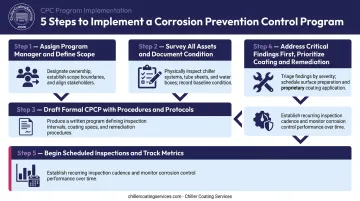
Building a CPC program from scratch doesn't require tackling everything at once. A phased approach lets you address the highest-risk assets first, then build out from there.
**Assign a program manager or cross-functional team. Define which assets are in scope and set measurable goals: reduction in unplanned corrosion repairs, equipment service life extension, maintenance cost per critical asset.
**Survey all in-scope assets to document current condition. Identify the highest-risk areas and use findings to drive both immediate remediation and the development of ongoing inspection schedules.
Draft a formal Corrosion Prevention and Control Plan (CPCP) covering:
- Inspection procedures and acceptance criteria
- Approved treatment methods and repair protocols
- Responsible parties and review intervals
This document is what separates a reactive maintenance habit from a true program.
**Address the most critical findings from the baseline assessment first. For chiller equipment, this typically means coating tube sheets and water boxes showing active galvanic corrosion or pitting before the next operating season.
**Begin scheduled inspections per the program plan, record all findings consistently, and track corrosion metrics against your established baseline.
Corrosion Prevention Methods and Protective Strategies
No single prevention method addresses every corrosion mechanism. Effective programs combine multiple strategies matched to the specific failure modes of each asset.
| Method | Best Application | Key Consideration |
|---|---|---|
| Protective coatings and linings | Water boxes, tube sheets, tanks, structural steel | Surface preparation to white metal is non-negotiable for immersion service |
| Water treatment inhibitors | Cooling towers, closed loops, boilers | Pair with corrosion coupons or probes for monitoring |
| Cathodic protection / sacrificial anodes | Immersed or buried steel, selected heat exchanger components | Requires electrical continuity and electrolyte contact |
| Environmental controls and filtration | Condenser water systems, cooling towers | Side-stream filtration delivers measurable energy and reliability benefits |
| Material selection and galvanic isolation | Mixed-metal heat exchangers, piping transitions | Review dissimilar-metal interfaces before failures develop |
Galvanic Corrosion in Cooling Systems
In any facility with cooling equipment, galvanic corrosion is one of the more damaging — and preventable — failure modes. When dissimilar metals are electrically connected in the presence of a conductive electrolyte, the less noble metal degrades at an accelerated rate.
SUEZ's industrial water treatment handbook notes that the most serious galvanic corrosion in cooling systems occurs when copper and steel alloys are present together — because dissolved copper ions can plate onto steel and trigger rapid attack. Tube-to-tube sheet junctions are the most vulnerable point in most chiller configurations, which is why targeted controls at those interfaces matter most.
Practical prevention strategies include:
- Auditing all dissimilar-metal interfaces in cooling systems
- Applying non-conductive coatings to electrically isolate contact points
- Using compatible filler materials and isolation hardware at metal transitions
- Monitoring copper levels in cooling water and using copper-specific inhibitors (such as triazoles) where needed
Monitoring, Reviewing, and Updating Your CPC Program
Ongoing KPI Tracking
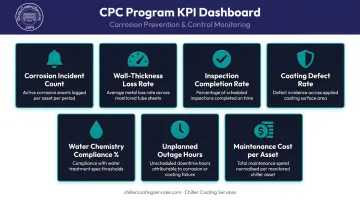
An effective CPC program is never static. Useful KPIs to track include:
- Corrosion incident and leak count per period
- Wall-thickness loss rate for monitored assets
- Inspection completion rate against scheduled intervals
- Coating holiday or defect rate at last inspection
- Water chemistry compliance percentage
- Unplanned outage hours attributable to corrosion
- Maintenance cost per critical asset
AMPP's corrosion management guidance recommends monthly reporting for high-threat assets — a cadence that keeps program managers ahead of worsening corrosion rather than reacting to failures.
Periodic Program Audits
Review your CPC program formally at least once a year and update it to reflect:
- Changes in facility assets or operating conditions
- New protective technologies or approved materials
- Lessons learned from corrosion incidents or near-misses
- Results of third-party audits for high-risk systems
The annual capital planning cycle is a natural trigger for this review — connecting corrosion findings directly to budget decisions.
Frequently Asked Questions
What is a corrosion control program?
A corrosion control program is a structured, documented plan for identifying, managing, and mitigating corrosion across a facility's equipment and infrastructure. Unlike reactive maintenance, it uses defined inspection intervals, prevention strategies, and formal repair procedures to reduce corrosion risk across the full equipment lifecycle.
What should be included in a corrosion prevention and control plan?
A complete CPCP includes a baseline corrosion risk assessment of all assets, defined inspection schedules and acceptance criteria, specified prevention and repair methods (including protective coatings), assigned program ownership, and a formal written plan with documentation and review procedures.
What are the most common types of corrosion in industrial facilities?
Five types appear most often in facility contexts:
- Uniform corrosion — general surface thinning on carbon steel
- Galvanic corrosion — dissimilar metals in cooling systems
- Pitting corrosion — localized attack on stainless and copper alloys
- Crevice corrosion — at gaskets, lap joints, and tube-to-tube sheet interfaces
- Erosion-corrosion — pump impellers and high-velocity zones
What is the difference between corrosion prevention and corrosion control?
Prevention focuses on stopping corrosion from initiating — through material selection, protective coatings, and environmental controls. Control addresses managing corrosion that has already begun to limit further damage. An effective CPC program addresses both, because most facilities have assets at different stages of the corrosion lifecycle simultaneously.
How do protective coatings fit into a CPC program?
Protective coatings are one of the primary tools within a CPC program. Applied to a properly prepared surface, they create a physical and electrochemical barrier against corrosion — formulated for specific conditions including long-term immersion — and extend equipment service life while reducing lifecycle maintenance costs.