Introduction
Electrolytic corrosion is one of the most destructive threats a chiller system faces — and one of the quietest. Copper tubes sitting against steel shells, brass tube sheets bathed in circulating water, aluminum components nearby: every element of a chiller's construction creates conditions for electrochemical attack.
The problem rarely announces itself early.
Left unaddressed, that attack produces a predictable chain of failures — pitting on heat-transfer surfaces, weakened tube-to-tube-sheet joints, coolant contamination, and eventually unplanned downtime or full equipment replacement.
This guide covers what electrolytic corrosion is in a chiller context, why protection matters, the methods available to stop it, and the warning signs that indicate it's already underway. A practical maintenance schedule is included at the end.
Key Takeaways
- Electrolytic corrosion in chillers is driven by mixed-metal construction, circulating water as an electrolyte, and stray electrical currents — often all three at once
- Tube sheets and waterboxes are the most vulnerable points; pitting and joint failures there cascade into system-wide damage
- Protection requires three layers: non-conductive barrier coatings, controlled water chemistry, and consistent inspection
- Rising approach temperatures, discolored water, and elevated dissolved metals are early warnings that show up before structural failure
- Inspect tube sheets annually and sample water quarterly at minimum — higher-risk systems need both more often
Why Electrolytic Corrosion Protection Matters for Chiller Systems
The Mixed-Metal Problem
Chillers are not built from a single metal. A typical water-cooled chiller contains copper alloy tubes, carbon steel or cast iron shells, brass tube sheets, and sometimes aluminum components — all immersed in circulating water. That combination doesn't just create the possibility of corrosion; it virtually guarantees it without active protection.
Two mechanisms run simultaneously:
- Galvanic corrosion — occurs naturally when dissimilar metals contact each other through an electrolyte (the circulating water)
- Electrolytic corrosion — driven by external electrical currents, such as stray currents from grounding faults or nearby electrical equipment, and tends to be more localized and aggressive
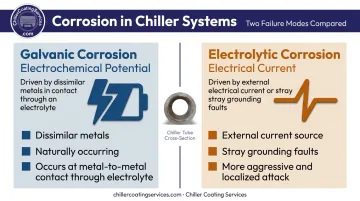
The tube sheet is where these forces concentrate. It's the interface between copper tubes and a steel or cast iron shell, constantly wetted, with current pathways available in every direction.
The Efficiency and Energy Cost
Corrosion doesn't just weaken metal — it degrades performance. As pitting and scale build up on heat-transfer tube surfaces, thermal resistance increases. The chiller must work harder to deliver the same cooling output.
According to a DOE/PNNL report, each 0.001-inch increase in foulant on heat-transfer surfaces produces a 10% increase in power consumption, based on ASHRAE Standard 550-98 data for cooling-tower water and chiller heat-transfer penalty. A separate DOE operational benchmark puts chiller energy consumption 2.5%–3.5% higher for each 1°F rise in condenser temperature — translating to $2,500–$7,000 in additional annual electricity cost on a 100-ton chiller with a $20,000 annual energy baseline.
Structural Risk and Safety Implications
That efficiency loss is only part of the problem. Electrolytic corrosion weakens tube-to-tube-sheet joints — the mechanical connections that keep the tube bundle seated and sealed. When those joints fail, tubes pull out, refrigerant and coolant mix, and what began as a corrosion issue becomes a full equipment failure.
The consequences extend beyond the chiller itself:
- Contaminated water circulates to downstream pumps, coils, and heat exchangers
- Corroded tube ends compromise refrigerant containment and circuit integrity
- Facilities subject to Joint Commission, ISO, FDA, or GMP audits face compliance exposure when water-quality records reflect untreated corrosion events
The Cost Argument for Prevention
The cost drivers behind unaddressed corrosion are straightforward:
- Higher compressor energy consumption (ongoing, compounding)
- Leak testing, waterbox removal, and tube plugging labor
- Loss of redundancy during unplanned repair windows
- Downstream equipment damage from contaminated water
- Risk of full chiller replacement rather than restoration
A professional tube sheet coating service — surface preparation, corrosion reconstruction where needed, and 100% solids coating application — addresses all of these vectors in a single planned mobilization, at a cost that typically compares favorably to one unplanned repair event.
Types of Electrolytic Corrosion Protection for Chiller Systems
No single method is universally sufficient for chillers. Effective programs combine barrier protection, electrochemical protection, and chemical treatment, selected based on system age, water chemistry, and operating environment.
Barrier Coatings and Tube Sheet Linings
Non-conductive epoxy or polymer coatings applied to tube sheets and waterboxes interrupt the electrochemical circuit directly. By insulating dissimilar metals from the electrolyte, they eliminate the pathway for both galvanic and electrolytic corrosion at the most vulnerable contact points in the system.
High-quality tube sheet coatings deliver several performance benefits simultaneously:
- Eliminates electrolytic contact between copper tubes and steel/iron tube sheets with a non-conductive barrier
- Increases tube-to-tube-sheet push-out strength when applied after surface reconstruction
- Reduces deposit accumulation and maintains heat-transfer efficiency through smoother surfaces
- Resists dissolved oxygen, scale chemistry, and anti-scale treatment programs
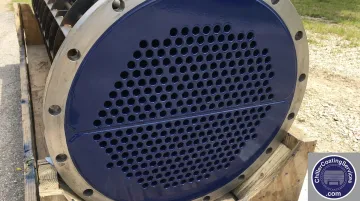
We apply a proprietary 100% solids epoxy coating system: solvent-free, zero-VOC, and specifically engineered for continuous water-side immersion service. Our three-step process covers deep cleaning, contained abrasive blasting to white metal finish per SSPC-SP 5/NACE No. 1, and coating application.
Documented push-out strength increases of over 1,000 pounds at tube-to-tube-sheet joints have been achieved in some cases. The quick-cure formulation is designed to fit within planned outage windows, minimizing facility downtime.
Sacrificial Anode Systems
Sacrificial anodes (typically zinc or magnesium) protect metal surfaces by corroding preferentially instead of the base metal. Johnson Controls' chiller application guidance recommends magnesium anodes for certain freshwater chiller waterboxes and zinc for high-salinity conditions, including coated waterboxes where anodes protect coating holidays.
In fully closed chilled-water loops, sacrificial anodes require careful consideration: consumed anode particles can potentially damage pumps and other system components. They are most commonly used in:
- Open or semi-open cooling systems (cooling towers, condenser water circuits)
- Chiller waterboxes where the OEM specifically recommends them
- Applications where anode sizing and replacement schedules are actively managed
Replace anodes before full depletion. A depleted anode provides no protection and may leave base metal exposed.
Water Treatment and Chemical Inhibitors
Maintaining proper water chemistry is a foundational protection layer. It's not a standalone solution, but an essential complement to barrier coatings. Inhibitor programs using molybdate or nitrite-based formulations create a passive film on metal surfaces that slows electrochemical attack.
Key chemistry parameters to manage:
| Parameter | Limit | Notes |
|---|---|---|
| pH | 7.5–9.0 (Trane); 9.0–10.5 (NIH, closed loops) | Correct range depends on metal mix and OEM requirements |
| Chloride | 125 ppm max (Trane) | |
| Sulfate | 35 ppm max (Trane) | |
| Total hardness | 350 ppm max (Trane) |
One critical warning: over-treatment that increases water conductivity can actually accelerate galvanic corrosion rather than preventing it. Regular water testing and professional chemical program management are non-negotiable.
Impressed Current Cathodic Protection (ICCP)
ICCP uses an external DC power source to force protective current onto a structure, suppressing oxidation. AMPP documents its application for carbon-steel seawater condenser waterboxes coupled to titanium tubes. That's a large industrial condenser context, not a standard closed commercial chilled-water loop.
ICCP requires rectifiers, reference electrodes, continuous monitoring, and electrical control infrastructure. For most commercial chiller applications, it represents higher cost and complexity than the exposure warrants. It's more appropriate for:
- Large open condenser systems in industrial or utility settings
- Cooling towers with significant structural metal exposure
- Critical infrastructure where passive methods are insufficient
Warning Signs Your Chiller System Has Electrolytic Corrosion
Catching corrosion early cuts repair costs and extends equipment life. These indicators give facilities managers and engineers a practical reference for routine assessments.
Reduced Efficiency or Abnormal Operating Conditions
Performance degradation is often the first measurable signal:
- Rising approach temperature — Trane expects approximately 1–2°F approach on listed water-cooled screw chillers; Johnson Controls recommends condenser cleaning when approach exceeds the new-unit baseline by more than 4°F
- Longer run cycles to reach target temperatures
- Unexplained utility bill increases without corresponding changes in cooling load
A chiller running harder than normal with no clear operational cause typically traces back to fouling or pitting on heat-transfer surfaces.
Visual and Physical Inspection Findings
During tube sheet and waterbox inspections, look for:
- Pitting craters — concentrated at tube-to-tube-sheet joints
- Discoloration — green or blue staining indicates copper corrosion; reddish deposits indicate iron oxide
- White or gray mineral deposits — scale buildup compounding heat-transfer degradation
- Coating degradation — blistering, delamination, or bare metal patches signal that barrier protection has failed and active corrosion is underway
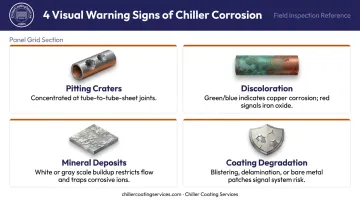
Coating condition is as important as metal condition. A coating that looks mostly intact but shows even small delaminated areas or holidays is actively failing.
Water Quality and Sampling Indicators
Chemical evidence of active corrosion shows up in water samples before structural damage becomes visible:
- Elevated dissolved metals (copper, iron, zinc) above makeup water concentrations indicate active corrosion of system metals
- pH drift outside the OEM-specified range
- Cloudiness or discoloration of system water
- Rising conductivity readings, which signal corrosion byproducts and heightened electrochemical activity
Compare loop samples against makeup water rather than relying on a single absolute number — trends over time are more informative than any single measurement.
Recurring Leaks, Noises, or Structural Issues
These symptoms point to progressive joint deterioration rather than isolated failures:
- Repeated tube leaks returning at the same locations
- Unusual gurgling sounds inside waterboxes
- Unexplained coolant loss with no identifiable failure point
Each of these signals weakened tube-to-tube-sheet joints undermined by electrolytic corrosion working below the surface.
A temporary fix — re-rolling tubes, patching — that fails again within months means the root cause hasn't been addressed. Surface preparation down to bare metal, corrosion reconstruction where needed, and a protective coating application stops the cycle rather than delaying it.
Chiller Corrosion Protection Maintenance Schedule
A consistent maintenance schedule is the most reliable way to catch electrolytic and galvanic corrosion before it causes tube failures or waterbox damage. Inspection frequency should be adjusted based on system age, water chemistry, operating hours, and whether stray current sources are present in the facility electrical system. Older chillers, hard or high-conductivity water, and systems with a prior corrosion history all warrant more frequent attention.
| Interval | Tasks |
|---|---|
| Daily/Weekly | Check system water pressure differentials and temperatures for anomalies; review water treatment chemical feed rates and conductivity readings |
| Monthly/Quarterly | Conduct water sampling and laboratory analysis for dissolved metals, pH, inhibitor levels, and biological activity; inspect accessible waterbox surfaces and anode condition where applicable |
| Annual | Full tube sheet and waterbox visual inspection during scheduled chiller shutdown; assess coating for blistering, delamination, or exposed metal; evaluate tube-to-tube-sheet joint integrity; replace sacrificial anodes if applicable; consider professional coating inspection or reapplication if surface degradation is detected |
| Biannual | High-usage or continuously operated systems (hospitals, data centers, manufacturing plants) should schedule internal inspections twice per year |
| Condition-based | Any system with a history of corrosion problems should be assessed by a qualified coatings and surface restoration specialist before the next cooling season |
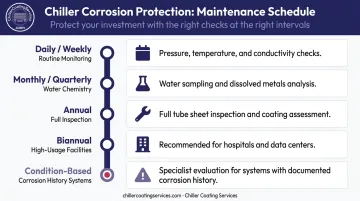
Systems showing repeated leaks, elevated dissolved metals, or prior tube plugging need more than a visual check — they need a full surface evaluation, including tube sheet condition, coating integrity, and any reconstruction of corroded areas. Waiting until the next failure to act typically means more extensive damage and longer downtime than a proactive assessment would have required.
Conclusion
Electrolytic corrosion in chiller systems is predictable and preventable. It follows knowable chemistry from knowable conditions — mixed metals, circulating water, and electrical current — and it responds to protection strategies that have been proven in field applications for decades.
The most effective programs combine barrier coatings (which eliminate the electrochemical pathway at the tube sheet), water treatment (which manages the chemistry of the electrolyte), and regular inspection (which catches degradation before it becomes failure). Applied on a structured schedule, that combination consistently costs less than emergency repairs or unplanned equipment replacement.
Treating corrosion protection as an ongoing maintenance discipline — with documented schedules, service records, and periodic professional assessment for aging or high-value assets — is how facilities keep chillers running through their full intended service life.
For facilities across New England and New York ready to take that step, Chiller Coating Services offers on-site evaluations and project-specific guidance. Call (877) 427-0090 or visit chillercoatingservices.com/contact.
Frequently Asked Questions
How do you prevent electrolytic corrosion in chillers?
Prevention relies on three approaches: barrier coatings or electrical isolation to interrupt the electrochemical circuit, pH control and inhibitor programs to manage water chemistry, and cathodic protection where appropriate. In chiller systems, tube sheet coatings are the most effective first line of defense — they eliminate direct metal-to-electrolyte contact at the most vulnerable points.
What are the three basic types of corrosion protection?
The three fundamental types are:
- Barrier protection — coatings and linings that prevent metal contact with the electrolyte
- Cathodic protection — sacrificial anodes or impressed current systems that redirect the electrochemical reaction
- Chemical inhibition — water treatment programs that passivate metal surfaces and reduce conductivity
Most effective chiller programs use all three in combination.
What is the difference between galvanic and electrolytic corrosion in chillers?
Galvanic corrosion occurs naturally when two dissimilar metals — copper tubes and a steel shell, for example — are in contact through an electrolyte. Electrolytic corrosion is driven by an external electrical current, such as stray currents from building electrical systems or grounding faults. Electrolytic corrosion tends to be more aggressive and localized than galvanic corrosion.
What causes electrolytic corrosion in chiller systems?
Primary causes include mixed-metal construction (copper, steel, brass, aluminum), circulating water acting as an electrolyte between those metals, stray electrical currents from grounding faults or nearby electrical equipment, and poor water chemistry management that increases conductivity and accelerates ion migration.
How often should chiller tube sheets be inspected for corrosion?
Plan on annual visual inspections during scheduled shutdowns and quarterly water quality sampling. Systems with a history of corrosion, older equipment, or challenging water chemistry — including facilities with hard or high-conductivity water — should have biannual professional inspections.
Can coatings fully stop electrolytic corrosion in chiller systems?
Properly applied non-conductive tube sheet coatings are highly effective at stopping both electrolytic and galvanic corrosion by eliminating direct metal-to-electrolyte contact. They work best as part of a broader program that includes water treatment and periodic inspection to confirm coating integrity.