That confusion has real consequences. Misdiagnosing a condenser problem as a compressor failure. Overlooking gradual performance degradation until a system fault forces emergency repairs. Deferring tube sheet inspection until corrosion has already compromised structural integrity.
This guide is written for facilities teams who operate these systems but may not have a deep HVAC engineering background. It explains how chillers and condensers work together, the three main condenser types, what degrades performance over time, and the maintenance misconceptions that lead to the most costly errors.
Key Takeaways
- A chiller is the complete refrigeration system; the condenser is its heat-rejection component
- The refrigeration cycle — evaporation, compression, condensation, and expansion — drives all heat movement
- Three condenser types exist: air-cooled, water-cooled, and evaporative, each suited to different facility needs
- Heat transfer surface condition — tubes, tube sheets, and coils — is the most controllable performance variable
- Most efficiency losses blamed on compressors trace back to tube and tube sheet condition — proactive inspection catches them first
What Are Condenser and Chiller Systems?
These two terms get used interchangeably in facilities conversations — they shouldn't be.
Here's how each term is defined:
- Chiller: A complete thermodynamic system that removes heat from a process fluid (typically water or a water-glycol mix) and transfers it elsewhere. As AHRI Standard 551/591-2026 defines it, a water-chilling package is a factory-made assembly containing compressors, condensers, evaporators, and associated components designed to cool water — a full refrigeration loop, not a single component.
- Condenser: One of four core components inside a chiller. It's the heat exchanger stage where refrigerant releases absorbed heat and converts back from vapor to liquid. The condenser is part of the chiller, not a competing or separate system.
A chiller cannot function without its condenser. A condenser alone cannot chill anything. That distinction matters every time a service decision lands on your desk.
How Chillers Differ from Standard HVAC Equipment
Facilities managers sometimes conflate chillers with residential or light commercial split systems. Here's how they differ in scale and scope:
- Chilled water systems circulate through a building-wide loop, serving multiple air handlers across large floor areas
- Condensing units in split systems are localized components serving a single zone or small area
- Buildings over 50,000 sq ft — hospitals, office towers, campuses, data centers — are where chillers are typically found
- EIA's 2018 Commercial Buildings Energy Consumption Survey found cooling towers (associated with water-cooled chillers) in approximately 17% of commercial floorspace and 43% of buildings over 200,000 sq ft — confirming their concentration in large, high-consequence facilities
How a Chiller and Condenser System Works
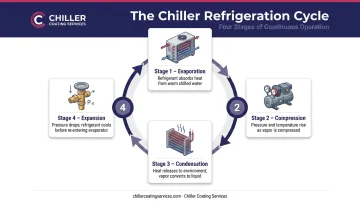
The chiller operates on a closed refrigeration cycle that continuously absorbs heat from the building or process side, transfers it through refrigerant, and rejects it to the environment via the condenser. Trane identifies four fundamental components in this cycle: evaporator, compressor, condenser, and expansion device.
Here's what each stage actually does:
Evaporation
Warm return water from the building arrives at the evaporator. Refrigerant circulates on the opposite side of the heat exchanger, absorbs heat from that water, and converts to vapor. The building water, now cooled, returns to serve air handlers throughout the facility.
Compression
The compressor raises the pressure and temperature of the refrigerant vapor — making it hot enough to release heat to the condenser medium. This is the energy-input stage of the cycle and the highest-wear component in the system. Compressor work is also why the condenser carries a larger load than the evaporator alone: the condenser must reject 100% of the heat absorbed in the evaporator plus the heat added by the compressor.
Condensation
The hot, high-pressure refrigerant vapor enters the condenser, contacts a cooler medium (air, water, or a combination), and releases its heat load. It converts back into a high-pressure liquid, ready to re-enter the cycle.
Condensation efficiency drives the health of the entire system. Any of the following conditions raises head pressure and forces every other component to work harder:
- Elevated ambient or condenser water temperature
- Fouled or scaled heat transfer surfaces
- Restricted airflow across condenser coils
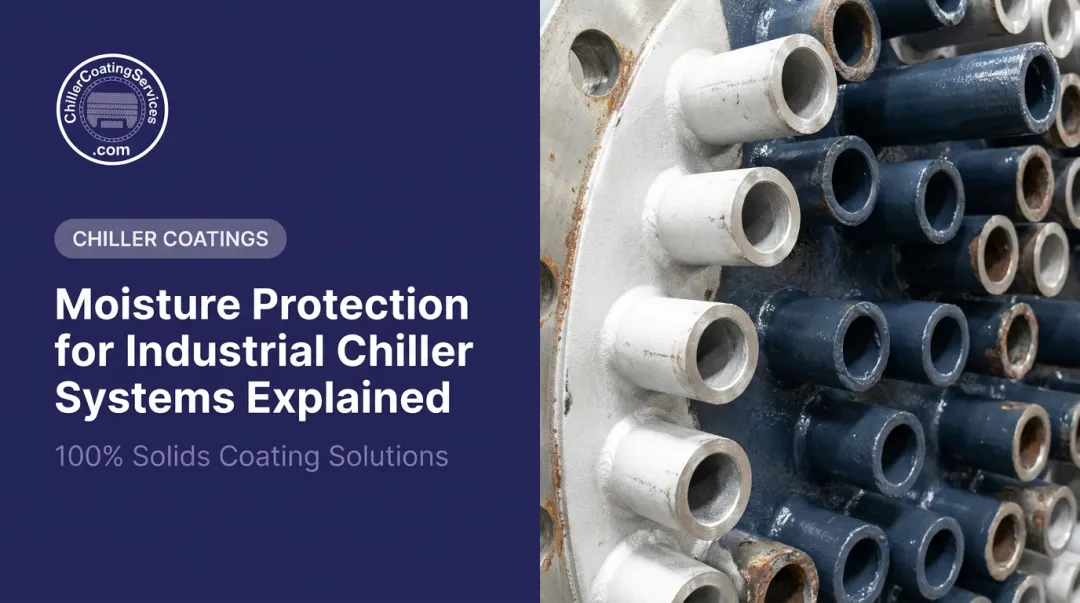
- Pitted or corroded tube sheets reducing heat transfer contact
Expansion and Return
The liquid refrigerant passes through an expansion device, dropping sharply in pressure and temperature before re-entering the evaporator. The cycle repeats continuously as long as cooling is demanded.
Types of Condensers Used in Chiller Systems
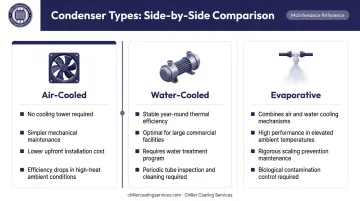
Facilities teams typically encounter three condenser types. The right choice depends on water access, outdoor space, ambient climate, and operating load profile.
Air-Cooled Condensers
Air-cooled condensers use fans to move ambient air across refrigerant coils, rejecting heat directly to the outdoor environment. Key characteristics:
- No cooling tower or condenser water supply required
- Lower upfront infrastructure cost and simpler maintenance footprint
- Efficiency declines as outdoor temperatures rise: the temperature differential between refrigerant and ambient air narrows, reducing heat rejection capacity
- Facilities in warmer climates or with peak summer loads need to factor this into capacity planning
For New England facilities, air-cooled systems perform well through much of the year given moderate summer temperatures, but peak August cooling loads can challenge capacity margins.
Water-Cooled Condensers
Water-cooled condensers transfer refrigerant heat to a circulating water loop through a shell-and-tube heat exchanger. That water then carries the heat to a cooling tower, where it's rejected via evaporation. Key characteristics:
- More stable, year-round efficiency — the condensing temperature is governed by tower return water, not outdoor air temperature
- Preferred for large or continuous-load facilities: hospitals, data centers, universities
- Require ongoing water treatment, makeup water supply, and regular tube and tube sheet inspection
- Tube-side fouling and corrosion are the primary sources of efficiency loss over time
Water-cooled systems deliver better thermodynamic performance than air-cooled alternatives, but that advantage depends entirely on maintenance discipline. Skipping water treatment or tube inspection doesn't reduce costs; it defers damage that compounds over time.
Evaporative Condensers
Evaporative condensers combine air and water cooling by spraying water directly over condenser coils. As water evaporates, it significantly improves heat rejection capacity beyond what dry air alone can achieve.
- Used where high ambient temperatures challenge air-cooled systems and water supply is available
- Thermodynamically favorable compared to air-cooled but requires rigorous maintenance
- Scaling, biological growth, and water chemistry management are major operational requirements
Each condenser type carries a distinct maintenance profile — and in water-cooled and evaporative systems especially, tube sheet and water box condition directly affects how well that heat rejection holds up over time.
Key Factors That Affect Chiller and Condenser Performance
Ambient and Water Temperatures
Ambient and water temperatures set the operating ceiling. Air-cooled condensers lose efficiency as outdoor temperatures rise. Water-cooled systems depend on condenser return water temperature — if tower performance degrades or water treatment lapses, condensing temperature climbs even on moderate days.
Facilities teams should track condenser entering and leaving temperatures and benchmark against design specifications. Any drift from design specs is one of the earliest signs that performance is slipping.
Heat Transfer Surface Condition
This is the most controllable performance variable, and also the most consistently neglected.
In water-cooled condensers, scale buildup, biological fouling, and corrosion on tube surfaces and tube sheets act as insulating layers. A Trane technical report documented that 0.6 mm of scale reduced heat-transfer efficiency by 34% and increased energy consumption by 21% — and that's a single fouling scenario, not cumulative corrosion damage.
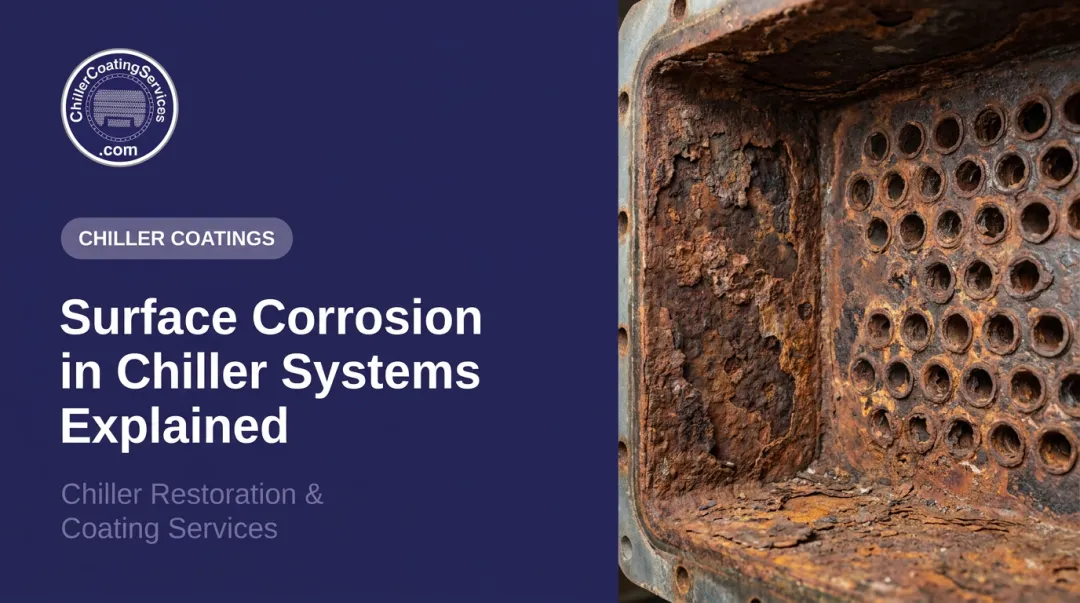
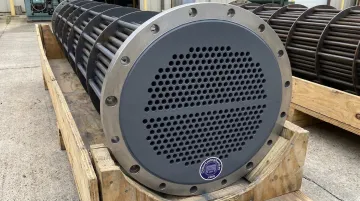
Tube sheet corrosion is a specific vulnerability in shell-and-tube condensers. Galvanic reactions between dissimilar metals — copper or brass tubes meeting steel tube sheets — and water chemistry attack the metal at the tube-to-tube-sheet joint. Crevice corrosion develops in the tight geometry at these joints, where stagnant water chemistry concentrates.
Protective tube sheet coating services address this directly. Chiller Coating Services, for example, applies a proprietary 100% solids non-conductive epoxy system to tube sheets, tube ends, and water boxes after blasting surfaces to a white metal finish (SSPC-SP 5 / NACE No. 1 equivalent). The non-conductive coating eliminates the electrolytic pathway between dissimilar metals, stopping galvanic corrosion at its source rather than managing it afterward.
Documented push-out strength gains of over 1,000 pounds at tube-to-tube-sheet joints show that the coating does more than protect — it structurally reinforces the assembly.
Refrigerant Charge and Airflow/Water Flow
These factors are interdependent:
- Dirty coils restrict airflow in air-cooled systems → elevated head pressure → compressor overwork
- Fouled tubes reduce water flow in water-cooled systems → reduced heat rejection → same result
- Refrigerant charge imbalances affect the entire cycle's thermodynamic efficiency
All three issues share a common consequence: the compressor works harder, energy consumption rises, and wear accelerates across the system.
Common Issues and Misconceptions Facilities Teams Should Know
"If it's cooling adequately, it doesn't need attention"
Gradual performance degradation — rising head pressure, increased energy draw, slightly reduced output — often goes unnoticed until a system fault occurs. By that point, the damage is compounding. Efficiency loss almost always originates at the condenser, where fouling and corrosion reduce heat transfer capacity over multiple operating seasons.
Confusing condenser problems with compressor failure
When a chiller trips on a high-pressure fault, the instinct is to suspect the compressor. Carrier's service documentation states directly that higher-than-normal condenser pressure usually indicates dirty tubes — not compressor failure. Noncondensable air is another possibility. Misdiagnosing this leads to expensive compressor inspections when the actual fix is a cleaning or maintenance procedure.
The discipline here is to investigate heat rejection before assuming compressor problems. Before opening the refrigerant circuit, check:
- Coil cleanliness and tube fouling
- Cooling tower performance
- Entering and leaving water temperatures
"Water-cooled systems need less maintenance than air-cooled"
This misconception is widespread and costly. Water-cooled systems avoid outdoor air temperature sensitivity but introduce an entirely different maintenance requirement set:
- Ongoing water treatment program (chemistry, biocide, inhibitors)
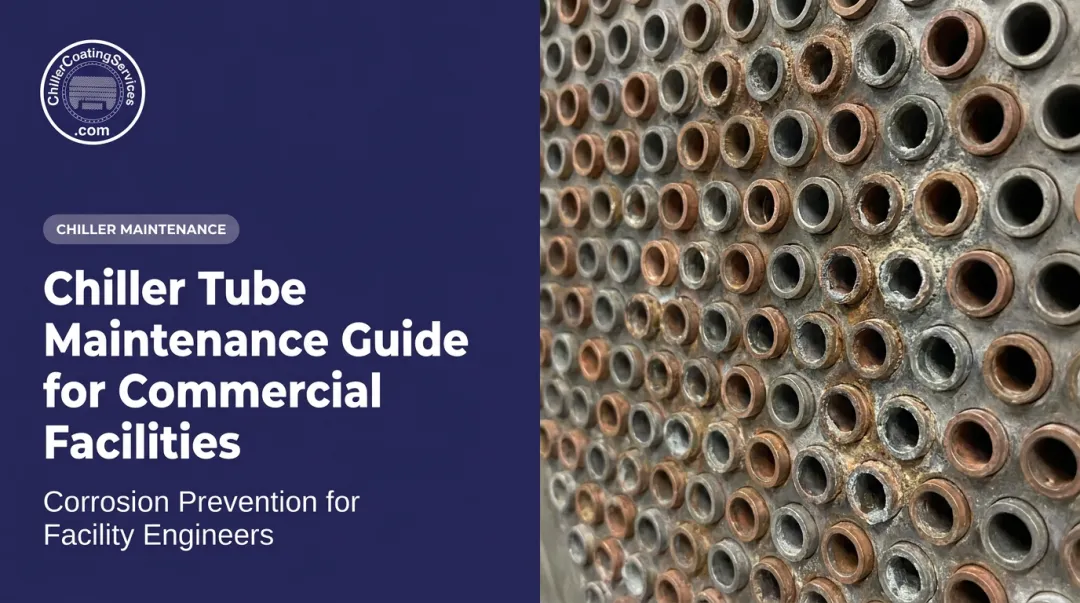
- Regular tube inspection for fouling and wall integrity
- Tube sheet integrity checks — particularly at tube-to-tube-sheet joints where galvanic and crevice corrosion are most active
- Cooling tower maintenance
Neglecting any of these leads to accelerated corrosion, reduced heat transfer efficiency, and tube failure that contaminates the refrigerant circuit — a failure mode that can force complete bundle replacement.
Frequently Asked Questions
Is a condenser the same as a chiller?
No. A condenser is one component within a chiller system — specifically the heat rejection stage where refrigerant releases heat and converts back to liquid. The chiller is the complete refrigeration package containing the condenser, compressor, evaporator, and expansion device.
What is the function of the condenser in a chiller?
The condenser removes the heat the refrigerant absorbed during evaporation and rejects it to the surrounding environment — air, water, or a combination. This allows the refrigerant to return to a liquid state and continue the cooling cycle.
What are the three types of chillers?
Chillers are most commonly classified by condenser type: air-cooled, water-cooled, and evaporative. They can also be classified by compressor type (centrifugal, screw, scroll, or reciprocating), which determines capacity range — roughly 3 to 6,000 tons — and application fit.
Is a chiller the same as HVAC?
A chiller is one component within a broader HVAC system. It produces chilled water that is distributed through air handlers or fan coil units to condition spaces. HVAC refers to the entire heating, ventilation, and cooling infrastructure of a building.
What causes a chiller condenser to lose efficiency over time?
The most common causes are scale and fouling on heat transfer surfaces, dirty condenser coils in air-cooled systems, elevated ambient or condenser water temperatures, and tube sheet corrosion that limits heat transfer capacity.
How often should chiller condenser tubes and tube sheets be inspected?
Most OEM guidance calls for annual fouling inspections and nondestructive tube testing every three to five years. The right interval depends on water chemistry, operating hours, and facility criticality. Protective tube sheet coatings reduce corrosion-related degradation between service visits.