The consequences are predictable — and expensive. Tube sheet pitting, weakened tube-to-tube-sheet joints, reduced heat transfer, coolant leaks, and premature equipment failure. What makes galvanic corrosion particularly damaging is how quietly it progresses, often going undetected until structural failure forces an emergency response.
This guide covers how galvanic protection works, the main protection methods available for chiller systems, the warning signs facilities managers should watch for, and a practical inspection and maintenance schedule.
Key Takeaways
- Galvanic corrosion forms when dissimilar metals (copper tubes, steel tube sheets) contact each other in circulating water
- Protective coatings and electrical insulation are the primary, practical defense for chiller systems
- DOE/FEMP data shows preventive maintenance saves 12–18% versus reactive maintenance on facility equipment
- Warning signs include pitting on tube sheets, efficiency losses, pressure anomalies, and rising metal ion levels in water samples
- A layered program combining coatings, material compatibility, water treatment, and inspection outperforms any single method
Why Galvanic Protection Matters for Chiller and HVAC Systems
Chiller systems are among the most electrochemically complex mechanical assemblies in a building. Copper alloy tubes, carbon steel or cast iron tube sheets, brass fittings, and aluminum components all share the same water circuit — and that water acts as the electrolyte completing the galvanic cell.
Performance and Efficiency Impact
When galvanic corrosion attacks tube-to-tube-sheet joints, it creates surface roughness and deposits that directly degrade thermal performance. ASHRAE confirms that corrosion and deposits create added fouling resistance in the thermal path, reducing the overall heat-transfer coefficient. As tube surfaces roughen and joint integrity declines, the chiller works harder for the same cooling output — a slow, measurable rise in energy consumption that facility managers often misdiagnose as equipment aging.
ASHRAE also notes that liquid velocities below roughly 3 ft/s (0.9 m/s) tend toward excessive fouling, which compounds corrosion-related heat transfer losses over time.
Structural and Safety Risk
Galvanic attack doesn't just reduce efficiency — it undermines structural integrity. As the less noble metal (typically the tube sheet) corrodes preferentially, the tube-to-tube-sheet joint weakens. Left unchecked, this leads to:
- Coolant leaks and refrigerant-water cross-contamination
- Process water quality compromise in hospitals, food facilities, and pharmaceutical plants
- Tube pull-out failure in severely degraded systems
In regulated facilities, a documented corrosion event can trigger compliance review. Contaminated process water in a hospital or pharma setting carries consequences well beyond equipment repair costs.
The Cost of Waiting
Reactive repairs — tube replacement, tube sheet re-facing, full chiller replacement — are far more expensive than preventive protection. DOE/FEMP facility O&M benchmarks put the savings in concrete terms:
- Preventive maintenance saves 12–18% versus reactive repair
- Predictive maintenance saves an additional 8–12% on top of that
For chiller systems where a single tube sheet restoration can cost a fraction of a full bundle replacement, those percentages translate directly to the decision in front of every facilities engineer: act early, or pay significantly more later.
Types of Galvanic Protection for Chiller and HVAC Systems
Galvanic protection is not a single-method solution. Most well-protected chiller systems use a combination of approaches, selected based on the metals involved, system design, and operating conditions.
Protective Coatings and Electrical Insulation
Applying a non-conductive coating to the tube sheet is one of the most effective and practical protection strategies available. The coating physically interrupts the electrolytic pathway between dissimilar metals — with no conductive path, the galvanic reaction stops.
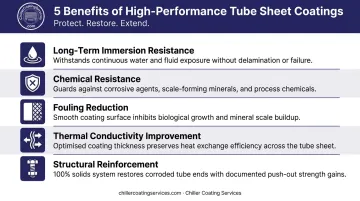
A high-performance tube sheet coating delivers multiple benefits beyond corrosion prevention:
- Long-term immersion resistance — survives continuous water-side service without delaminating
- Chemical resistance — protects against dissolved oxygen, scale chemistry, and acidic anti-scale treatments
- Fouling reduction — smooth coated surfaces limit adhesion of scale, biofilm, and deposits
- Thermal conductivity improvement — reduces inlet turbulence and improves flow characteristics
- Structural reinforcement — Chiller Coating Services' proprietary 100% solids system, for example, increases tube-to-tube-sheet push-out strength by over 1,000 pounds in some cases — a meaningful benefit when joint integrity has already been compromised by corrosion or erosion
One important caveat: Johnson Controls notes that epoxy coatings on waterboxes and tube sheets provide limited protection and require annual inspection and maintenance. Coatings are a maintainable barrier, not a permanent set-and-forget solution.
Surface preparation is equally critical. Chiller Coating Services blasts tube sheets to a white metal finish meeting SSPC-SP 5 / NACE No. 1 before coating — removing 100% of rust, scale, and contamination. Any residual corrosion product beneath the coating creates adhesion failures that allow galvanic activity to resume underneath the film.
Insulating gaskets, sleeves, and flange isolators serve a similar electrical isolation function at piping connections, preventing direct metal-to-metal contact between dissimilar materials. The VA hydronic piping master specification requires dielectric connections wherever dissimilar metals join — a standard worth applying beyond regulated contexts.
Material Selection and Compatibility
The galvanic series ranks metals by their electrochemical potential. The greater the potential difference between two coupled metals, the faster the anodic (less noble) metal corrodes. Copper and carbon steel, for instance, sit far apart on the galvanic series — a pairing that drives aggressive corrosion at tube sheet junctions.
Per ASTM G82, galvanic series rankings are electrolyte-specific — seawater tables don't map directly to treated chilled water, and no universal potential table exists for HVAC water chemistry.
The practical takeaway: during system design or retrofit, specifying metals with closer electrochemical potentials reduces galvanic risk without adding ongoing operational cost.
AMPP also flags that a small anodic area coupled to a large cathodic area is especially unfavorable — a geometry common in chiller tube sheets, where a relatively small exposed steel area contacts the large copper surface area of hundreds of tubes.
Chemical Inhibitors and Water Treatment
In closed-loop HVAC systems, corrosion inhibitors reduce galvanic potential and build protective films on metal surfaces. Sodium nitrite and sodium molybdate are common choices for steel protection; azole compounds protect copper alloys.
Federal UFGS guidance (UFGS 23 25 00) recommends monthly field testing of pH, inhibitor concentration, and conductivity, plus quarterly QA testing that includes total iron analysis and written evaluation.
Corrosion coupons for mild steel and copper should be analyzed every three months, with acceptable rates below 3 mpy for steel and 0.2 mpy for copper. Hitting those benchmarks assumes the treatment program is dialed in correctly — which isn't always straightforward. Two cautions apply: inhibitor concentrations are system- and specification-specific, so published "universal" targets don't translate reliably across different water chemistries. The NIH also notes that nitrite can feed denitrifying bacteria, making microbiological monitoring relevant alongside corrosion monitoring.
Cathodic Protection Systems
Two types of cathodic protection exist:
- Galvanic anode cathodic protection (GACP): Sacrificial anodes of zinc, magnesium, or aluminum corrode preferentially, protecting the base metal. Johnson Controls recommends magnesium anodes for freshwater systems showing corrosion, with a Trane service manual specifying inspection after 1–3 months and replacement once the anode has lost 50% or more of its original mass.
- Impressed current cathodic protection (ICCP): An external DC power source supplies protective current. AMPP recognizes both approaches, but verified HVAC heat exchanger applications for ICCP are limited — this method is better established for pipelines and marine assets.
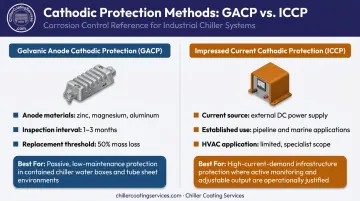
For most closed-loop chiller systems, protective coatings with compatible material selection and water treatment are the more practical primary strategy. Cathodic protection is a useful supplementary tool, particularly where coatings have holidays or defects.
Signs of Galvanic Corrosion in Your Chiller or HVAC System
Galvanic corrosion rarely announces itself until damage is well underway. These warning signs allow earlier intervention.
Performance and Efficiency Changes
Gradual efficiency losses are often the first detectable symptom:
- Rising energy consumption for the same cooling output
- Longer time to reach set-point temperatures
- Increasing pressure differentials across the heat exchanger
- Reduced chilled water flow rates
Compare actual performance against the chiller's clean baseline and OEM specifications. Because fouling and corrosion typically compound each other, no single anomaly confirms a diagnosis — look for patterns across multiple indicators.
Visible Physical Deterioration
During scheduled inspections, look for:
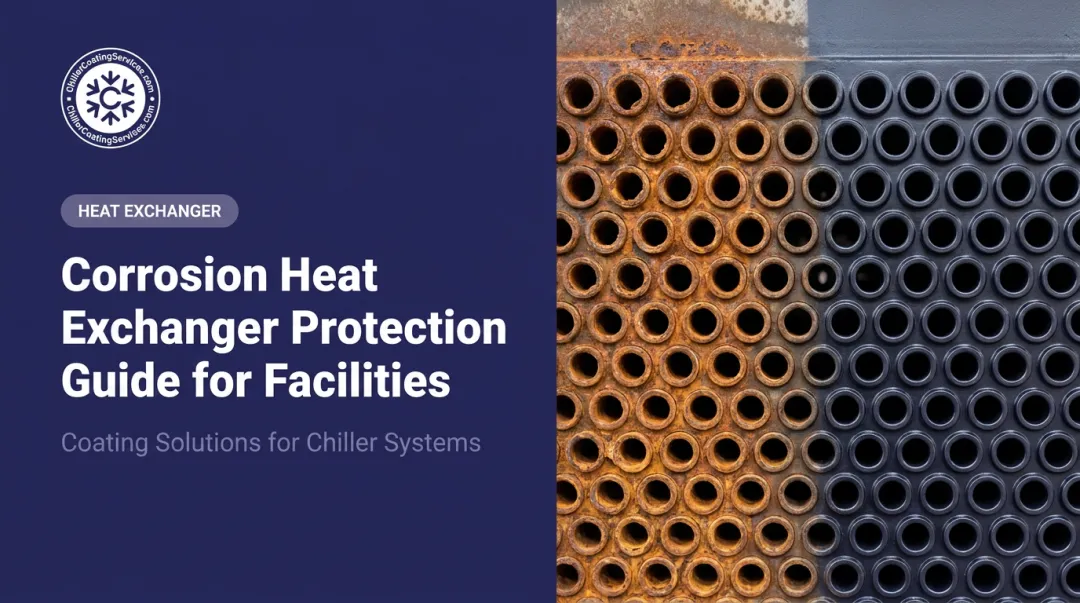
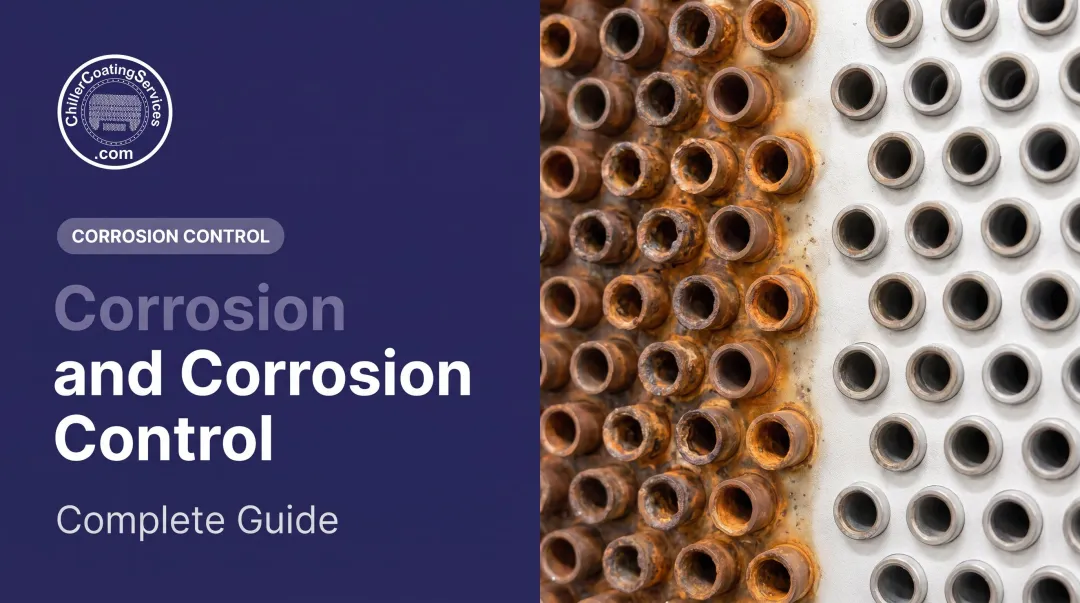
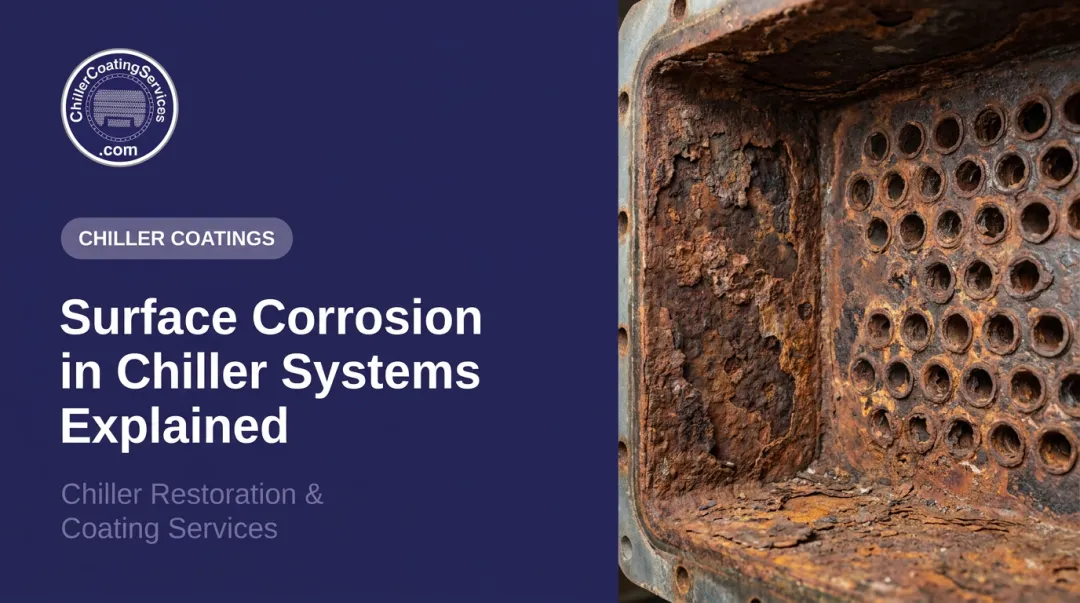
- Pitting, channeling, or cratering on tube sheet surfaces — in advanced cases, corrosion may have removed enough metal to require reconstruction before coating
- Discoloration, rust-colored deposits, or white mineral buildup around tube ends
- Thinning or undermining at tube-to-tube-sheet joints
- On previously coated surfaces: blistering, delamination, or pinhole failures indicating the coating barrier has been breached
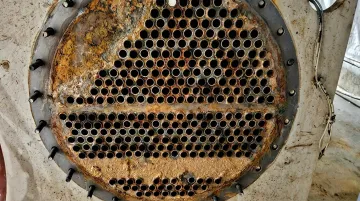
In field work at severely corroded sites, Chiller Coating Services technicians frequently find tube sheets with pitting deep enough to require full metal reconstruction before any protective coating can be applied.
Water Quality Indicators
Water chemistry is a sensitive early warning system:
- Iron, copper, or zinc concentrations higher in loop samples than in makeup water — a direct sign that system components are actively dissolving
- Inhibitor depletion accelerating beyond the expected treatment schedule, signaling corrosion is consuming chemistry faster than anticipated
- Cloudiness, rust particulates, or visible deposits in system water, indicating active corrosion or scale formation
Galvanic Protection Maintenance Schedule
The appropriate inspection frequency depends on system age, water chemistry, and the metals present. Even well-protected systems need regular checks to confirm protection integrity.
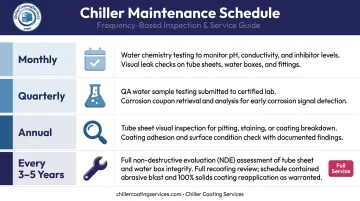
| Frequency | Tasks |
|---|---|
| Monthly | Test chilled water chemistry (pH, inhibitor concentration, conductivity, metal ion levels); log results; check for visible leaks or performance anomalies |
| Quarterly | QA water testing including total iron; analyze steel and copper corrosion coupons; review trends against acceptable corrosion rates |
| Annual | Visual tube sheet inspection during scheduled shutdown; check coating for blistering, disbondment, or mechanical damage; verify integrity of pipe insulating joints and flange isolators |
| Every 3–5 years | Full tube sheet assessment including nondestructive testing; recoat if protective coating shows wear; review water treatment program with a specialist |
These intervals are a baseline — three conditions warrant tightening the schedule:
- The initial inspection of a newly coated waterbox or tube sheet should occur after 1–3 months per Trane OEM guidance, to catch any early coating issues before they progress
- No fixed recoating interval is supported by OEM documentation — annual inspection with condition-based repair is the validated approach
- Systems in harsh water chemistry environments (high chloride, high conductivity, variable pH) or with a previous corrosion history should be inspected more frequently than standard intervals
Scheduling around these conditions also means choosing the right time of year. In New England and New York, fall and spring shoulder seasons are the most practical windows for tube sheet inspection and coating work — aligning service with planned chiller downtime rather than triggering an unscheduled outage.
Conclusion
Galvanic corrosion in chiller and HVAC systems is preventable, but only when protection is treated as an ongoing program rather than a one-time fix. The most resilient systems combine compatible material selection, effective electrical isolation, a monitored water treatment program, and regular inspection of coating and joint integrity. No single method does the job alone.
For facilities managers and engineers dealing with aging chiller fleets, the decision to act proactively comes down to simple math: the cost of a tube sheet inspection and coating service is a fraction of the cost of tube bundle replacement or unplanned chiller retirement.
We bring 40+ years of management experience to tube sheet coating, water box restoration, and corrosion repair across New England and New York, serving hospitals, data centers, universities, manufacturing facilities, and commercial properties from Massachusetts to New York City. Our three-step process restores corroded tube sheets and protects them for years of continued service:
- Deep cleaning to remove scale, biofilm, and corrosion deposits
- Contained abrasive blasting to a white metal finish
- Application of a 100% solids non-conductive protective coating
To discuss a specific chiller or schedule a free on-site assessment, contact Chiller Coating Services at (877) 427-0090 or visit their website.
Frequently Asked Questions
What does galvanic mean?
"Galvanic" refers to electrochemical reactions between dissimilar metals, named after Luigi Galvani. In corrosion, it describes how one metal degrades preferentially when in electrical contact with a different metal in the presence of an electrolyte, such as circulating chilled water.
What are the two techniques used for galvanic protection?
The two main techniques are galvanic anode cathodic protection (GACP), which uses sacrificial anodes, and impressed current cathodic protection (ICCP), which relies on an external DC power source. For most chiller systems, non-conductive protective coatings and electrical insulation are the more practical primary approach.
How does galvanic corrosion specifically affect chiller tube sheets?
When copper alloy tubes contact steel or cast iron tube sheets in circulating water, a galvanic cell forms that accelerates corrosion of the less noble metal, usually the tube sheet itself. This weakens tube-to-tube-sheet joints over time, reduces heat transfer efficiency, and can eventually cause leaks or joint failure.
Can coatings fully prevent galvanic corrosion in HVAC systems?
A properly applied non-conductive coating can effectively block the electrolytic pathway required for galvanic corrosion at tube sheets. However, coatings require periodic inspection and maintenance — coating damage or disbondment creates pathways for galvanic activity to resume, which is why annual inspection is essential.
What metals are most at risk from galvanic corrosion in HVAC systems?
Carbon steel and cast iron tube sheets paired with copper alloy tubes are among the highest-risk combinations in chiller systems. Aluminum components near copper or stainless steel connections also present significant galvanic risk due to the large electrochemical potential difference between these metals.
How often should chiller tube sheets be inspected for galvanic corrosion?
Plan for at least one visual inspection annually during scheduled maintenance shutdowns. Systems with aggressive water chemistry, highly dissimilar metals, or a corrosion history warrant more frequent checks. Newly coated systems should receive a follow-up inspection within 1–3 months of initial service.