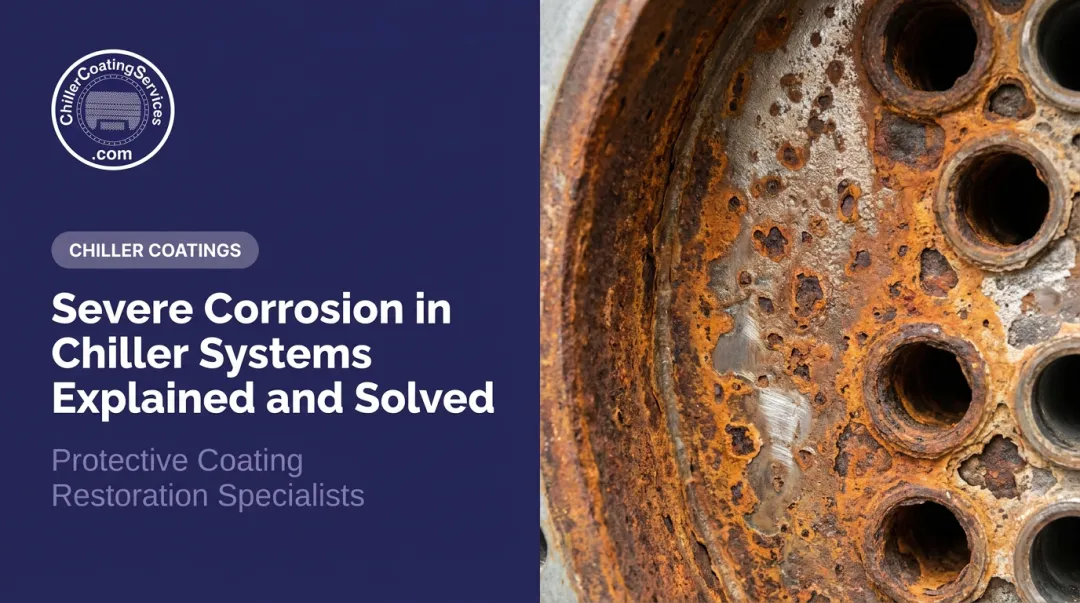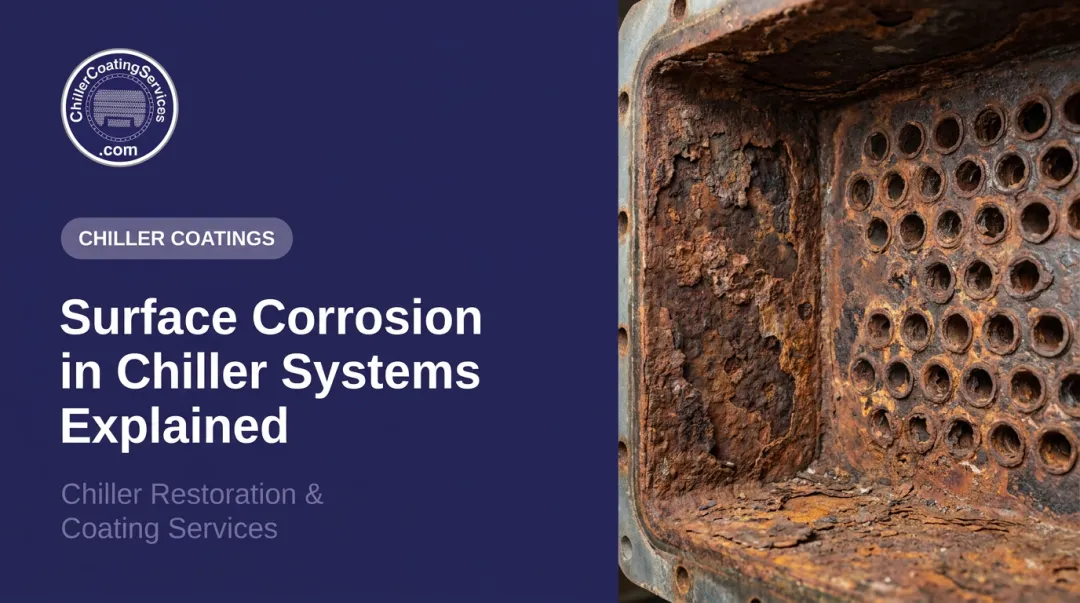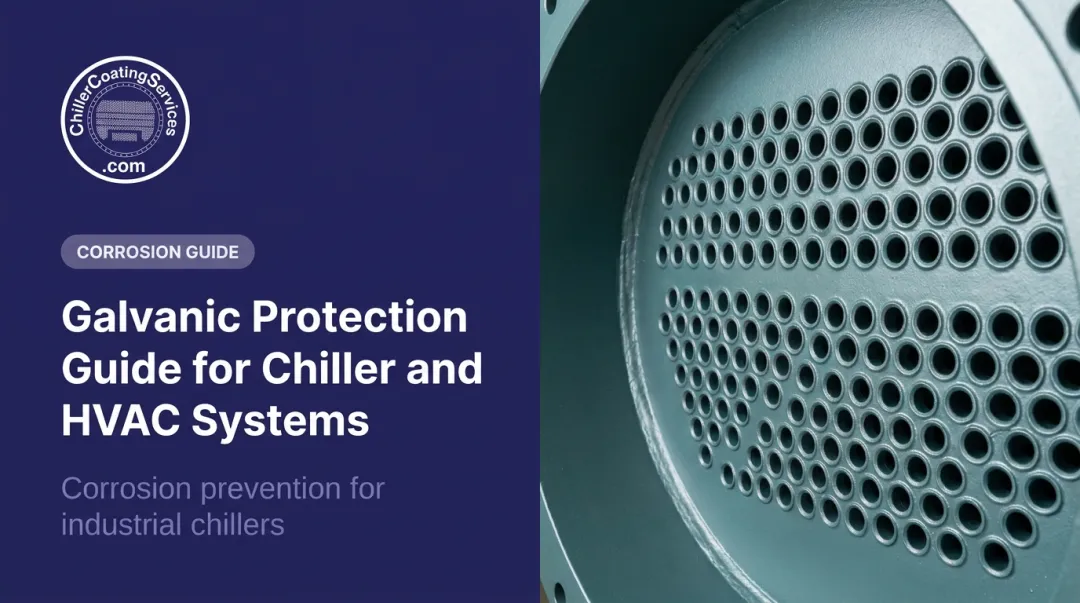
According to Trane, just 0.6 mm of scale on condenser tubes reduces heat-transfer efficiency by 34% and raises energy consumption by 21%. Corrosion-roughened surfaces accelerate that fouling process significantly.
The consequences of neglect compound quickly: degraded heat transfer, coolant contamination, tube-to-tube sheet joint failures, unplanned downtime, and — in the worst cases — premature chiller replacement. For hospitals, data centers, and manufacturing facilities, a failed chiller isn't just an inconvenience; it's an operational emergency.
This guide covers the four primary types of copper corrosion in chiller systems, how to recognize early warning signs, and the most effective protection strategies — including water chemistry management, dielectric isolation, and professional coating services.
Key Takeaways
- Chiller copper faces four distinct corrosion types — galvanic, pitting, erosion, and uniform — each requiring a targeted response
- Corrosion degrades heat transfer efficiency, weakens tube-to-tube sheet joints, and risks coolant contamination
- Protective coatings, water chemistry management, and dielectric isolation work best in combination
- Blue-green staining, discolored water, or unexplained pressure drops all signal active corrosion — inspect immediately
- Scheduled inspections and recoating cycles extend chiller service life and prevent costly unplanned failures
Why Copper Corrosion Protection Matters in Chiller Systems
The Efficiency and Structural Stakes
Copper's thermal conductivity is what makes it valuable in chiller heat exchangers. Any surface degradation — roughening from pitting, thinning from erosion, or deposit accumulation from corrosion — directly reduces the rate at which heat transfers across the tube wall. The U.S. Department of Energy quantifies the downstream consequence: 2.5%–3.5% more energy consumed for each 1°F increase in condenser temperature caused by fouling. Corrosion sets the stage for that fouling to accelerate.
The structural risk compounds the efficiency problem. Corrosion at tube-to-tube sheet joints weakens the mechanical bond until coolant migrates from the water side to the refrigerant side — contaminating the cooling circuit and, left unaddressed, driving the system toward full tube bundle replacement. That outcome is both costly and avoidable.
Financial and Operational Consequences
Reactive repairs cost far more than prevention — in dollars, downtime, and regulatory exposure:
- Unplanned outage repairs carry premium labor rates and unpredictable timelines
- A refrigerant contamination event from a tube leak requires far more than a simple patch
- Full tube bundle replacement pulls the chiller offline for weeks, not days
- Repeated corrosion events shorten equipment life well below its designed service span
For regulated facilities, the stakes extend beyond budget. Hospitals must maintain documented maintenance programs under Joint Commission and CMS requirements. Pharmaceutical manufacturers operate under FDA GMP mandates. A corroded chiller that causes a process interruption or triggers an audit finding creates liability that no reactive repair budget covers.
The sections below cover the specific strategies — water chemistry control, physical isolation, and surface coatings — that stop corrosion before it reaches the point of failure.
Types of Copper Corrosion in Chiller Systems
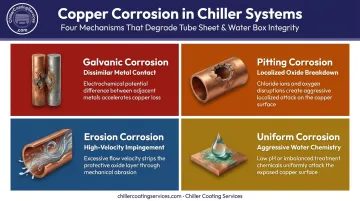
Copper corrosion in chillers isn't a single phenomenon. Several distinct mechanisms attack tube sheets, tube ends, and water boxes — each with different causes and warning signs.
Galvanic Corrosion
Galvanic corrosion occurs when copper contacts a dissimilar metal — steel water boxes, iron components, or fasteners of a different alloy — in the presence of an electrolyte like chiller water. The result is an electrochemical cell where the less noble metal (the anode) degrades preferentially.
In chillers, this shows up most destructively at tube-to-tube sheet joints, where copper tubes meet steel or cast-iron tube sheets. The joint interface becomes the site of accelerating metal loss, progressively weakening the bond that keeps tube ends seated. A non-conductive coating applied across the tube sheet face interrupts this electrolytic pathway entirely — no conductivity, no galvanic cell.
Pitting Corrosion
Pitting is localized breakdown of copper's protective oxide layer — creating small, deep craters that penetrate tube walls far faster than general thinning. Once a pit initiates, the chemistry inside it turns more aggressive, deepening the attack in a self-reinforcing cycle.
Water chemistry factors that drive pitting in chiller circuits include:
- Low pH (below the recommended operating range)
- High chloride ion concentration
- Dissolved oxygen in the cooling water
- Stagnant or low-flow zones where deposits concentrate
- Aggressive disinfectants that break down protective films
Erosion Corrosion
Erosion corrosion is the combined mechanical and electrochemical wear that occurs where water velocity is highest — tube inlets, bends, and tube sheet faces at inlet nozzles. High-velocity water impingement strips away the protective oxide layer faster than it can reform, exposing fresh metal to continuous attack.
Tube ends on the inlet side bear the worst of this damage. Smooth-surface coatings that reduce inlet turbulence and protect the tube-end geometry slow this wear mechanism considerably.
Uniform and Chemical Corrosion
Uniform corrosion is the general dissolution of copper driven by broadly aggressive water chemistry. Acidic water (low pH), high dissolved inorganic carbon, and oxidizing chemicals like chlorine and chloramine all accelerate the rate at which metal dissolves across the entire exposed surface.
This mechanism is slower than pitting or galvanic attack, but easy to miss until significant wall thickness is already gone. A tube sheet that has lost measurable thickness across its face is structurally compromised — even with no visible pits or active leaks.
Warning Signs of Copper Corrosion in Your Chiller
Catching corrosion early is the difference between a planned coating intervention and an emergency repair. These are the indicators that warrant immediate attention:
Performance anomalies:
- Declining cooling efficiency or rising energy consumption for the same cooling load
- Unexplained pressure drops across the heat exchanger
- Elevated approach temperature on the condenser that can't be explained by flow or load changes
Visual and water-quality indicators:
- Blue-green staining on tube sheets or water box interiors
- Discolored chiller water (blue or green tinge)
- Elevated copper ion levels in water analysis results
- Visible pitting on tube sheet faces
- Moisture or mineral deposits around tube-to-tube sheet joints
Maintenance pattern red flags:
- Increasing frequency of tube plugging
- Repeated joint sealing that fails to hold
- Worsening fouling despite consistent cleaning schedules
Maintenance pattern red flags deserve extra scrutiny because they signal active, ongoing deterioration — not isolated incidents. Plugging more tubes each year or re-sealing joints that failed the previous season means the underlying corrosion is advancing, not stabilizing.
Any combination of the signs above warrants a professional inspection to determine whether surface preparation and protective recoating can restore the equipment — before the damage reaches a point where replacement is the only option.
How to Protect Copper in Chiller Systems
Effective copper corrosion protection requires multiple layers. No single measure addresses all four corrosion mechanisms, and the best outcomes come from combining water chemistry management, physical isolation, and surface protection.
Water Chemistry Control
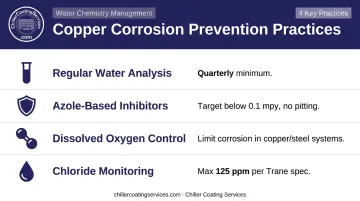
Water chemistry is the foundation. Trane specifies a pH range of 7.5–9.0 for chiller systems containing steel and copper components, with a maximum chloride concentration of 125 ppm. Keeping cooling water within those parameters significantly reduces the chemical aggressiveness that drives pitting and uniform corrosion.
Key chemistry management practices:
- Regular water analysis — at minimum quarterly for most systems, more frequently for high-risk or high-usage facilities
- Azole-based inhibitors for copper protection, with the target of keeping copper corrosion below 0.1 mpy with no pitting, as recommended by the Association of Water Technologies for systems with enhanced tubes
- Dissolved oxygen control — Trane specifically identifies low oxygen content as important for limiting corrosion damage in copper/steel systems
- Chloride monitoring — particularly for facilities drawing from municipal water supplies with aggressive chemistry or treating with chlorine-based disinfectants
Note that the pH and chloride limits above are Trane OEM specifications, not universal ASHRAE standards. Always verify applicable limits against your specific chiller model and treatment program.
Dielectric Isolation
Where copper contacts dissimilar metals — steel water boxes, iron piping, fasteners — dielectric unions, non-conductive fittings, or insulating gaskets interrupt the galvanic cell before it can form. This is straightforward to implement in new installations and in retrofits where component access allows it.
In older chillers where access is constrained, full dielectric hardware may not be practical. In those cases, a non-conductive epoxy coating applied to the tube sheet face and tube end interfaces achieves the same electrical isolation — physically eliminating the conductive pathway between copper and adjacent steel or iron.
Protective Coatings for Tube Sheets
Epoxy-based, 100% solids coatings applied to chiller tube sheet faces protect against corrosion, erosion, and cavitation in a single application. Unlike solvent-based systems that contain only 50–80% solids, the 100% solids formulation produces no shrinkage during cure and no VOC emissions.
The result is a structurally denser cured film that bonds more effectively to the substrate and holds up under continuous immersion.
What professional coating application delivers:
- Non-conductive barrier that eliminates galvanic pathways
- Chemical resistance against dissolved oxygen, scale chemistry, and anti-scale treatments
- Smooth surface that reduces inlet turbulence and inhibits fouling adhesion
- Reinforcement of tube-to-tube sheet joints, with push-out strength increases documented at over 1,000 pounds in some applications
Surface preparation is what separates durable results from field repairs that fail prematurely. Proper coating requires abrasive blasting to a white metal finish — SSPC-SP 5 / NACE No. 1 equivalent — removing all rust, mill scale, and contamination to expose clean, bondable metal.
Where severe corrosion has already degraded tube sheet thickness or joint integrity, reconstruction must precede coating. Applying a protective layer over compromised metal won't hold; the substrate has to be sound first.
Chiller Coating Services executes this three-step sequence — deep cleaning, contained abrasive blasting with reconstruction where needed, and proprietary 100% solids coating application — using quick-cure technology to minimize chiller downtime.
Regular Inspection and Monitoring
Visual inspections, water analysis, and non-destructive testing — particularly eddy current tube testing — catch developing corrosion before it progresses to structural failure. Trane specifies annual tube inspection and cleaning, with non-destructive testing every three years for standard service and more frequently for critical process applications.
Schedule inspections to align with seasonal startups and shutdowns, when the chiller is already offline and tube sheet access is straightforward. More important than the inspection schedule is what happens after: findings must drive action. Early pitting or coating degradation warrants one of the following responses:
- Adjusted water treatment chemistry to address the underlying cause
- Recoating of degraded tube sheet surfaces before corrosion advances
- Targeted tube plugging where individual tubes show wall loss or perforation
A finding logged but not acted on provides no protection.
Copper Corrosion Protection and Inspection Schedule
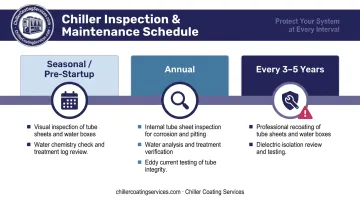
Inspection frequency depends on system age, operating hours, water quality, and facility type. A hospital running chillers year-round has very different needs from a seasonal retail complex. Use the schedule below as a baseline, then adjust based on your facility's specific risk factors.
| Frequency | Tasks |
|---|---|
| Seasonal / Pre-Startup | Visual inspection of tube sheets, water boxes, and joints for corrosion or staining; water chemistry test and inhibitor dosing check |
| Annual | Internal inspection of tube sheet surfaces and coating condition; water analysis review; eddy current tube testing when findings indicate it |
| Every 3–5 Years | Professional surface preparation and recoating where degradation is confirmed; dielectric isolation component integrity review |
Accelerate this schedule for:
- Coastal facilities with saltwater or salt-air exposure
- Systems using aggressive chlorine or chloramine disinfectants
- Older chillers with dissimilar metal assemblies showing visible galvanic damage
- Facilities with documented water quality challenges (high chlorides, low pH, elevated dissolved oxygen)
Extended intervals may be appropriate for:
- Well-maintained systems with consistently stable water chemistry
- Systems with documented low corrosion rates from regular water analysis
- Previously coated tube sheets confirmed to be in good condition
Conclusion
Copper corrosion in chiller systems is predictable and manageable. Facilities operators who combine water chemistry control, dielectric isolation, and professional coating services see measurably longer equipment service life and lower total maintenance costs — outcomes documented across structured preventive programs in hospitals, data centers, and manufacturing facilities alike.
The alternative is reactive: plugging tubes, re-sealing joints, and escalating repair costs — followed by a chiller retirement that arrives years ahead of schedule. Preventive coating programs routinely cost a fraction of a single emergency repair cycle, let alone early equipment replacement.
If your chiller shows any of the warning signs described in this guide — or if the tube sheets haven't been professionally inspected in more than a year — schedule an assessment before the next cooling season. Chiller Coating Services provides free on-site estimates across New England and New York. Reach them at (877) 427-0090 or through their contact form at chillercoatingservices.com/contact.
Frequently Asked Questions
What causes copper corrosion in chiller systems?
Copper corrosion in chiller systems typically stems from imbalanced water chemistry (low pH, high chlorides, dissolved oxygen), galvanic interaction with dissimilar metals like steel, high-velocity flow causing erosion at tube inlets, and aggressive disinfectants that break down the protective oxide layer. Most real-world failures involve several of these factors at once.
Is copper corrosion-proof?
Copper forms a natural protective oxide layer (patina) that provides baseline corrosion resistance. In chiller systems, however, that layer breaks down under aggressive water chemistry, galvanic exposure, or high-velocity flow — and without intervention, active corrosion follows. Corrosion-resistant is accurate; corrosion-proof is not.
What is the best protective coating for copper tube sheets?
100% solids epoxy coatings applied over a white-metal-blasted surface are the most durable option for copper tube sheets in chiller service. They resist corrosion, erosion, and chemical attack while creating a non-conductive barrier that prevents galvanic attack. Surface preparation to SSPC-SP 5 / NACE No. 1 is essential — any coating applied over inadequately prepared metal will fail prematurely regardless of product quality.
What is the best corrosion inhibitor for copper in chiller systems?
Azole-based inhibitors are commonly specified for copper protection in chiller circuits, targeting corrosion rates below 0.1 mpy with no pitting. The right product and dosage depend on your water chemistry, system metallurgy, and local water quality — a professional water treatment assessment will identify the correct inhibitor program for your specific system.
How often should chiller tube sheets be inspected for corrosion?
Perform visual inspections at each seasonal startup, a comprehensive internal inspection annually, and professional recoating every 3–5 years — or sooner if corrosion damage, coating breakdown, or water quality problems are identified. High-risk environments (coastal exposure, aggressive disinfectants, older equipment) warrant shorter intervals.
How does copper corrosion affect chiller efficiency?
Corrosion roughens tube and tube sheet surfaces, creating attachment points where scale and biofilm accumulate. That fouling acts as thermal insulation, forcing the chiller to work harder to achieve the same cooling output. The result is higher energy consumption, increased operating costs, and shortened equipment lifespan — all of which worsen the longer corrosion goes unaddressed.