This guide is written for facilities managers, building owners, plant engineers, and maintenance professionals who manage commercial or industrial equipment. You'll find clear explanations of how corrosion works, which types are most dangerous, what drives accelerated damage, and — most practically — which control strategies deliver the best protection.
The core message: corrosion is not inevitable. With the right knowledge and a proactive program, it can be managed, slowed, and in many cases, stopped before it becomes catastrophic.
Key Takeaways
- Corrosion costs the global economy $2.5 trillion annually, but up to 35% of those costs are preventable
- Six distinct corrosion types require different control strategies — identifying the type matters
- All four elements of a corrosion cell — anode, cathode, electrolyte, and metallic path — must be present for corrosion to occur
- No single control method works universally — layered approaches deliver the best outcomes
- Chillers and heat exchangers face heightened risk from dissimilar metals, constant moisture, and confined flow passages
What Is Corrosion and How Does It Work?
AMPP defines corrosion as the deterioration of a material — typically a metal — resulting from a chemical or electrochemical reaction with its environment. In plain terms: metal reacts with its surroundings and breaks down.
Two broad categories exist:
- Wet (electrochemical) corrosion — the most common type, requiring moisture or a conductive liquid to drive the reaction
- Dry (chemical) corrosion — occurs at high temperatures without liquid water, common in furnaces and exhaust systems
Most of what facilities professionals encounter in buildings, HVAC systems, and industrial equipment falls into the electrochemical category.
The Electrochemical Process Behind Corrosion
A corrosion cell works like a battery. Four elements must all be present:
- Anode — where metal oxidizes and is lost
- Cathode — where a reduction reaction occurs (the protected zone)
- Electrolyte — the conductive liquid connecting them (water, moisture, process fluid)
- Metallic path — a conductive connection between anode and cathode
Remove any one element and the corrosion process stops. This is the foundational principle behind most corrosion control strategies.
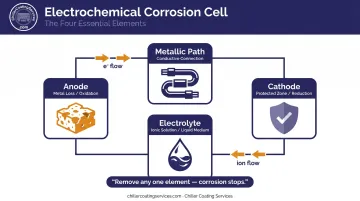
At the anode, metal atoms lose electrons, which is oxidation and where material loss happens. At the cathode, those electrons are consumed in a reduction reaction. The electron flow through the metal and ion flow through the electrolyte complete the circuit.
Water alone can act as an electrolyte. Several dissolved substances dramatically accelerate the process:
- Chloride ions — increase conductivity, promote pitting under low-flow conditions, and are a primary driver of stress corrosion cracking in stainless steels
- Dissolved oxygen — accelerates steel corrosion rates by sustaining the cathodic oxygen reduction reaction
- Dissolved salts and acids — lower resistance and speed up ion transfer through the electrolyte
Types of Corrosion
Corrosion is not a single phenomenon. Each type has different triggers, a distinct appearance, and demands a specific response. Misidentifying the type leads to the wrong control strategy.
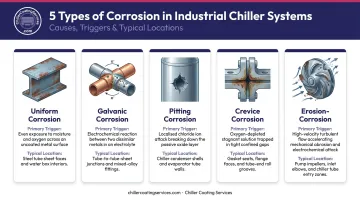
Here's how the most common forms compare at a glance:
| Corrosion Type | Trigger | Where It Appears |
|---|---|---|
| Uniform | General exposure to moisture/oxygen | Steel beams, tanks, exposed surfaces |
| Galvanic | Dissimilar metals + electrolyte | Tube-to-tube-sheet junctions, pipe fittings |
| Pitting | Localized breakdown of passive film | Pressure vessels, heat exchanger tubes |
| Crevice | Stagnant solution in confined spaces | Gaskets, bolted joints, lapped connections |
| Erosion-Corrosion | High-velocity fluid + oxide removal | Pump impellers, tube inlets, water box nozzles |
Uniform (General) Corrosion
Uniform corrosion spreads evenly across an exposed metal surface, like a steel beam rusting uniformly on all sides. It's the most common and most predictable form. Because it progresses at a measurable rate across the whole surface, it's also the easiest to monitor and plan around. Protective coatings and proper material selection are the primary defenses.
Galvanic Corrosion
Galvanic corrosion occurs when two dissimilar metals are in electrical contact in the presence of an electrolyte. The more active (anodic) metal corrodes faster than it would alone, while the more noble (cathodic) metal is protected.
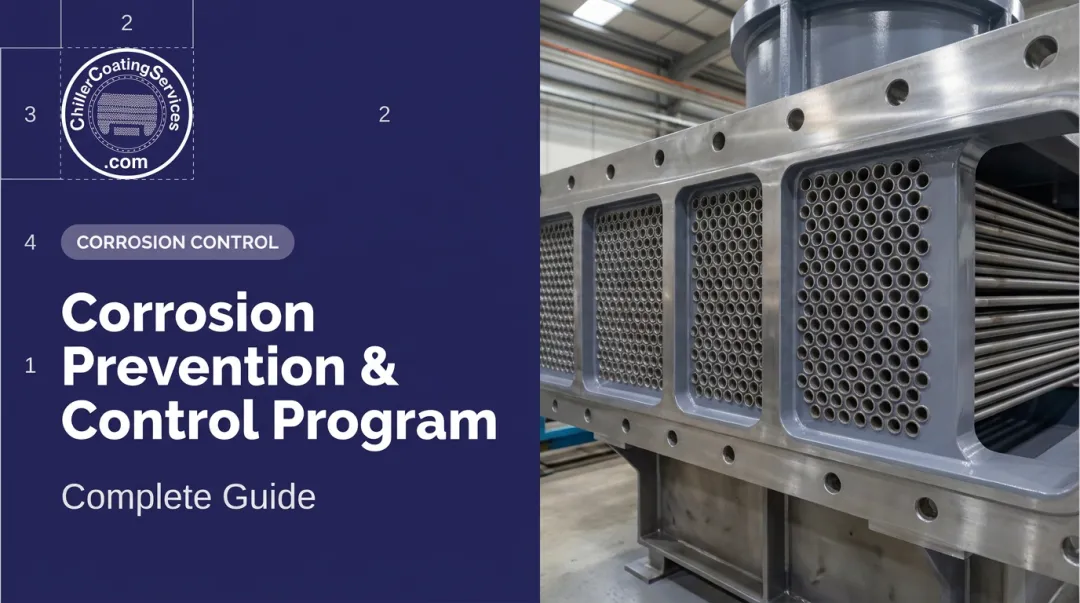
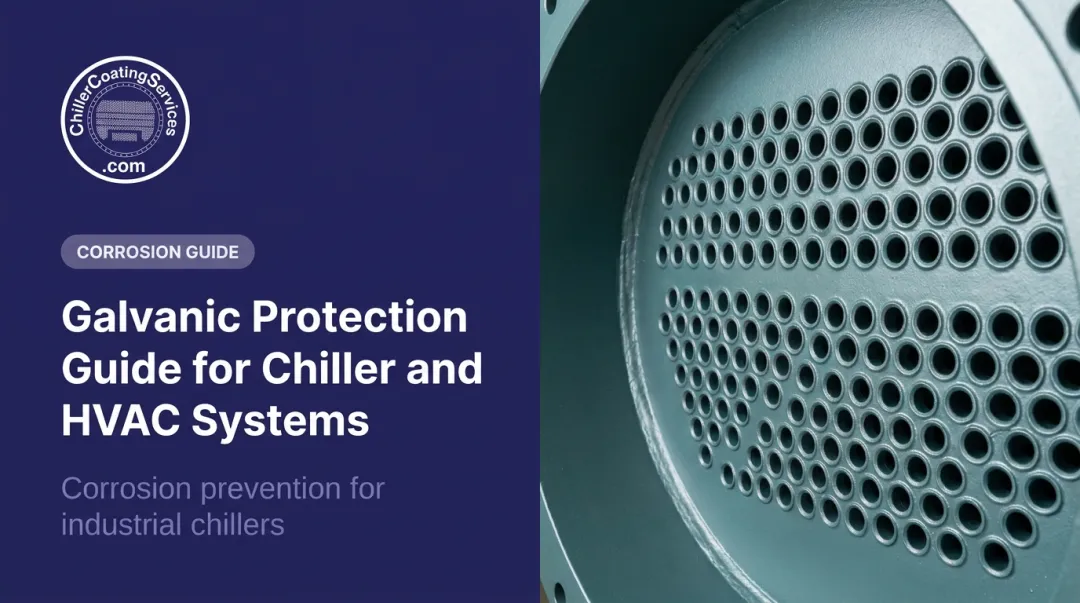
A practical example: copper tubes connected to steel fittings in a piping or heat exchanger system. With circulating water as the electrolyte, the steel acts as the anode and corrodes preferentially. This is one of the most common failure modes in commercial chiller and HVAC systems, where dissimilar metals meet at tube-to-tube-sheet junctions.
Pitting Corrosion
Pitting is localized corrosion that creates small cavities or holes in the metal surface. AMPP notes that pitting is more dangerous than uniform corrosion because it is harder to detect and predict. A component can appear largely intact while a small pit has penetrated through the wall, causing structural failure with minimal overall material loss.
This unpredictability makes pitting especially risky in pressure vessels, heat exchanger tubes, and chiller components.
Crevice Corrosion
Crevice corrosion develops in confined spaces (gaskets, bolted joints, lapped connections) where stagnant solution becomes depleted of oxygen. The chemistry inside the crevice shifts toward higher acidity and chloride concentration. This creates an aggressive local environment that attacks metal even when the surrounding bulk conditions are relatively mild.
Erosion-Corrosion and Cavitation
Erosion-corrosion combines mechanical wear with electrochemical attack, typically in high-velocity fluid systems. The fluid physically removes the protective oxide layer, exposing fresh metal to continuous corrosive attack.
Cavitation is a related mechanism: vapor bubbles form in low-pressure zones and collapse violently near metal surfaces, generating shock waves and microjets that cause pitting and surface fatigue. A 2024 peer-reviewed review confirmed that cavitation bubble collapse creates characteristic pit morphology and material removal in pumps and valves.
Both are relevant in chiller pump impellers, heat exchanger tube inlets, and water box nozzles.
Common Causes and Contributing Factors
Most corrosion failures in building and industrial systems trace back to identifiable root causes — environmental conditions, design decisions, and operational practices that compound over time.
Environmental Factors
- Relative humidity above 80% creates conditions for electrochemical corrosion — marine atmospheric research shows that hygroscopic salt deposits can initiate corrosion at even lower humidity through deliquescence
- Chloride deposition above 300 mg/m²/day can cause exfoliation of carbon steel rust layers, sharply increasing metal loss in coastal environments
- Acidic or alkaline pH in process water shifts corrosion rates dramatically
Material and Design Factors
- Dissimilar metals in contact without dielectric isolation
- Poor drainage design that allows water pooling on horizontal surfaces
- Inadequate surface preparation during installation, which leaves mill scale and corrosion products that undermine coating adhesion from day one
- Using standard carbon steel where the job calls for a corrosion-resistant alloy
Operational Factors
- High-velocity fluid flow that strips protective oxide layers (erosion-corrosion)
- Thermal cycling that introduces fatigue cracking, giving corrosion a path into the substrate
- Stray electrical currents from nearby buried structures, which can interfere with cathodic protection and accelerate attack
- Microbiologically influenced corrosion (MIC): a 2024 review found that MIC accounts for approximately 20% of total corrosion costs, driven by microbes that produce organic acids, hydrogen sulfide, and other corrosive metabolites in cooling systems
Effects of Corrosion: Costs and Consequences
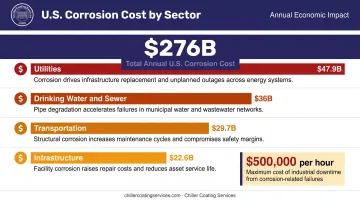
Corrosion costs U.S. industries $276 billion annually in direct costs alone — that figure comes from the most detailed sector breakdown available, a 2002 FHWA/NACE study that remains the primary reference for U.S. corrosion economics. The breakdown by sector:
- $47.9 billion — utilities
- $36 billion — drinking water and sewer systems
- $29.7 billion — transportation
- $22.6 billion — infrastructure
For facilities managers, these numbers translate to real operational consequences: unplanned downtime, emergency repair spending, and premature equipment replacement. Industrial downtime from equipment failures can cost up to $500,000 per hour according to ABB's 2025 estimates — and corrosion-induced failures are among the hardest to anticipate before damage is already underway.
The consequences extend beyond cost:
- Safety and structural risk — corrosion-induced failures in pressure vessels, pipelines, and structural supports can be catastrophic. A 2010 pipeline rupture in Marshall, Michigan resulted in approximately 320 people reporting symptoms from crude oil exposure
- Environmental liability — fluid leaks from corroded piping can contaminate water supplies and trigger regulatory action. EPA levied a $5 million civil penalty in a pipeline oil-spill settlement involving Sunoco and Mid-Valley Pipeline
- Regulatory exposure — in healthcare, pharmaceutical, food processing, and utility environments, corrosion-related equipment failures can trigger compliance failures on top of operational ones
Corrosion Control Methods
No single control method works universally. The most effective programs layer multiple approaches, and industry bodies including AMPP (formerly NACE International) publish standards that set the benchmark for each method.
Protective Coatings and Linings
Coatings act as a physical barrier between the metal surface and the corrosive environment. Their effectiveness depends on three factors in roughly equal measure: surface preparation quality, coating selection, and application precision.
Surface preparation is where most failures begin. SSPC-SP 5 / NACE No. 1 — the white metal blast standard — requires 100% removal of all visible rust, mill scale, coatings, and corrosion products. It's the most rigorous preparation standard available, and for good reason: as high as 80% of coating failures can be attributed to inadequate surface preparation, according to Sherwin-Williams' technical guidance.
Coating chemistry matters equally. 100% solids coating systems deliver advantages that solvent-based alternatives can't match:
- No solvent flash-off means no film shrinkage during cure
- No VOC emissions — important in occupied facilities
- Maximum film build per coat — a solvent-based 7-mil wet film may cure to only 3–3.5 mils after solvent evaporation; a 100% solids system delivers the full thickness
- No pinholes or microporosity from solvent vapor escaping through the wet film
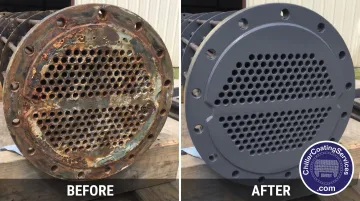
In chiller and heat exchanger applications, these properties are critical. Chiller Coating Services applies this approach to tube sheets, water boxes, tube ends, and heat exchanger components across New England and New York. Their three-step process covers deep cleaning, contained abrasive blasting to white metal finish, and proprietary 100% solids coating application — including reconstruction of severely corroded areas before any coating is applied, since coating over structurally compromised metal produces premature failure.
The non-conductive coating eliminates the electrolytic pathway between dissimilar metals at tube-to-tube-sheet junctions, stopping galvanic corrosion at its source. In documented cases, it has increased joint push-out strength by over 1,000 pounds — preventing the tube leaks that lead to refrigerant cross-contamination.
Cathodic Protection
Cathodic protection (CP) makes the entire metal surface act as a cathode by supplying electrons from an external source:
- Impressed current CP — uses an external DC power source to drive current through the system
- Sacrificial anode CP — attaches a more active metal (zinc, magnesium, aluminum) that corrodes preferentially, protecting the structure
CP is standard for pipelines, storage tanks, ship hulls, and underground structures. AMPP's SP0169 standard governs external corrosion control for underground and submerged metallic piping systems.
Material Selection and Design Changes
Choosing the right material upfront eliminates many corrosion problems entirely:
- Stainless steel, titanium, and duplex alloys resist corrosion in environments that would rapidly attack carbon steel
- Non-metallic materials (composites, plastics, FRP) can be appropriate where chemical exposure is extreme
- Eliminating crevices in joint design, ensuring proper drainage, and avoiding dissimilar metal contacts are equally important engineering decisions
Design modifications are essentially free during the engineering phase. The same changes, retrofitted after construction, can cost orders of magnitude more — if they're feasible at all.
Corrosion Inhibitors
Inhibitors are chemicals added to process fluid or environment to reduce corrosion rate. Three categories:
- Anodic inhibitors (chromate, nitrite, molybdate, orthophosphate) — form protective films at the anode
- Cathodic inhibitors (zinc salts) — precipitate at cathodic sites, blocking the reduction reaction
- Mixed inhibitors — address both sites simultaneously
Common applications include cooling water systems, boiler feedwater, HVAC closed-loop circuits, and oil and gas pipelines. Copper-alloy azoles such as benzotriazole protect copper and brass surfaces specifically.
Environmental Control
Controlling the environment that drives corrosion is often more cost-effective than hardening the metal:
- Dehumidification in storage areas reduces time-of-wetness below the threshold for electrochemical activity
- Deaeration of process water reduces dissolved oxygen, directly cutting corrosion rates
- pH control in cooling and process water keeps chemistry out of the aggressive range
- Filtration removes chlorides and other aggressive ions before they reach metal surfaces
Corrosion in Industrial Building Systems and HVAC Equipment
HVAC chillers and heat exchangers concentrate nearly every corrosion risk factor in one place: constant water-side exposure, dissolved oxygen, thermal cycling, and dissimilar metal contact between tubes and tube sheets. Few industrial environments combine all four simultaneously.
What Chiller Corrosion Looks Like in Practice
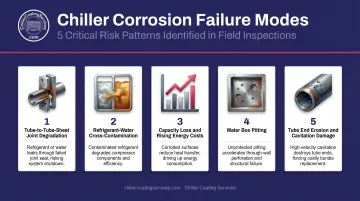
Based on Chiller Coating Services' inspection experience across facilities in Massachusetts, New York, Connecticut, and the broader New England region, the most commonly observed failure modes include:
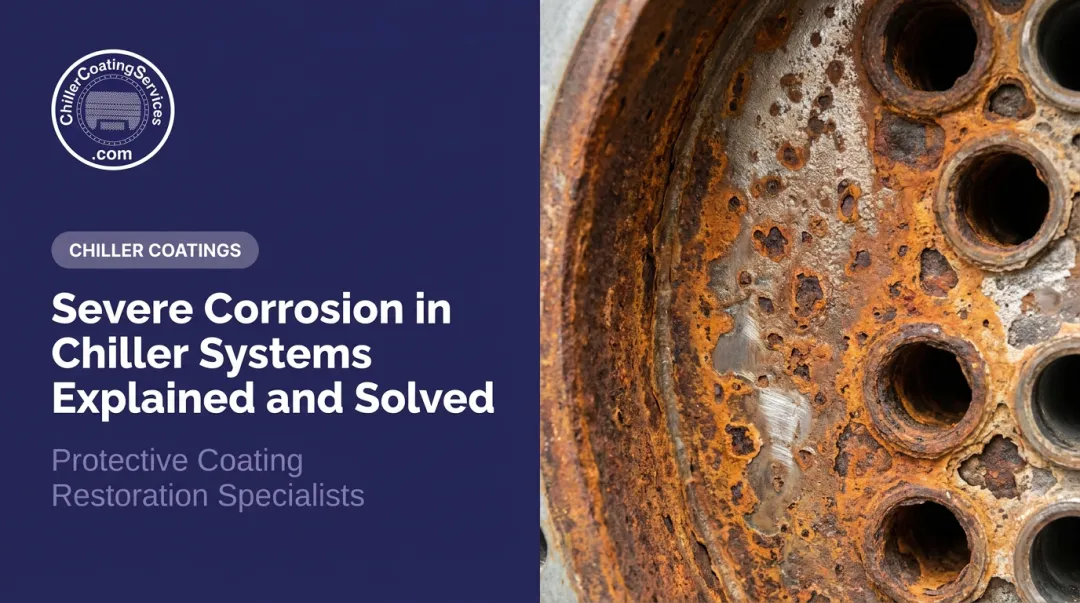
- Tube-to-tube-sheet joint degradation — galvanic and pitting corrosion at the dissimilar metal junction progressively weakens joint push-out strength until leaks develop
- Refrigerant-water cross-contamination — once joint leaks form, refrigerant contamination risk requires complete tube bundle replacement or chiller retirement if not caught early
- Capacity loss and rising energy costs — pitting and surface roughness disrupt laminar flow and reduce thermal conductivity, directly increasing cost per ton of cooling
- Water box pitting — high-turbulence inlet and outlet zones suffer impingement erosion and corrosive water chemistry simultaneously
- Tube end erosion and cavitation damage — particularly on inlet-side tube ends, where velocity is highest
Trane's maintenance guidance notes that heat exchanger tubes can suffer internal pitting from aggressive water elements, and eddy-current testing is used to detect these defects before they cause failures.
A Proactive Approach vs. Reactive Replacement
A full chiller replacement is a major capital event — often six figures before project management and downtime costs are included. Protective coating of tube sheets, water boxes, and tube ends — performed during a planned maintenance window — is a fraction of that cost and extends serviceable life by years.
Carrier recommends condenser tube scanning every five years. For facilities with aggressive water chemistry or older equipment, that interval may be too long without protective coating in place between inspections.
Chiller Coating Services schedules work around planned downtime windows — fall and spring shoulder seasons for most facilities, summer breaks for schools and universities, and redundancy-aware mobilizations for data centers operating on N+1 or 2N configurations. Quick-cure proprietary coating technology keeps equipment offline for the minimum necessary time.
Every completed project includes documented service records structured to support compliance audits across facility types: Joint Commission and CMS for healthcare, ISO and FDA/GMP for manufacturing and life sciences, NERC for utilities, and SOC 2 for data centers.
For facilities across New England and New York managing aging chiller fleets, an inspection now costs far less than an emergency replacement later.
Frequently Asked Questions
What are the most common types of corrosion in industrial and commercial settings?
Uniform, galvanic, pitting, and crevice corrosion are the most prevalent. Galvanic and pitting corrosion are especially common in HVAC heat exchangers and chiller systems, while crevice corrosion appears in bolted joints and gasket interfaces across most building and industrial equipment.
What is the difference between corrosion prevention and corrosion control?
Prevention eliminates the conditions that cause corrosion — through material selection, design changes, or environmental controls — before exposure begins. Control manages and slows corrosion in systems already operating in corrosive environments, using coatings, inhibitors, or cathodic protection.
How do protective coatings prevent corrosion?
Coatings create a physical barrier that isolates metal from moisture, oxygen, and corrosive agents. Effectiveness depends heavily on surface preparation — inadequate prep is responsible for the majority of premature coating failures, regardless of coating quality.
What causes galvanic corrosion in HVAC and chiller systems?
Galvanic corrosion occurs when dissimilar metals — such as copper tubes and a carbon steel tube sheet — are in electrical contact within a conductive fluid, causing the more active metal to corrode preferentially. Applying a non-conductive coating to the tube sheet face and tube ends eliminates the electrolytic pathway and stops the reaction.
How often should commercial or industrial equipment be inspected for corrosion?
Annual inspection is the minimum, with visual checks after significant thermal or operational events. For high-humidity environments or systems with known water chemistry challenges, fall and spring seasonal inspections — aligned with planned chiller maintenance windows — are the practical standard.
What is the most cost-effective corrosion control strategy for building equipment?
Protective coatings combined with a scheduled inspection and water treatment program typically deliver the best return. They prevent emergency repairs and premature equipment replacements that cost far more than proactive maintenance — and they work best before corrosion has caused structural metal loss.