For facilities managers and building engineers, this isn't a theoretical concern. Biological growth in commercial systems compounds quietly, degrading indoor air quality, eroding heat transfer efficiency, and accelerating corrosion on expensive equipment. Understanding what drives it — and how to systematically prevent it — is the difference between proactive management and costly remediation.
Key Takeaways
- Biological growth in HVAC systems covers mold, bacteria (Legionella included), algae, and biofilm — not just the visible stuff
- Excess moisture, standing water, organic debris, and poor drainage are the primary triggers
- Biofilm on heat exchanger surfaces measurably reduces thermal efficiency and drives corrosion
- Early signs include musty odors, visible staining on vents or coils, and occupant health complaints
- Effective prevention layers moisture control, routine cleaning, UV-C treatment, and protective surface coatings
Common Causes of Biological Growth in HVAC Systems
Biological growth in HVAC systems refers to colonization by mold, bacteria such as Legionella, algae, and multispecies biofilm communities. These organisms need only three things: moisture, organic nutrients, and a surface. In commercial systems, all three are almost continuously present.
Excess Moisture and Condensation
Condensation forms naturally on evaporator coils and other cold surfaces during normal cooling operation. The problem begins when that moisture doesn't drain promptly.
Common failure points include:
- Clogged condensate drain lines that allow water to back up into the drain pan
- Malfunctioning or poorly sloped drain pans that hold standing water rather than directing it out
- Intermittently operated systems where moisture sits without evaporation between cycles
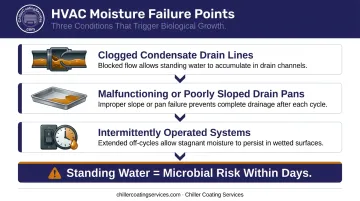
Wet surfaces can begin supporting microbial colonization within days. The EPA's moisture control guidance identifies cooling coils, drain pans, condensate lines, and downstream duct surfaces as the primary moisture-risk locations in commercial HVAC systems.
Organic Debris and Dust Accumulation
Moisture alone isn't enough — organisms also need a nutrient source. Dust, pollen, insulation fibers, and organic particles that enter through air intakes or leaky ductwork provide exactly that.
This issue is more pronounced in:
- Buildings near vegetation-heavy environments where pollen and debris loads are elevated
- High-traffic commercial facilities generating elevated indoor dust levels
- Systems with aging or degraded filter banks that allow particulate bypass
Poor Drainage and System Sizing
Undersized or aging drain pans, corroded pan surfaces, and inadequate slope angles all contribute to standing water — the single most reliable predictor of biofilm formation.
Oversized cooling equipment creates another significant problem: short-cycling. An oversized unit satisfies the sensible cooling load quickly and shuts off before the coil has adequately removed humidity. EPA research shows that humidity loads at peak outdoor dew point can run 30–100% higher than at peak dry-bulb conditions — meaning a system sized only for temperature will regularly leave excess moisture in the air and ductwork.
What Happens If Biological Growth Is Left Unmanaged
Biological growth in a commercial HVAC system isn't a cosmetic issue. It degrades air quality and mechanical performance simultaneously, and the consequences compound the longer it goes unaddressed.
Health and Regulatory Risk
Mold and bacteria distributed through air ducts can trigger respiratory symptoms, allergic reactions, and eye and throat irritation. The stakes are considerably higher when Legionella colonizes cooling towers or chilled water systems. A 2022 CDC investigation in Napa County identified 14 confirmed and 3 suspected cases of Legionnaires' disease — including one death — potentially linked to a cooling tower with documented maintenance deficiencies and low disinfectant residuals.
For hospitals, schools, and office buildings, this creates direct compliance exposure. CMS requires Medicare-certified hospitals and nursing homes to maintain water-management policies specifically addressing Legionella risk, and the Joint Commission's Environment of Care standards require documented evidence of preventive maintenance.
Efficiency and Equipment Degradation
Beyond the health risk, biological growth directly attacks system efficiency. Biofilm on heat transfer surfaces acts as an insulating layer: a laboratory heat-exchanger study found that a biofilm of 200–250 micrometers — developed over 40 days — produced 27 ± 3% heat loss in that test condition. A separate HVAC coil study measured 3.0–6.4% improvement in wet-coil heat-transfer effectiveness when UV treatment controlled microbial fouling.
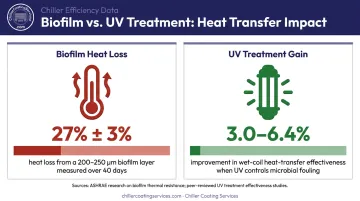
These figures aren't universal benchmarks, but they confirm that even thin biofilm layers on evaporator coils or chiller tube sheets force systems to run harder, draw more energy, and fall short of rated cooling capacity.
Corrosion Acceleration
Many biofilm-forming organisms, particularly sulfate-reducing bacteria, produce organic acids and create localized electrochemical conditions that accelerate corrosion of metal surfaces. In water-side HVAC components like tube sheets and water boxes, this corrosion progresses from surface pitting to leaks, which can result in refrigerant-water cross-contamination requiring tube bundle replacement or full chiller retirement.
Chiller Coating Services' field experience reflects this consistently: biofilm is a routine finding during pre-restoration cleaning of tube sheets, water boxes, and heat exchanger interiors. Biofilm removal is a named, standardized step in their surface preparation process — not an occasional exception.
Warning Signs to Watch For
Biological growth is often detected late because affected components are enclosed. Recognize these indicators early:
- Musty or earthy odors from supply air vents, especially when the system first starts or after periods of inactivity
- Visible discoloration — black, green, or gray staining — on duct registers, drain pans, coil fins, or accessible internal surfaces
- Occupant health complaints that correlate with time spent in the building and improve when occupants leave the building
How to Prevent Biological Growth in HVAC Systems
No single measure eliminates biological growth risk in a commercial HVAC system. A layered approach — combining moisture control, professional cleaning, treatment technologies, and surface protection — is what creates a durable barrier against colonization.
Condensate and Drain System Management
What to do: Inspect and flush condensate drain lines, verify drain pan slope and cleanliness, and confirm all drainage pathways are fully functional.
How it helps: Eliminating standing water removes the primary initiation condition for biofilm formation. Even small accumulations allow microbial colonization within days.
When to implement: Before the start of each cooling season and again mid-season for high-use commercial systems. ASHRAE/ACCA Standard 180-2018 specifies quarterly checks of AHU drain pans, drain lines, coils, and P-traps as the commercial baseline.
Regular Professional Inspection and Cleaning
What to do: Schedule inspections by qualified technicians covering evaporator coils, blower assemblies, drain pans, and air handler interiors — not just filter replacement.
How it helps: Mechanical removal of biofilm, dust, and organic debris eliminates both the growth medium and existing colonies before they spread or degrade performance.
When to implement: At minimum annually for commercial systems. Semi-annually for healthcare facilities, schools, and high-humidity environments. The EPA recommends professional cleaning when substantial visible microbial growth is confirmed — and specifies that the moisture source must be corrected first.
Chiller Coating Services performs deep cleaning of chiller tube sheets, water boxes, and air handler interiors as part of its restoration process — removing biofilm, scale, and corrosion deposits before abrasive surface preparation and coating application begin.
UV-C Light Systems and Antimicrobial Treatment
What to do: Install UV-C germicidal lights in air handling units, positioned to irradiate coil surfaces and drain pans. Consider EPA-registered antimicrobial coatings on internal surfaces after professional cleaning.
How it helps: A double-blind crossover study in three office buildings found that UV-C reduced surface microbial and endotoxin concentrations by 99% (95% CI: 67–100%) on cooling coils and drip pans. UV-C works continuously between scheduled cleanings; antimicrobial coatings provide a residual inhibiting effect on treated surfaces.
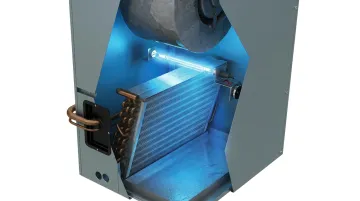
Important caveat: UV-C performance depends on geometry, surface wetness, lamp dose, and maintenance. It works best as a supplement to drainage control and cleaning — not a replacement for them. Note also that EPA requires any antimicrobial HVAC product to list that specific use on its label; generic hard-surface claims don't qualify for duct or coil applications.
When to implement: UV systems are permanent installations; antimicrobial treatments follow deep cleaning events.
Protective Coatings for Internal HVAC Surfaces
Apply professional-grade protective coatings to vulnerable internal surfaces — heat exchanger tube sheets, coil casings, drain pans, and water box interiors. Smooth, chemically resistant barriers resist microbial adhesion and slow fouling accumulation at the surface level.
Rough or corroded surfaces give biofilm-forming organisms anchoring points to establish colonies. Research on heat exchanger tubes has measured biofilm-thickness differences up to 74% across varying surface roughness conditions — confirming that surface condition directly influences fouling resistance.
Chiller Coating Services applies 100% solids epoxy coating systems to chiller tube sheets, water boxes, evaporator and condenser surfaces, and air handler drain pans and casings. The 100% solids formulation cures without solvent flash-off or shrinkage, producing a denser, more continuous film than solvent-based alternatives — a non-porous barrier that gives microorganisms no surface defects to exploit for adhesion.
The coating system provides documented chemical resistance to acidic water chemistry and long-term immersion conditions. Reduced fouling is a directly documented outcome across tube sheet, heat exchanger, and air handler services.
When to implement: During scheduled maintenance windows. Quick-cure technology allows application with minimal system downtime.
Tips for Long-Term Prevention and Control
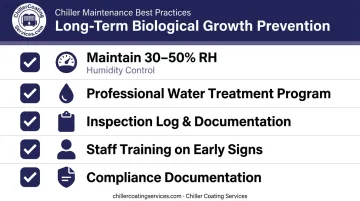
Biological growth doesn't stop after a single remediation. Keeping it under control across a commercial HVAC system's full service life depends on consistent, documented practices:
- Maintain indoor humidity between 30–50% RH — the range recommended by the EPA. Use building automation systems or standalone dehumidification equipment to maintain this year-round, particularly in humid climates.
- Implement a professional water treatment program for systems with cooling towers or chilled water loops. This covers chemical dosing, filtration, blowdown management, and Legionella controls per ASHRAE Standard 188-2021.
- Keep an inspection log for each HVAC unit — dates, findings, corrective actions. Recurrence patterns often point to unresolved root causes like persistent drainage design deficiencies.
- Train maintenance staff to recognize early signs of biological growth, follow a documented inspection checklist, and know when to escalate to professional remediation.
- Maintain compliance documentation — in regulated environments, this isn't optional. Hospitals (Joint Commission, CMS), pharma facilities (FDA/GMP), data centers (SOC 2), and utilities (NERC) all require documented maintenance records. Chiller Coating Services generates service records formatted to meet audit requirements across these regulated verticals.
Conclusion
Biological growth in commercial HVAC systems follows a predictable pattern: moisture accumulates, organic matter provides nutrients, and microbial communities establish themselves on surfaces that are rarely inspected until something fails. This pattern is also controllable.
For facilities serving large occupant populations — hospitals, schools, office buildings, data centers — proactive management delivers measurable results across several fronts:
- Protects occupant health by reducing airborne microbial load
- Supports regulatory compliance for Joint Commission, OSHA, and facility audit requirements
- Preserves system efficiency and extends equipment service life
- Avoids the significantly higher cost of remediation or premature equipment replacement
Consistent protocols are what separate facilities that manage biological growth from those that react to it. Schedule inspections, document findings, and treat coil surfaces and drain pans before contamination takes hold — not after.
Frequently Asked Questions
What is biological growth in HVAC?
Biological growth in HVAC refers to the colonization of system components — including coils, drain pans, ducts, and air handlers — by mold, bacteria, algae, and biofilm. These organisms thrive wherever HVAC systems create warm, moist, and dark conditions with available organic nutrients from dust and debris.
Does microbial growth mean mold?
Microbial growth is a broader term that includes mold but also includes bacteria such as Legionella, algae, and multispecies biofilm communities. Mold is the most visually recognizable form, but bacterial colonization in water-side components can be equally or more dangerous in commercial systems.
How much does microbial growth treatment cost?
Treatment costs vary depending on contamination extent, system size, and whether the scope involves remediation, UV system installation, or protective coating. Contact a qualified service provider for a site-specific assessment.
Where does biological growth most commonly occur in HVAC systems?
The most common sites are evaporator coils, drain pans, condensate lines, and air handler interiors. In commercial systems, cooling tower basins and chiller tube sheets are also high-risk zones due to their combination of moisture, warmth, and organic debris.
Can biological growth in HVAC affect system efficiency?
Yes. Biofilm and fouling on heat transfer surfaces act as insulating layers that reduce thermal efficiency and force systems to work harder. Even thin biofilm accumulation on chiller tubes or evaporator coils measurably increases operating costs over time.
How often should commercial HVAC systems be inspected for biological growth?
Annual professional inspections are the baseline minimum. Healthcare, educational, and high-humidity facilities should inspect semi-annually. Building staff should also conduct monthly visual checks of accessible components like drain pans and vent registers between formal inspections.