Chiller systems are particularly vulnerable. Closed loops, mixed metals, temperature differentials, and recirculating water chemistry all create conditions where pitting can initiate and advance quietly over months or years. Facilities managers and engineers who understand the root causes have a real advantage — not because pitting is inevitable, but because it's preventable when you know where to look.
Key Takeaways
- Pipe pitting forms deep, hidden voids that go undetected until a leak forces emergency repairs
- The four primary causes are poor water chemistry, galvanic corrosion between dissimilar metals, MIC from biofilm-forming bacteria, and cavitation
- ASHRAE Standard 180 requires quarterly chemical testing and annual heat-exchange surface checks for closed systems
- Protective coatings applied to tube sheets, tube ends, and water boxes interrupt both galvanic and electrochemical pitting mechanisms
- Sustained prevention depends on documented schedules, trained staff, and early-detection protocols
Common Causes of Pipe Pitting in Chiller Systems
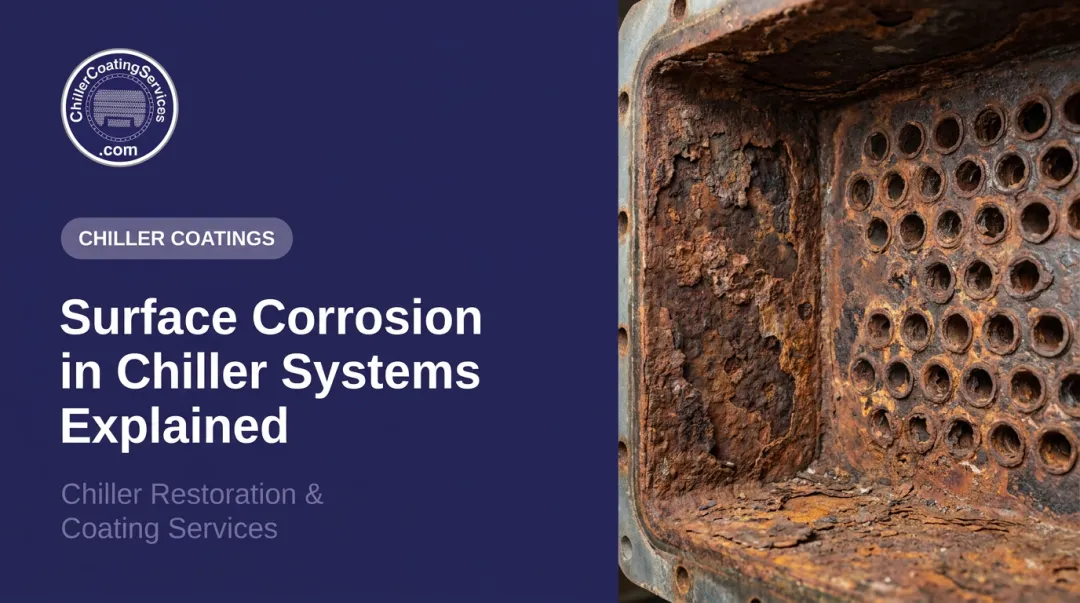
AMPP defines pitting as localized corrosion that produces cavities or holes in metal surfaces — damage that is more difficult to detect, predict, and design against than uniform corrosion because the corrosion products often cover the pit opening. A small amount of total metal loss can still perforate a pipe wall or create a stress concentration point that leads to failure.
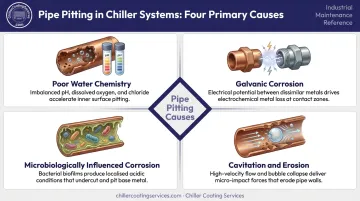
In chiller systems, pitting rarely has a single cause. It typically results from a combination of water chemistry conditions, electrochemical interactions, biological activity, and mechanical forces acting simultaneously.
Poor Water Chemistry and pH Imbalance
When pH drifts outside the appropriate range for the system's metallurgy, the protective oxide layer on pipe interiors breaks down. AWT's training parameters list a typical closed-loop pH of 8.0–10.5 for steel systems, with a narrower range when aluminum components are present (manufacturer-dependent, often 7.5–8.5). Operating outside these ranges exposes bare metal to aggressive chemical attack.
Additional chemistry contributors include:
- Dissolved oxygen introduced through makeup water, leaks, or inadequate air removal, sustains the cathodic reaction that drives pitting on steel surfaces
- High chloride or sulfate levels destabilize the passive film and accelerate pit initiation, particularly at existing surface defects
- Inhibitor depletion Corrosion inhibitors in closed loops must be maintained at specific concentrations; seasonal water makeup events or system modifications can deplete them faster than scheduled replenishment
Galvanic Corrosion from Dissimilar Metals
Most chiller systems contain multiple metals: copper alloy tubing, carbon steel piping, brass fittings, and sometimes aluminum components. When these metals contact each other in the presence of an electrolyte (the circulating water), galvanic cells form.
The general active-to-noble order in aqueous environments is aluminum → carbon steel → brass → copper, though actual behavior depends on water chemistry, temperature, and surface films.
The anodic metal corrodes preferentially, often as pitting concentrated at the transition zone. In closed-loop systems, the same water recirculates continuously, allowing ion concentrations to build near galvanic sites and accelerating pit growth over time. A small anodic area coupled to a large cathodic area makes the attack especially severe.
Microbiologically Influenced Corrosion (MIC)
AMPP defines MIC as corrosion accelerated by microorganisms — not a distinct corrosion type, but a mechanism that intensifies localized attack. Sulfate-reducing bacteria (SRB) generate sulfide-related corrosive conditions in anaerobic zones beneath biofilm. Iron-oxidizing bacteria create iron-rich deposits; differential conditions beneath those deposits concentrate attack and initiate pitting.
Several operational gaps raise MIC risk significantly:
- Biocide dosing is inconsistent or skipped during off-seasons
- Systems sit idle for extended periods
- Water temperatures are in ranges favorable to bacterial growth
MIC pits are often clustered and can be mistaken for other corrosion forms. Bulk water chemistry can appear normal while localized conditions beneath a biofilm are chemically aggressive — making MIC one of the harder failure modes to catch through routine monitoring alone.
Cavitation and High-Flow Erosion
Cavitation occurs when local fluid pressure drops below vapor pressure, causing vapor bubbles to form and then collapse violently in higher-pressure regions. The Hydraulic Institute identifies this as a driver of impeller damage, noise, and performance loss. That same bubble collapse mechanism strips protective oxide films from pipe surfaces near pump inlets, valve transitions, and pipe bends.
High-velocity turbulent flow at pipe inlets and constrictions can also cause erosion-corrosion pitting independent of cavitation. Improper pump sizing and poor system balancing are common contributors in commercial chiller installations. Both conditions force pumps to operate away from their best-efficiency point, increasing adverse recirculation and hydraulic loading on vulnerable surfaces.
What Happens If Pipe Pitting Goes Unaddressed
Because pitting advances inward while the outer pipe surface appears intact, it's routinely missed during visual inspections. The first visible sign is often a coolant leak — at which point facilities face:
- Emergency repairs during peak cooling season
- Water damage to surrounding infrastructure
- System flushing and recharging after coolant contamination
- Risk of refrigerant-side contamination if tube walls fail in a shell-and-tube chiller
The costs extend well beyond the repair itself. Pit deposits and biofilm reduce heat-transfer efficiency, drive up pump energy consumption, and accelerate the deterioration of tube sheets and water boxes that protective coating could have preserved.
Catching deterioration before it reaches this point requires knowing what to look for. These warning signs give facilities teams a window to act before an emergency forces the issue.
Warning Signs of Active Pipe Pitting
- Discolored chiller water — brown, orange, or cloudy water indicates iron oxide or corrosion byproducts in the loop, an early signal of active pitting on steel surfaces
- Unexplained pressure or flow loss — gradual decline without a visible external leak can point to seepage at pit perforations or flow restriction from deposit buildup
- Out-of-range water chemistry — pH drift, faster-than-expected inhibitor depletion, or elevated chloride and conductivity levels are chemical precursors to pitting; high turbidity and metal-ion concentrations above makeup-water baseline are additional indicators of active corrosion
No single indicator confirms pitting on its own, but each one justifies immediate investigation. Waiting for a second sign means the damage is already further along.
How to Prevent Pipe Pitting in Chiller Systems
Effective prevention requires multiple layers working in concert: chemistry management, physical barrier coatings, and regular inspection. Each addresses a different failure pathway, and none alone is sufficient.
Water Treatment Program and Chemistry Monitoring
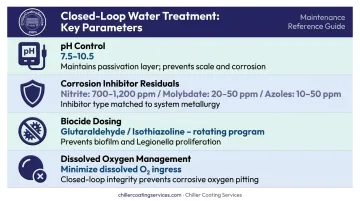
A properly managed closed-loop water treatment program is the first line of defense. Key program elements:
- pH control — maintain within the range appropriate for system metallurgy (8.0–10.5 for steel systems; narrower for aluminum)
- Corrosion inhibitor residuals — AWT training parameters include nitrite (800–1,600 ppm as NaNO₂), molybdate (250–500 ppm as MoO₄), and azoles (10–50 ppm) for copper-alloy components; actual targets are program- and metallurgy-specific
- Biocide dosing — glutaraldehyde, isothiazoline, and TTPC are typical closed-loop biocide chemistries; maintain consistent dosing to prevent biofilm establishment
- Dissolved oxygen management — control makeup water introduction and ensure adequate air removal to limit oxygen ingress
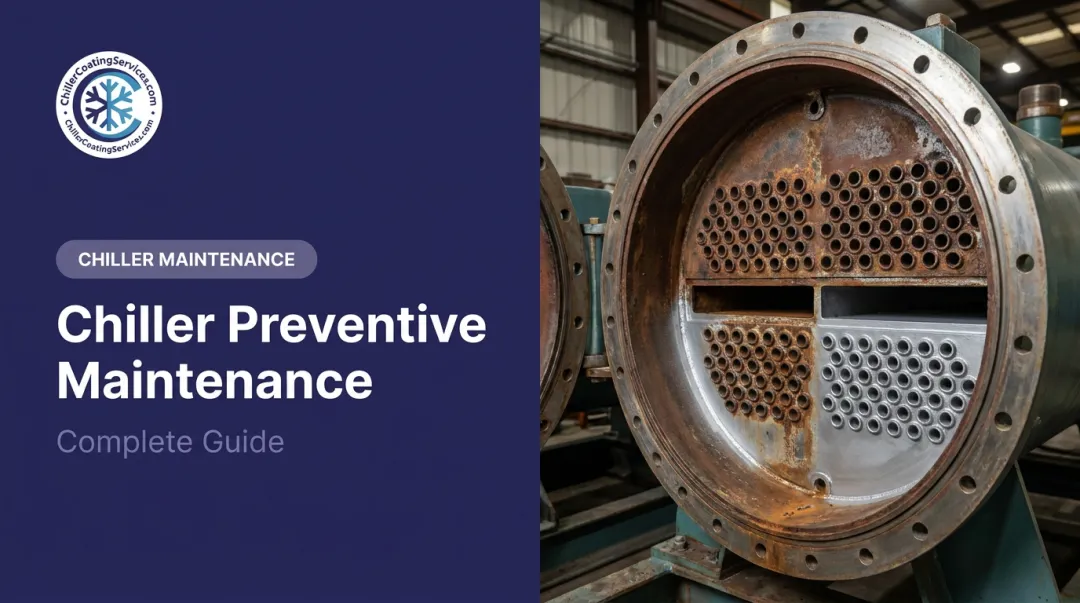
ASHRAE Standard 180 specifies quarterly chemical testing for closed systems and an annual check of heat-exchange surfaces for fouling, corrosion, or degradation. Treat these as minimums, not targets — systems with a history of chemistry issues warrant monthly testing.
Document every reading. Trend data is more valuable than any single result, and it's what allows you to catch inhibitor depletion or pH drift before pitting initiates.
Protective Coatings for Vulnerable Surfaces
Protective coatings create a physical and electrochemical barrier between metal surfaces and the chiller water, interrupting the galvanic circuit and eliminating the exposed substrate that pitting requires to initiate.
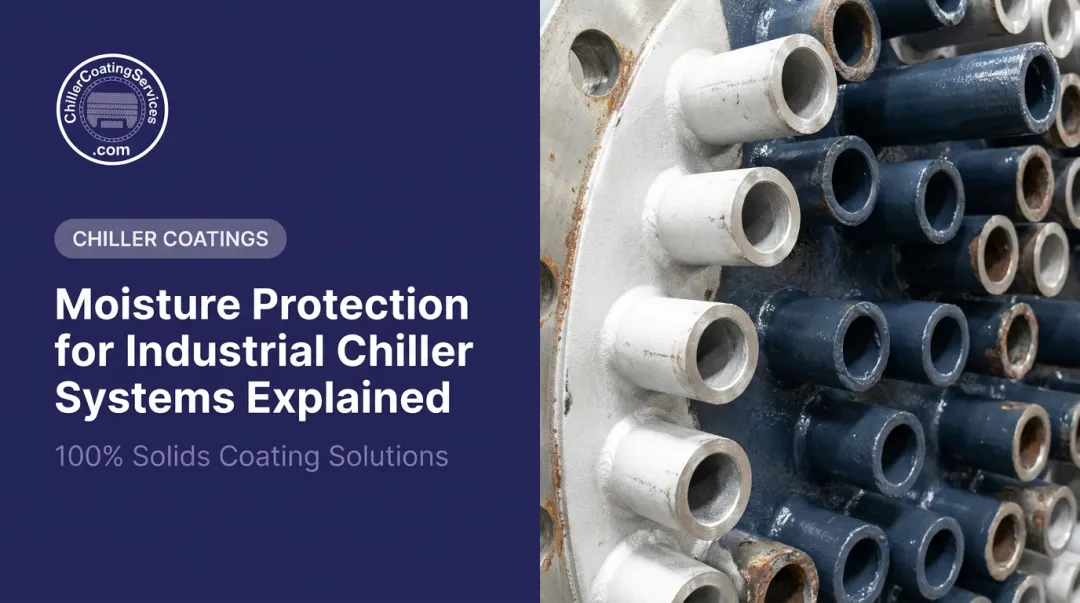
Chiller Coating Services applies a proprietary 100% solids epoxy system to tube sheets, tube ends, water boxes, condenser and evaporator surfaces, and the dissimilar metal transition zones where galvanic corrosion concentrates most.
The 100% solids formulation matters technically: unlike solvent-based coatings that contain only 50–80% solids and lose volume during cure, 100% solids systems deliver maximum film build per coat with zero shrinkage and no VOC emissions.
The coating functions as a non-conductive barrier — eliminating the electrolytic pathway between dissimilar metals and protecting against pitting, erosion, and cavitation damage simultaneously. In tube-to-tube-sheet joint applications, documented push-out strength increases exceed 1,000 pounds in some cases, which means the coating also reinforces the joint rather than just protecting it.
Surface preparation is non-negotiable. AMPP's NACE No. 1 / SSPC-SP 5 white-metal blast standard requires complete removal of all rust, mill scale, oxides, and foreign matter — bare, uniformly bright metal.
Chiller Coating Services' process includes contained abrasive blasting to this standard, with reconstruction of severely corroded areas before coating is applied. Coating over structurally compromised metal produces premature failure; damaged metal must be restored first.
Coatings serve two roles: preventive application on recently inspected systems, and rehabilitation for surfaces already showing early-stage pitting. At advanced stages — perforations or significant structural metal loss — section replacement is typically required before coating becomes viable.
Regular Inspection and Early Detection
Schedule periodic internal inspections using borescope or camera equipment to assess pipe interiors for pit formation, deposit buildup, and biofilm.
Supplement visual inspection with ultrasonic thickness testing (UTT) at high-risk locations — pump inlets, pipe bends, valve transitions, and dissimilar metal junctions — to measure remaining wall thickness where surface access is limited.
Inspection frequency should scale with risk. Critical facilities like hospitals and data centers warrant semi-annual review. Most commercial chiller systems benefit from annual inspection as a baseline.
System Design and Material Compatibility
Where system upgrades or repairs allow, design choices can reduce pitting risk from the start:
- Material selection — choose pipe and fitting materials with compatible electrochemical potentials to minimize galvanic driving force
- Dielectric unions — where dissimilar metals must be joined, dielectric unions interrupt the galvanic circuit at the transition point
- Pump sizing and system balance — operate near the best-efficiency point; the Hydraulic Institute links cavitation prevention directly to maintaining adequate NPSHA above NPSHR within the preferred operating region
Tips for Long-Term Prevention and Control
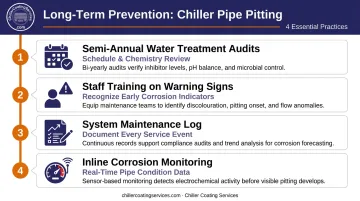
A documented maintenance program turns one-time fixes into lasting protection. Build yours around these practices:
- Schedule semi-annual or annual water treatment audits with a certified provider to review inhibitor performance, biocide efficacy, and overall chemistry trajectory
- Train operations staff to recognize early warning signs — discolored water, pressure anomalies, chemistry drift — and establish escalation protocols so problems are addressed before pipe integrity is compromised
- Maintain a system log recording water chemistry results, inhibitor dosing dates, inspection findings, and repairs — trend analysis across this data reveals whether a pitting problem is isolated or systemic
- Consider inline corrosion monitoring for larger or higher-criticality installations — continuous pH and conductivity tracking flags chemistry drift before damage can initiate
Even with a rigorous prevention program in place, pitting that has already progressed into pipe walls or tube sheets requires physical intervention — not just chemistry adjustments. Professional surface preparation and protective coating restore compromised metal and create a barrier against future corrosion cycles.
Conclusion
Pipe pitting in chiller systems has identifiable causes — water chemistry imbalances, galvanic reactions between dissimilar metals, biofilm activity, and mechanical erosion — and each one responds to the right countermeasure.
Facilities teams that invest in preventive water treatment, protective coatings, and routine inspections avoid the far greater costs of emergency repairs, unplanned downtime, and premature equipment replacement. For hospitals, data centers, manufacturing facilities, and any operation that depends on continuous chiller performance, surface protection and corrosion repair before failure occurs is far less disruptive — and far less expensive — than the alternative. If pitting is already visible on tube sheets, water boxes, or condenser surfaces, professional assessment and coating restoration can stop the damage before it reaches the point of equipment replacement.
Frequently Asked Questions
What is pitting in a pipe?
Pipe pitting is a form of localized corrosion that creates small, deep holes or cavities in the pipe wall. Unlike uniform corrosion, pitting concentrates damage in isolated spots, making it hard to detect until a leak develops.
What causes pitting corrosion in chiller pipes?
The main causes in chiller systems are poor water chemistry and pH imbalance, galvanic corrosion between dissimilar metals, microbiologically influenced corrosion from biofilm-forming bacteria, and cavitation or high-velocity flow erosion at vulnerable pipe sections. These mechanisms typically act in combination.
How can you tell if chiller pipes have pitting corrosion?
Early warning signs include discolored or rust-tinged chiller water, unexplained pressure or flow drops, and out-of-range water chemistry readings during routine testing. Borescope inspection or ultrasonic thickness testing can confirm pitting before a visible leak occurs.
Can pitting corrosion in chiller pipes be repaired without full replacement?
Early-stage pitting can often be addressed through surface preparation, reconstruction of lost metal, and application of a protective 100% solids coating. Pipes with perforations or severe structural metal loss typically require section replacement before coatings can be applied effectively.
How often should chiller pipes be inspected for pitting?
Most commercial chiller systems benefit from annual inspection, while critical facilities like hospitals or data centers may warrant semi-annual review. Frequency should also increase for older systems or any system with a history of chemistry problems.
Does water treatment prevent pipe pitting in chiller systems?
A properly managed closed-loop water treatment program is one of the most effective defenses against pipe pitting. Maintaining correct pH, corrosion inhibitor levels, dissolved oxygen control, and biocide dosing all matter — and the program works best when paired with physical protection like coatings and regular inspection.