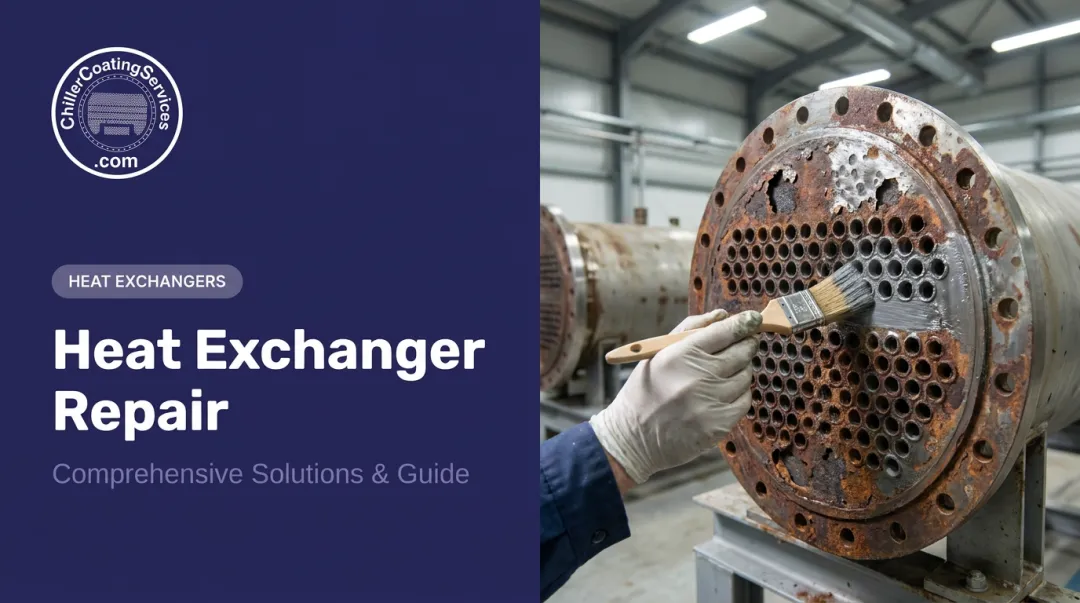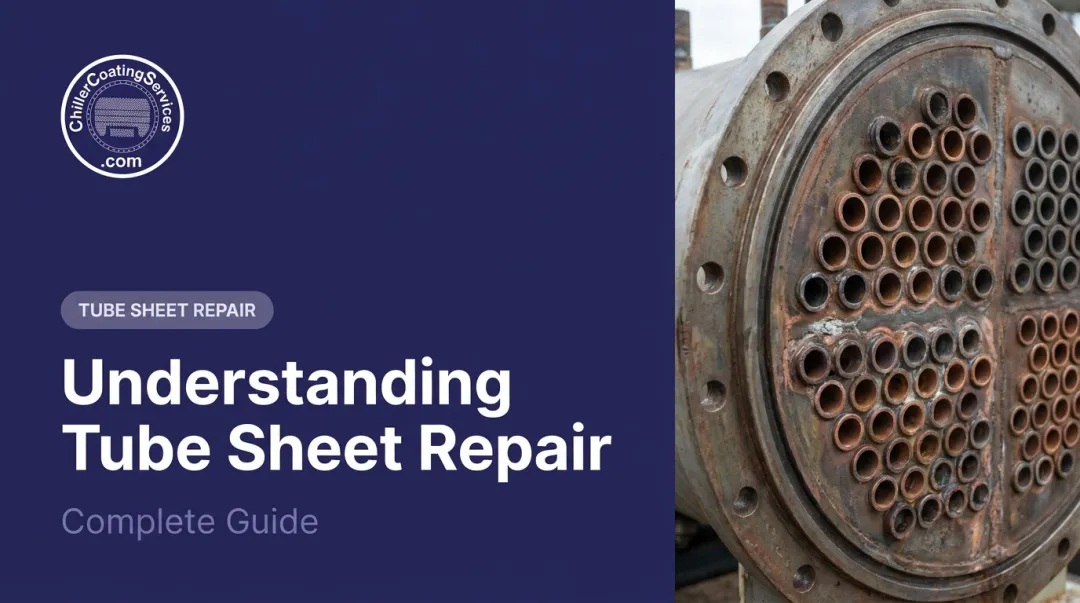
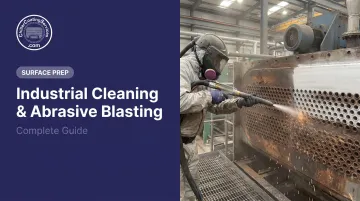
According to Sherwin-Williams, up to 80% of coating failures can be attributed directly to inadequate surface preparation. That single statistic frames everything in this guide.
Here's what this guide covers: what industrial cleaning and abrasive blasting are, how the core methods and media differ, what safety and compliance requirements govern these operations, and why surface preparation is the foundation every coating project stands on.
Key Takeaways
- Up to 80% of industrial coating failures trace back to inadequate surface preparation, not coating quality
- Abrasive blasting removes rust, mill scale, and contaminants while creating a surface profile that coatings bond to mechanically
- White metal blast (SSPC-SP 5 / NACE No. 1) is the highest cleanliness standard, required for high-performance coatings in immersion or corrosive service
- Media selection depends on substrate type, contaminant, and environmental constraints — options include steel grit, garnet, crushed glass, and soft abrasives
- Sand is no longer used as blasting media due to serious silica dust health hazards
What Is Industrial Cleaning?
Industrial cleaning refers to the systematic removal of contaminants from industrial surfaces — steel, concrete, metal equipment, tanks, and structural components — to prepare them for protective coatings or restore them to serviceable condition. This is a different discipline from commercial or janitorial cleaning. The goal isn't aesthetics; it's surface condition.
Contaminants targeted in industrial cleaning include:
- Rust and corrosion products
- Mill scale (the iron oxide layer formed during steel manufacturing)
- Oil, grease, and chemical deposits
- Old or failed coatings
- Scale and mineral deposits from water chemistry
- Biofilm and biological fouling
AMPP — the Association for Materials Protection and Performance, formed from the 2021 merger of NACE International and SSPC — sets the standards that define industrial surface preparation and distinguish it from routine maintenance. Those standards are the industry reference whenever coating adhesion and equipment longevity are at stake.
Where Industrial Cleaning Is Required
Industrial cleaning is essential in virtually every sector where coated metal or concrete assets are in service:
- Power plants and utilities: condensers, heat exchangers, and auxiliary equipment operating under continuous thermal stress
- Hospitals and healthcare facilities: chiller systems and mechanical piping where contamination carries compliance risk
- Manufacturing and process facilities: tanks, structural steel, and process chillers exposed to chemical and moisture cycling
- Data centers: cooling components where unplanned downtime is not an option
- Schools and commercial buildings: aging HVAC equipment that rarely gets attention until corrosion forces the issue
Surface condition drives coating performance. That's why the methods used to achieve it — and the standards that define acceptable results — matter as much as the coating itself.
What Is Abrasive Blasting and How Does It Work?
Abrasive blasting (also called blast cleaning or shot blasting) is a surface preparation process that propels abrasive media at high velocity against a surface to remove contaminants, rust, old coatings, and mill scale.
OSHA defines it as using compressed air or water to direct a high-velocity abrasive stream to clean an object or surface, remove burrs, apply texture, or prepare a surface for coating. The EPA's version is simpler: the use of abrasive material to clean or texturize metal or masonry.
The Mechanics of Surface Blasting
An air compressor or centrifugal blast wheel accelerates small abrasive particles that strike the surface at high speed. Two things happen at once:
- Removes contaminants — rust, mill scale, old coatings, and deposits are broken apart and dislodged
- Creates a surface anchor profile — microscopic peaks and valleys form in the metal surface, giving coatings a mechanical grip point
According to the U.S. Bureau of Reclamation's coatings guide, a profile too shallow reduces adhesion, while one that's too deep can create pinpoint rusting risk. The coating manufacturer's data sheet specifies the required profile depth — cleanliness grade and profile depth are separate requirements, and both must hit spec.
Applying coatings over inadequately prepared surfaces creates voids between coating and substrate. Those voids allow moisture and oxygen beneath the coating, triggering under-film corrosion that progresses invisibly until significant damage has already occurred.
Surface Cleanliness Standards
The industry uses AMPP (SSPC/NACE) and ISO standards to define specific cleanliness grades:
| Cleanliness Level | SSPC/NACE Standard | ISO 8501-1 |
|---|---|---|
| Brush-off blast | SSPC-SP 7 / NACE No. 4 | Sa 1 |
| Commercial blast | SSPC-SP 6 / NACE No. 3 | Sa 2 |
| Near-white blast | SSPC-SP 10 / NACE No. 2 | Sa 2.5 |
| White metal blast | SSPC-SP 5 / NACE No. 1 | Sa 3 |
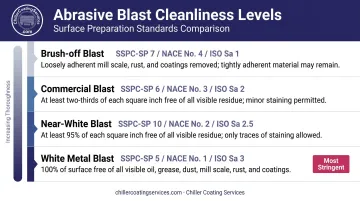
White metal blast is the most thorough — it removes all visible rust, mill scale, coatings, oxides, and contaminants to expose bare, bright metal.
Types of Abrasive Blasting Methods and Equipment
No single method fits every application. The right choice depends on substrate, contaminant severity, dust constraints, and facility sensitivity.
Dry Blasting (Pneumatic / Pressure Blasting)
The most common method. Compressed air propels abrasive media through a blast nozzle at the target surface. Dry blasting delivers aggressive cutting action, making it the workhorse for heavy rust removal, mill scale removal, and deep surface profiling on steel and iron.
Dust generation is the main trade-off. Dry blasting produces significant airborne particulate, requiring proper containment, ventilation, and PPE. In occupied or sensitive facilities, this requires a well-engineered containment system before blasting begins.
Wet / Dustless Blasting
Wet blasting mixes water with abrasive media, or uses water alone at extreme pressure (ultra-high-pressure water blasting). This significantly reduces airborne dust — EPA data shows wet blasting control efficiencies of 50% to 93% depending on configuration, and even a simple water curtain at the nozzle cuts airborne dust by 50% to 75%.
Wet blasting is the preferred approach in occupied facilities, near sensitive machinery, or wherever dry blasting dust control is impractical. One practical consideration: wet blasting leaves bare metal briefly exposed to moisture, requiring rapid coating application or flash rust inhibitors.
Centrifugal (Wheel) Blast Systems
Mechanical systems use high-speed rotating wheels to throw abrasive media against the surface. Designed for high-volume, continuous production environments (structural steel fabrication shops, for example), wheel blast systems process large quantities of material efficiently. Key advantages at scale:
- Abrasive is recyclable, keeping per-cycle costs low
- No compressed air required, reducing energy overhead
- Consistent, repeatable surface profiles across large batches
Specialized Methods
Three niche methods serve specific applications:
- Dry ice blasting: CO₂ pellets sublimate on contact, leaving no secondary waste. Ideal for sensitive electronics or food processing equipment — but note this is a cleaning method only, not a profiling method, and creates no anchor profile
- Soda blasting: Sodium bicarbonate media for gentle cleaning, paint removal, and degreasing on delicate surfaces like engine parts or soft metals
- Sponge blasting: Reusable sponge abrasive media designed for controlled environments where dust generation must be minimized
Key Equipment Components
The blasting equipment itself is only part of the system:
- Blast nozzles and hoses — sized and rated for the operating pressure and media flow
- Dust collection systems — fabric filters (baghouse) or cyclone collectors capture airborne particulate; OSHA requires exhaust from blast-cleaning equipment to discharge through dust-collecting equipment
- Media reclaim systems — recover and recycle spent abrasive, reducing waste and operating cost
- Containment solutions — blast rooms, blast cabinets, and portable enclosures protect surrounding areas, workers, and the environment from abrasive media and dust
Common Abrasive Blasting Media: Types and Selection
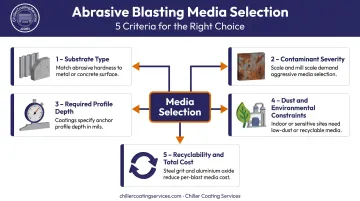
Choosing the wrong abrasive media wastes money, damages substrates, and can leave a surface profile that coatings won't bond to properly. The right choice depends on five factors: surface type, contaminant severity, required profile depth, environmental constraints, and total cost per cycle.
Steel Media (Grit and Shot)
Two forms with different performance profiles:
- Steel grit — angular particles that cut aggressively into the surface, creating deep profiles suited to heavy rust and mill scale removal
- Steel shot — spherical particles that produce a smoother, peened finish that also strengthens metal surfaces
Both are highly recyclable. Steel grit carries a 98% recyclability rate and can be recycled hundreds of times according to industry data. OSHA notes that steel grit and shot have less potential to cause lung damage than silica sand or mineral slag abrasives.
Garnet
A naturally occurring mineral abrasive that balances cutting speed, low dust generation, and consistent surface profiles. Garnet is widely used in shipbuilding, industrial maintenance, and waterjet cutting. It can typically be recycled up to five times before disposal. EPA data notes mineral abrasives like garnet can be more durable and generate less dust than sand.
Crushed Glass and Glass Beads
- Crushed glass — made from post-consumer recycled glass; effective for general-purpose coating removal and cleaning, with low free silica content
- Glass beads — smooth, spherical particles for lighter finishing and peening applications where a polished surface is needed without removing base material
Organic and Soft Abrasives
When the substrate can't tolerate aggressive abrasion:
- Walnut shell and corn cob — biodegradable, gentle on aluminum, composites, and wood
- Plastic media — used in aerospace and automotive stripping where coatings must be removed without affecting tight dimensional tolerances
Matching Media to Surface and Application
With media types catalogued, the next step is matching them to your specific job. Five criteria drive that decision:
- Substrate type — steel, aluminum, concrete, and fiberglass each respond differently to abrasive aggression; mismatching media to substrate causes surface damage
- Contaminant severity — heavy mill scale and deep rust require aggressive media; light oxidation may not warrant it
- Required surface profile depth — specified by the coating manufacturer, not the blasting contractor
- Dust and environmental constraints — occupied facilities, proximity to food processing areas, or local regulatory limits may require lower-dust or wet alternatives
- Recyclability and total cost — lowest purchase price rarely equals lowest operating cost once media cycles, disposal fees, and downtime are factored in
Safety Protocols and Regulatory Compliance in Abrasive Blasting
Abrasive blasting is one of the more hazardous industrial operations from a worker health standpoint. Understanding the specific hazards — and the regulations designed to control them — is essential before any blasting operation begins.
Primary Hazards
- Respiratory risk — the most serious hazard; fine airborne particles cause lung damage, with silicosis the most severe outcome. An estimated 2 million U.S. workers were historically at risk for silicosis, with about 100,000 of them sandblasters
- Eye and skin injuries — high-velocity media impacts cause lacerations and eye damage without proper protection
- Noise-induced hearing loss — blasting operations generate sustained high noise levels
- Musculoskeletal strain — blast hose handling and equipment operation create repetitive physical stress
NIOSH recommended as far back as 1974 that silica sand, or any material with more than 1% free crystalline silica, not be used as abrasive blasting media. The lung damage it causes is irreversible, which is why silica sand is no longer an acceptable blasting medium under current safety standards.
Required PPE and Engineering Controls
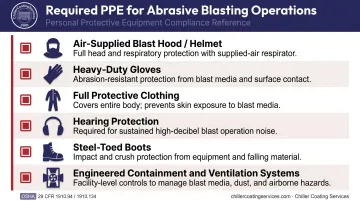
Controlling these hazards requires both personal protective equipment and engineered systems. OSHA's standards (29 CFR 1910.94 and 1910.134) establish specific requirements:
- Air-supplied blast hoods or helmets with respiratory protection
- Heavy-duty gloves and full protective clothing
- Hearing protection at all times during operations
- Steel-toed boots
- Engineered containment and ventilation systems
- Dust collection equipment for blast-cleaning exhaust
OSHA's current silica permissible exposure limit is 50 µg/m³ as an 8-hour TWA, with an action level of 25 µg/m³.
Regulatory Framework
PPE and engineering controls address the worksite — but blasting operations also fall under a broader set of environmental and industry regulations. Key frameworks include:
- OSHA — worker safety, PPE requirements, silica exposure limits, respiratory protection program (1910.94, 1910.134, 1910.1053)
- EPA — air quality, particulate emissions, and hazardous waste determination under 40 CFR 262.11 for spent abrasive characterization
- NFPA 660 — combustible dust prevention for operations generating combustible particulate (consolidates prior NFPA 654 requirements as of 2025)
- AMPP / ISO standards — surface cleanliness and preparation grade specifications
Federal rules do not automatically classify spent abrasive as hazardous waste. Generators must determine whether spent material is hazardous at the point of generation, based on substrate contamination, coating chemistry (particularly lead-containing coatings), and media type.
Why Proper Surface Preparation Is Critical for Industrial Coating Success
A 2024 AMPP CoatingsPro article cites a 75% coating failure rate attributable to inadequate surface preparation. Sherwin-Williams puts it at 80%. The mechanism is consistent regardless of the figure.
Contaminants and mill scale left on the surface create voids between coating and substrate. Moisture and oxygen migrate into those voids. Under-film corrosion advances invisibly until blistering, peeling, or structural failure appears — often well ahead of the coating's expected service life.
What White Metal Blast Means in Practice
SSPC-SP 5 / NACE No. 1 — the white metal blast standard — requires a surface free of all visible oil, grease, dust, dirt, mill scale, rust, coatings, oxides, corrosion products, and foreign matter. Bare, bright metal across the entire surface.
It's the most stringent cleanliness standard in the industry and the required baseline for high-performance coatings in demanding service environments: immersion service, power plant condensers, submerged tanks, and chiller tube sheets. This standard maps to ISO Sa 3 in international specifications.
The Connection to Chiller Tube Sheet Protection
Chiller Coating Services embeds this standard as a non-negotiable requirement before any coating application on chiller tube sheets, water boxes, and heat exchanger components. Their stated principle — "It's Only as Good as the Prep" — reflects the direct cause-and-effect chain: inadequate blasting leads to poor adhesion, which leads to premature failure.
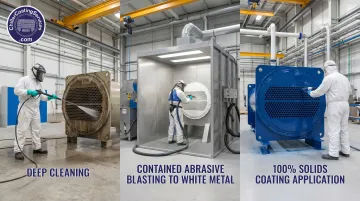
The company's three-step process sequences this precisely:
- Deep cleaning — removes biofilm, scale, corrosion deposits, and debris
- Contained abrasive blasting to white metal finish — achieves SSPC-SP 5 / NACE No. 1 surface condition; severely corroded areas are reconstructed at this stage before coating proceeds
- 100% solids coating application — the proprietary coating is applied only after the surface has been verified
When executed correctly, this sequence delivers tube-to-tube-sheet joint push-out strength gains of over 1,000 pounds in some cases. It also provides long-term protection against galvanic corrosion, pitting, erosion, and cavitation damage — extending service life for industrial facilities across New England and New York.
Frequently Asked Questions
What is considered industrial cleaning?
Industrial cleaning is the systematic removal of rust, scale, old coatings, oil, chemical deposits, and biological fouling from industrial surfaces and equipment. It differs from routine commercial cleaning by using specialized methods (abrasive blasting, high-pressure water jetting, and chemical treatments) to restore surfaces to a condition suitable for protective coating or continued service.
What is the difference between sandblasting and abrasive blasting?
Sandblasting originally referred to using sand as the blasting medium. Sand is no longer widely used due to severe respiratory risks from silica dust exposure. Abrasive blasting is the modern term, covering safer media such as steel grit, garnet, glass beads, and crushed glass, selected based on the surface and coating requirements.
What are the most common types of abrasive blasting media?
Common media include steel grit and steel shot for heavy industrial work, garnet for low-dust cutting, and crushed glass for general-purpose cleaning. Softer options like walnut shell or plastic abrasives suit sensitive substrates such as aluminum or composites. Selection depends on substrate material, contaminant type, and required surface profile.
What PPE is required for abrasive blasting operations?
Essential PPE includes an air-supplied blast hood or helmet with respiratory protection, heavy-duty gloves and protective clothing, hearing protection, and steel-toed boots. OSHA mandates specific requirements based on media type and the presence of hazardous materials. Lead-containing coatings, for example, require additional precautions beyond standard blasting PPE.
What surface preparation standard should be achieved before applying industrial coatings?
It depends on the coating system and service environment. General-purpose coatings may accept commercial blast (SSPC-SP 6), while high-performance coatings in immersion service or corrosive environments require white metal blast (SSPC-SP 5 / NACE No. 1). Follow the coating manufacturer's specification for both cleanliness standard and anchor profile depth.
How does abrasive blasting improve coating adhesion and longevity?
Blasting creates a clean surface with microscopic peaks and valleys that give the coating a mechanical anchor to grip. It also removes contaminants that would prevent chemical bonding. Coatings applied to unprepared surfaces fail prematurely through adhesion loss and under-film corrosion, often before any visible signs appear.