Both standard and marine waterboxes direct coolant flow across the chiller's tube bundle. But they differ significantly in materials, durability, and the conditions they're built to handle. Choosing between them requires understanding your water chemistry, loop type, and long-term maintenance capacity — not just a budget line.
Key Takeaways
- Standard waterboxes (cast iron or carbon steel) are designed for closed-loop, chemically treated freshwater systems
- Marine waterboxes use corrosion-resistant alloys (copper-nickel, titanium, or naval brass) built for aggressive or open-loop water sources
- Material selection directly affects corrosion risk, maintenance frequency, and total operating cost
- Coastal facilities, power plants, and open-loop systems frequently require marine-grade waterboxes, not just marine vessels
- Professional coatings applied to tube sheets and waterbox interiors extend service life for both types
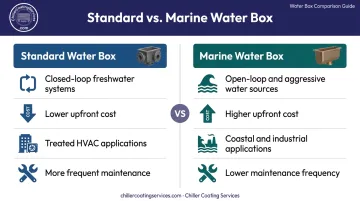
Marine vs Standard Water Box: Quick Comparison
| Factor | Standard Water Box | Marine Water Box |
|---|---|---|
| Primary material | Cast iron or carbon steel | Copper-nickel (90/10 or 70/30), titanium, naval brass, or stainless steel |
| Corrosion resistance | Adequate for treated freshwater; vulnerable to aggressive chemistry | High resistance to chloride-induced, galvanic, and erosion corrosion |
| Typical application | Closed-loop HVAC in commercial buildings, hospitals, schools | Open-loop systems, coastal facilities, seawater or brackish water cooling |
| Upfront cost | Lower | Higher |
| Maintenance frequency | More frequent; requires consistent water treatment | Less frequent with appropriate water chemistry management |
Configurations vary by manufacturer and project. Verify specs against your OEM documentation before making decisions.
What Is a Standard Chiller Water Box?
A waterbox is the end-cap enclosure on a shell-and-tube chiller that channels coolant into and out of the tube bundle. Standard waterboxes are fabricated from cast iron or carbon steel, typically with a factory paint or primer coating.
These are engineered for closed-loop, freshwater HVAC systems where water chemistry is treated and consistently monitored — commercial office buildings, schools, hospitals, and retail complexes running chemically treated recirculating water through cooling towers.
Carrier's 19XR/XRV product documentation confirms fabricated steel as the standard waterbox construction. Johnson Controls' 2024 materials guide separately lists carbon steel as the default for standard applications.
Where Standard Waterboxes Are Vulnerable
Cast iron and carbon steel have real limitations when water treatment lapses or conditions turn aggressive:
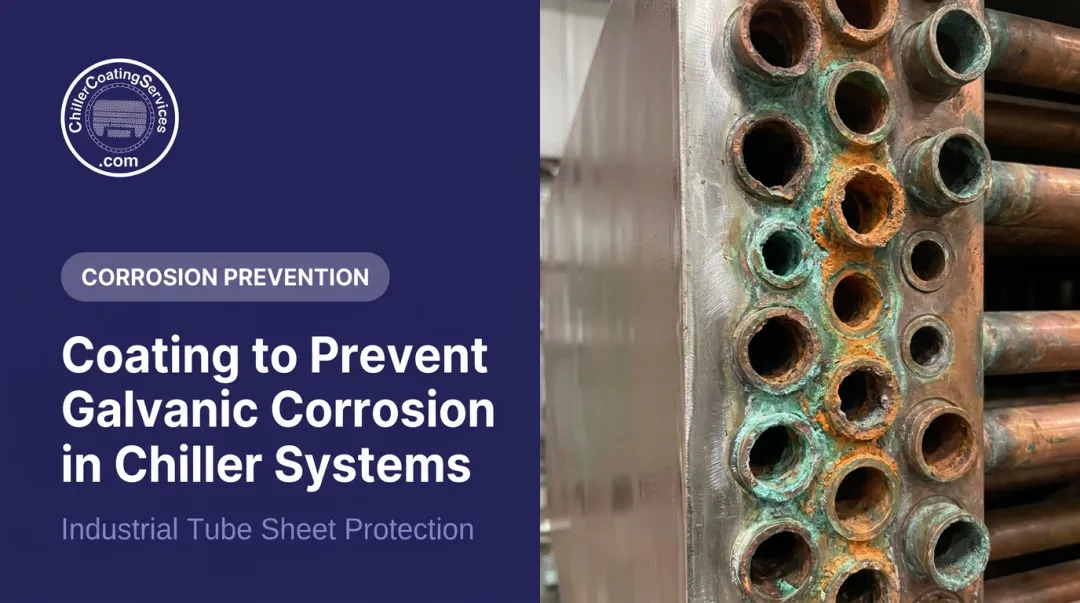
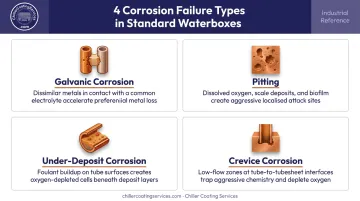
- Galvanic corrosion — where dissimilar metals (carbon steel waterbox, copper alloy tubes) contact through an electrolyte, driving preferential metal loss
- Pitting — from dissolved oxygen, scale chemistry, or biofilm accumulation masking underlying attack
- Under-deposit corrosion — foulant buildup on enhanced tubes can cause perforation failure, per Johnson Controls' 2024 materials guide
- Crevice corrosion — at the tube-to-tube-sheet interface where low-flow zones concentrate corrosive chemistry
Trane's water quality guidelines establish that pH below 7.5 dissolves copper's protective oxide film, and that chloride levels above 125 mg/L or sulfates above 35 mg/L can penetrate that film. Cross either threshold without correction and corrosion accelerates quickly. Trane recommends annual waterbox opening and tube inspection — checking for fouling, scaling, and gasket condition — precisely because those limits are easy to breach without active monitoring.
Use Cases for Standard Waterboxes
Standard waterboxes are appropriate when:
- Operating a closed-loop chilled water system with consistent chemical treatment and monitoring
- Located inland, with no seawater, brackish water, or high-chloride water exposure
- Water chemistry stays within OEM limits (pH 7.5–9.0, chloride <125 mg/L)
- A disciplined water treatment program is in place and maintainable long-term
Standard waterboxes are the most widely installed type in North American commercial HVAC — and cost-effective as long as those conditions are actively maintained.
What Is a Marine Chiller Water Box?
Marine waterboxes are engineered from corrosion-resistant alloys to handle aggressive coolant media — seawater, brackish water, treated sewage effluent, geothermal water, and high-TDS well water. Common materials include:
- Copper-nickel 90/10 (C70600) — 9–11% nickel content; listed by the Copper Development Association for saltwater-resistant condenser and heat exchanger applications
- Copper-nickel 70/30 (C71500) — 29–33% nickel content; specified for seawater condensers where higher chloride resistance is needed
- Titanium — highest corrosion and erosion resistance; highest cost; suited to the most aggressive environments including ammonia, sulfides, or anaerobic bacteria
- Naval brass (C46400) — used for condenser tube plates and heat exchanger components
- Stainless steel (SS316L) and Duplex S22053 — alternatives where specific chemistry profiles warrant
The term "marine" describes a package and configuration, not necessarily an exotic waterbox shell. Carrier's 19XR/XRV documentation identifies the marine waterbox shell as hot-rolled ASME/ASTM A516 Grade 70 steel. The alloy upgrades typically apply to the tubes, tubesheet cladding, and cathodic protection components rather than the shell itself.
Why "Marine" Extends Beyond Ships
Despite the label, marine waterboxes are widely specified far from any ocean:
- Coastal and waterfront facilities with salt-air environments
- Power plants using once-through cooling with river water or seawater
- Industrial processes with variable or high-TDS source water
- Buildings where open-loop systems draw from natural water sources
- Facilities where previous corrosion failures on standard waterboxes have created a pattern of unplanned downtime
Johnson Controls' 2024 materials guide addresses treated sewage effluent, geothermal water, and high-TDS well water as categories requiring alloy selection beyond standard carbon steel. Water chemistry analysis, not geography alone, should drive material specification.
Use Cases for Marine Waterboxes
Specify marine waterboxes when:
- Cooling water is drawn from open natural sources (seawater, river water, brackish water)
- Chloride content exceeds 200 ppm at operating cycle concentrations
- The facility is in a coastal or salt-air environment
- Water treatment cannot be consistently maintained
- Prior corrosion failures have already demonstrated that standard materials are inadequate for the site's conditions
Marine vs Standard Water Box: Which Does Your Chiller Need?
Selecting the right waterbox type depends on four operational factors. Evaluate each one against your system's actual conditions.
Decision Framework
1. Water source and loop type Closed-loop systems with treated recirculating water favor standard waterboxes. Open-loop systems drawing from natural sources almost always require marine-grade specifications.
2. Water chemistry — use OEM thresholds
| Chemistry Parameter | Standard Box Limit | Marine Consideration Triggered |
|---|---|---|
| pH | 7.5–9.0 (Trane) | Below 7.5 or highly variable |
| Chloride | <125 mg/L (Trane); <200 ppm at 1.5 cycles (JCI) | >200 ppm at operating concentration |
| TDS | <1,000 ppm (JCI potable/non-potable) | >1,000 ppm; seawater range 1,000–28,000 ppm Cl |
| Contaminants | — | Ammonia, sulfides, or anaerobic bacteria → titanium or Duplex 2205 (S32205) |
3. Facility environment Inland, controlled environments support standard waterboxes. Coastal environments, facilities with salt-air infiltration, or sites with variable source water quality favor marine specifications.
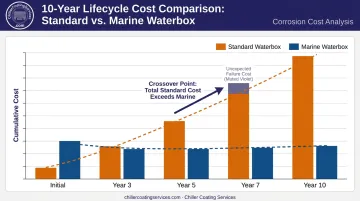
4. Total cost of ownership Marine waterboxes carry a higher upfront cost, but repeated corrosion failures on standard waterboxes — including unplanned downtime, emergency repairs, and early replacement — can exceed that premium quickly. A full life-cycle calculation should account for repair frequency, downtime costs, and expected service intervals — not just the initial equipment price.
Situational Guidance
Choose a standard waterbox when:
- Closed-loop system with consistent chemical treatment
- Water chemistry stays reliably within OEM limits
- Inland location with no brackish or seawater exposure
- Committed water treatment program is in place
Choose a marine waterbox when:
- Open-loop cooling with natural source water
- Chloride or TDS levels exceed OEM thresholds
- Coastal location or salt-air operating environment
- Water treatment consistency cannot be guaranteed
- Prior corrosion failures have established a pattern
Extending Water Box Life: The Role of Professional Coatings
Regardless of which waterbox type a facility uses, protective coatings applied to tube sheet and waterbox interiors are a proven strategy for extending service life. Johnson Controls explicitly calls coating "the simplest way to protect waterboxes from corrosion" — while also noting that coatings require proper surface preparation, inspection, and maintenance to perform.
What Professional Coating Involves
A properly executed coating program involves three integrated steps:
- Deep cleaning — removing biofilm, scale, and corrosion deposits to expose true metal condition
- Contained abrasive blasting to white metal finish (SSPC-SP 5 / NACE No. 1 equivalent): the most rigorous surface cleanliness standard in industrial coating practice, required for proper adhesion in constant-immersion service
- Reconstruction and 100% solids coating application — severely corroded areas are rebuilt before coating is applied; the coating is then applied to all interior surfaces, inlet/outlet nozzles, end-bell components, and the waterbox-to-tube-sheet seal area
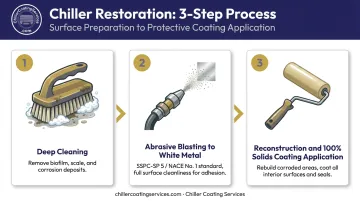
AMPP's surface preparation standards are clear: inadequate surface preparation prevents proper coating adhesion and causes system failure. The blast standard is not optional — it's the foundation of long-term coating performance.
Trane's IOM documentation recommends inspecting coatings within the first month in seawater service and within three months in less aggressive water — then adjusting the schedule based on observed condition.
Why Coatings Matter for Both Waterbox Types
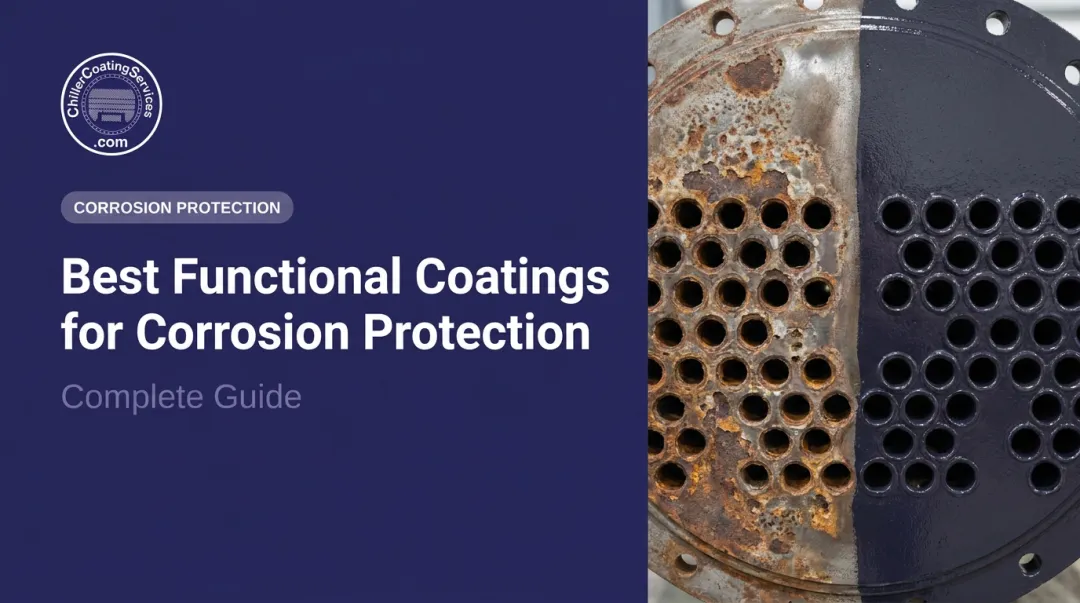
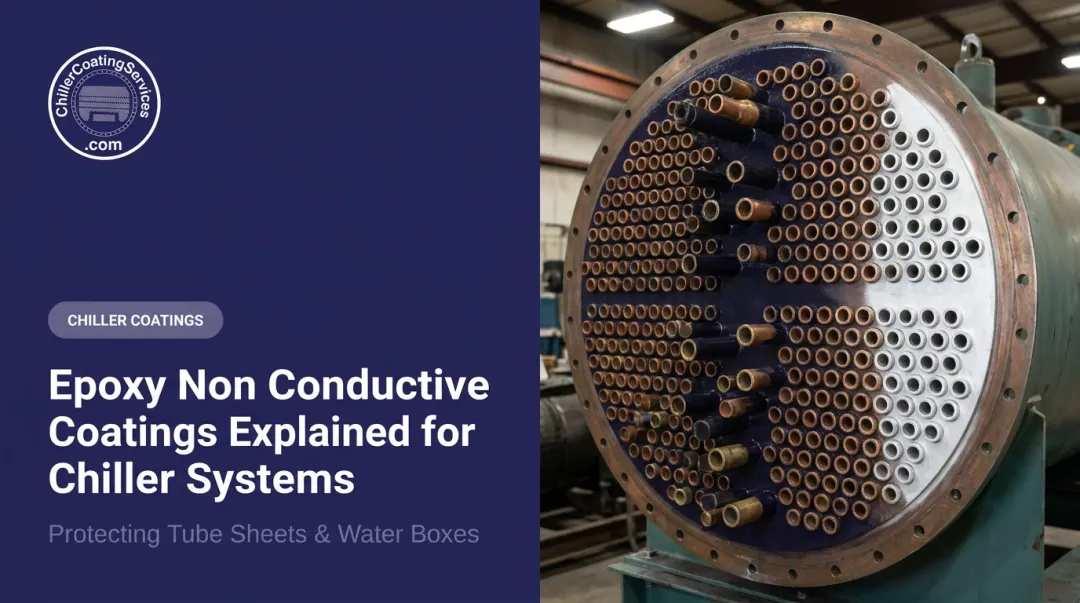
Standard waterboxes benefit from a 100% solids non-conductive coating that creates an electrical barrier between dissimilar metals at the tube-to-tube-sheet interface, eliminating the electrolytic pathway that drives galvanic corrosion. This can allow a standard carbon steel waterbox to perform reliably in environments that might otherwise push a specification toward marine-grade materials.
Marine waterboxes see targeted gains at their most vulnerable zones: inlet and outlet nozzles, crevice-prone joint areas, and tube-end interfaces. Coating those surfaces extends service intervals and reduces fouling accumulation.
Chiller Coating Services, based in Franklin, NH, applies this three-step process across commercial and industrial chiller systems throughout New England and New York. Their work spans hospitals, data centers, universities, power plants, and manufacturing facilities, with scheduling coordinated to minimize operational downtime.
Key outcomes from their 100% solids epoxy system include:
- Documented push-out strength increases of over 1,000 pounds at tube-to-tube-sheet joints in some cases
- Structural reinforcement alongside corrosion protection
- Service records that support Joint Commission, ISO, and SOC 2 audit requirements
Conclusion
Standard waterboxes are the practical default for closed-loop, chemically treated systems — cost-effective when water quality is controlled and maintenance programs are sustained. Marine waterboxes are the engineered answer for open-loop environments, aggressive water chemistry, and coastal facilities where standard materials simply won't hold up.
The right choice is determined by water source, water chemistry, facility environment, and realistic long-term maintenance capacity. Either way, both types benefit from the same proactive approach: annual inspection, water chemistry monitoring, and professional coating programs applied before corrosion reaches the point of forced replacement. Chiller Coating Services works with facilities across New England and New York to restore and protect waterboxes, tube sheets, and condenser components — extending equipment life without the cost of full replacement.
Frequently Asked Questions
What is a waterbox on a chiller?
A waterbox is the end-cap enclosure on a shell-and-tube chiller that channels coolant into and out of the tube bundle, directing water flow across the heat exchange surface. It sits at both ends of the heat exchanger and is the first component exposed to incoming cooling water chemistry.
What is the difference between a marine water box and a standard water box?
The primary difference is material and corrosion resistance. Standard waterboxes use cast iron or carbon steel suited for freshwater closed-loop systems; marine waterboxes use copper-nickel, titanium, or brass alloys to handle seawater, brackish water, or chemically aggressive open-loop conditions. The "marine" designation refers to configuration and performance rating — not the shell material alone.
What is the life expectancy of a water-cooled chiller?
According to BOMA's Preventive Maintenance Guidebook, water-cooled centrifugal chillers carry an average useful life of 20 years with proper preventive maintenance. Waterbox and tube-side corrosion are among the documented factors that shorten this lifespan when left unaddressed.
What materials are used in marine water boxes?
The most common materials are copper-nickel 90/10 (C70600), copper-nickel 70/30 (C71500), naval brass, titanium, and stainless steel (SS316L) or Duplex alloys. Material selection is driven by a water chemistry analysis, particularly chloride content, TDS, and the presence of contaminants like ammonia or sulfides.
Can a standard water box be protected against corrosion without replacing it?
Yes. Professional coatings applied to the tube sheet and waterbox interior — particularly 100% solids epoxy systems over a white metal blast finish — create a non-conductive barrier that interrupts galvanic corrosion and physically excludes aggressive water chemistry from the base metal, extending service life without full replacement.
How often should chiller water boxes be inspected?
Annual inspection is the OEM baseline, per Trane's maintenance documentation. Facilities with aggressive water chemistry, coastal environments, open-loop systems, or aging equipment should inspect more frequently — with intervals adjusted based on observed coating condition and service exposure.