Scale as thin as 0.6mm can increase chiller energy consumption by 21%. That's a significant efficiency penalty from a layer of mineral buildup you can't even see with the naked eye.
This guide covers what chiller tube maintenance actually involves, how to spot early warning signs before they become expensive failures, which types of maintenance apply to different situations, and a practical scheduling framework for commercial facilities — from hospitals and data centers to schools and office buildings.
Key Takeaways
- Scale as thin as 0.6mm can cut chiller efficiency by 21% — fouling costs money faster than most facilities expect
- Each degree of condenser temperature rise increases energy use by 2.5% to 3.5%
- Preventive maintenance costs a fraction of emergency repairs — or full chiller replacement
- Approach temperatures above 5°F signal fouling that needs immediate attention
- Protective coating during overhaul extends service life well beyond cleaning alone
Why Chiller Tube Maintenance Matters
Chiller tubes are where the entire heat exchange process happens. Any degradation in tube surface condition — whether from fouling, corrosion, or physical erosion — directly undermines the system's ability to reject heat.
The Fouling Problem
Fouling comes from multiple sources: mineral scale from hard water, biofilm growth, sediment, and corrosion byproducts. Each adds a layer of thermal resistance between the water and refrigerant sides. The result isn't just slower heat transfer: the system has to work harder to achieve the same output.
When condenser tubes foul, condensing pressure rises and the compressor operates against elevated head pressure. It consumes more electricity and wears faster than designed.
Over a cooling season, this means higher utility bills and a shorter compressor lifespan. Compressor failure is one of the most expensive single-component failures in a chiller system.
The Corrosion Cascade
Corrosion damage is harder to detect than fouling but ultimately more destructive. In New England and New York — where hard water chemistry, aging chiller fleets, and dissimilar-metal tube-to-tube-sheet junctions are common — the team at Chiller Coating Services regularly arrives at facilities to find:
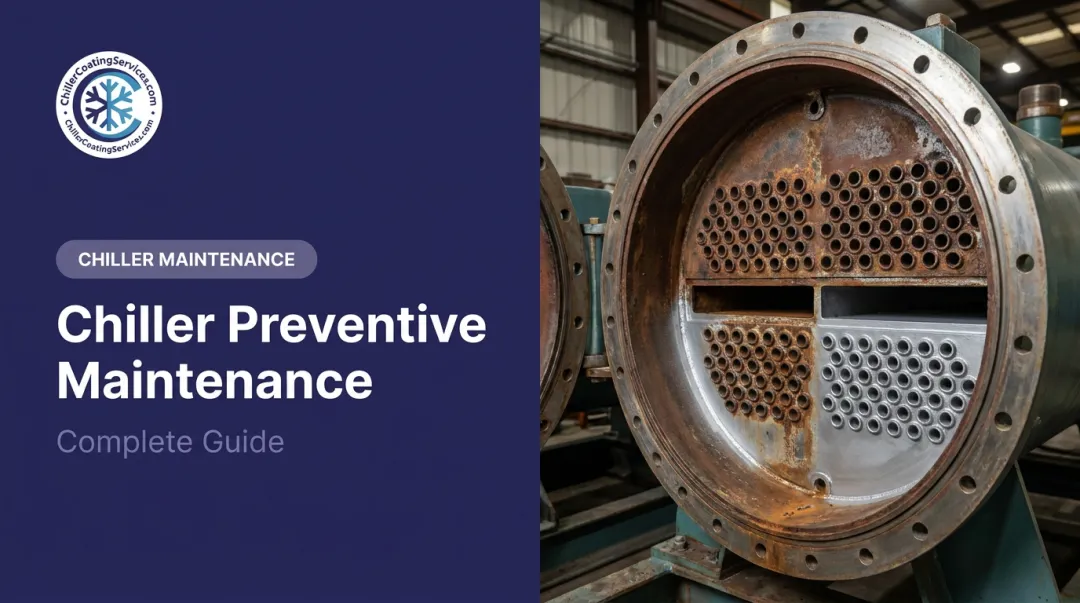
- Pitting corrosion on tube sheet faces from dissolved oxygen and acidic anti-scale treatments
- Galvanic corrosion at tube-to-tube-sheet junctions where dissimilar metals meet
- Tube end erosion on the inlet side from velocity-induced turbulence
- Water box deterioration from constant high-flow impingement at inlet and outlet nozzles
Once pitting corrosion initiates, it accelerates. The localized chemistry inside each pit becomes increasingly aggressive, deepening damage rapidly. Facilities that defer maintenance after the first corrosion findings consistently present with significantly more severe damage at the next inspection interval.
The Cost Reality
That deferred damage has a direct price tag. According to the U.S. Department of Energy's Operations and Maintenance Best Practices Guide, predictive and preventive maintenance programs reduce maintenance costs by 25–30% compared to reactive-only approaches. Emergency service calls, compressor repairs, and tube bundle replacement all cost more than planned cleaning and inspection — and full chiller replacement can run into six-figure territory that no preventive program approaches.
Types of Maintenance for Chiller Tubes
No single maintenance approach covers every scenario. An effective commercial program combines multiple types based on system age, water quality, operating environment, and usage intensity.
Routine / Preventive Maintenance
Scheduled preventive maintenance includes:
- Tube brushing and mechanical cleaning to remove soft fouling and scale deposits
- Visual tube sheet inspection for early corrosion signs, pitting, or joint deterioration
- Water treatment verification — checking scale inhibitor and biocide dosing levels
- Condenser end cover gasket inspection to prevent water-side leaks
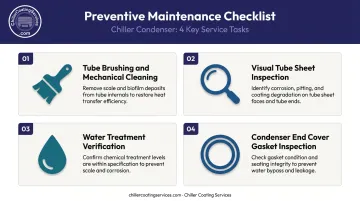
For facilities with good water quality, consistent treatment programs, and chillers operating within normal pressure and temperature parameters, annual preventive servicing is typically sufficient. This is the lowest-cost approach per service event and the most predictable maintenance expenditure in a facility budget.
Corrective / Reactive Maintenance
Reactive maintenance is triggered by:
- High condenser head pressure alarms
- Unexpected chiller shutdowns
- Significant drops in cooling capacity
- Confirmed tube leaks during operation
Over-relying on reactive maintenance is expensive. Emergency service costs more than planned work, disrupts operations at the worst possible time, and often reveals underlying corrosion that has been progressing unchecked for months. Repeated reactive interventions on the same equipment are a clear signal that something structural is wrong — and it typically worsens if not addressed.
Predictive / Condition-Based Maintenance
That pattern of reactive failures is precisely what condition-based monitoring is designed to prevent. Predictive maintenance uses diagnostic tools to catch degradation before it causes failure:
- Eddy current testing (ECT) — detects tube wall thinning, pitting, and cracking without removing tubes from service
- Thermal imaging — identifies hot spots in the condenser that indicate fouling or flow restriction
- Performance trending — tracking approach temperature and condensing pressure over time to quantify drift from baseline
Condition-based monitoring reduces unnecessary maintenance events while ensuring interventions happen before performance loss becomes severe. Trane's service documentation recommends non-destructive tube testing every three years for their RTHD series chillers, a widely cited reference point for large commercial equipment schedules.
Major / Overhaul Maintenance
Deep overhaul servicing involves:
- Full tube bundle cleaning down to bare metal
- Eddy current inspection of all tubes
- Tube sheet surface restoration including reconstruction of corroded areas
- Retubing or plugging of failed tubes
Overhaul-level maintenance is typically required every 5–10 years, or sooner when inspection reveals widespread corrosion, erosion, or tube-to-tube-sheet joint failure. Delaying overhaul maintenance doesn't pause degradation. It accelerates across the entire system.
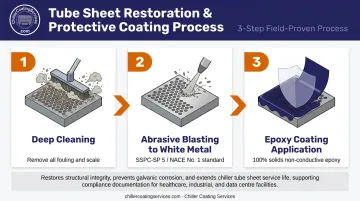
Overhaul timing also creates the ideal window for protective coating work. When tube sheets are cleaned to bare metal, that exposed surface accepts a coating bond that simply isn't achievable during routine maintenance cycles. Chiller Coating Services performs tube sheet restoration during overhaul cycles using a three-step process: deep cleaning, contained abrasive blasting to white metal finish (SSPC-SP 5 / NACE No. 1 equivalent), and application of a 100% solids non-conductive epoxy coating. The coating protects against galvanic, pitting, crevice, and electrolytic corrosion, reduces inlet turbulence, and has documented push-out strength gains of over 1,000 pounds at tube-to-tube-sheet joints in some cases.
How to Check If Your Chiller Tubes Need Maintenance
Most tube degradation develops gradually. By the time a chiller shuts down, the warning signs have typically been present for weeks or months.
Performance Changes
Efficiency red flags to watch for:
- Rising condenser approach temperature beyond the manufacturer's baseline — values above 5°F indicate fouling that requires cleaning
- Reduced cooling capacity — chiller can't meet load on peak demand days
- Longer compressor run times for the same building load
Comparing current operating data against prior-season logs is the most reliable way to quantify performance drift. A trend line moving in the wrong direction is often the first and clearest signal.
Unusual Operation
Operational anomalies worth investigating:
- High-pressure alarms triggering more frequently than normal
- Refrigerant pressure readings outside normal operating bands
- Unusual vibration or noise from the compressor, typically caused by elevated head pressure from fouled condenser tubes
A chiller that trips on high condenser pressure is signaling compromised heat rejection. Tube cleaning or inspection should be scheduled without delay.
Visible Wear During Inspection
During visual inspection, technicians look for:
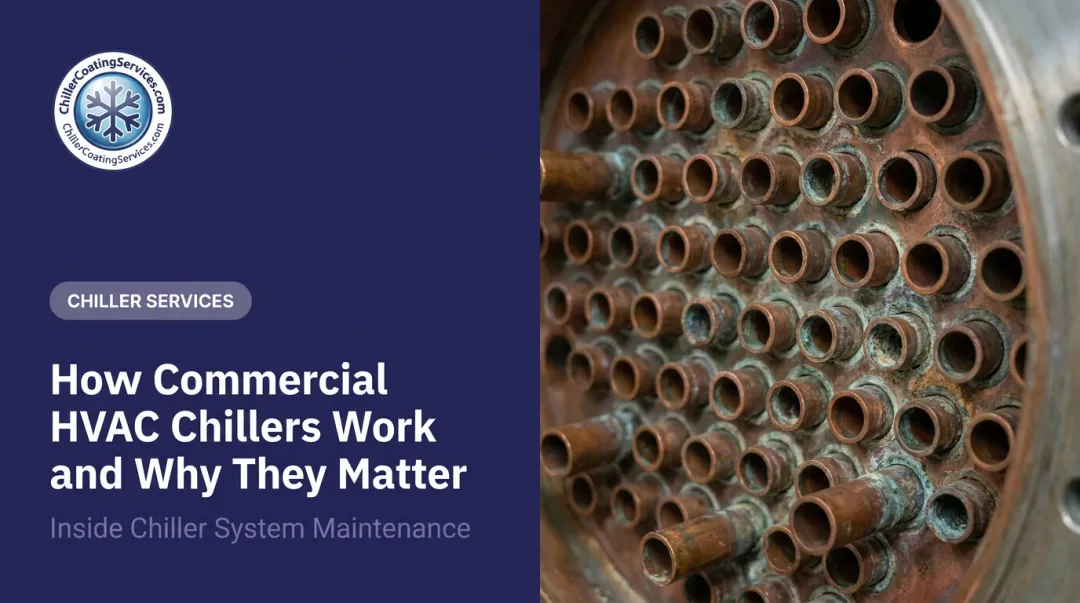
- Scale deposits and corrosion staining on tube sheet faces
- Pitting or erosion marks on tube ends, particularly on the inlet side
- Signs of leakage at tube-to-tube-sheet joints
- Damaged or deteriorated tube ends
- Discoloration or breakdown of any existing coating on the tube sheet surface
Discoloration or coating breakdown is a critical finding. It typically signals active galvanic or pitting corrosion progressing beneath the surface. The protective barrier between dissimilar metals has been compromised, and the degradation cycle is accelerating. That finding calls for formal corrosion assessment, not just cleaning.
Increased Energy Consumption
If electricity costs during comparable cooling-degree-day periods are noticeably higher than previous seasons with no change in building load, fouled tubes are among the first suspects. Each degree of condenser temperature increase raises energy consumption by 2.5–3.5%. A few degrees of fouling-related temperature rise adds up to a measurable line item on the utility bill every month.
Recurring Downtime
When the same chiller repeatedly trips on high pressure, requires manual resets, or produces temporary fixes that stop holding, the pattern points to systemic tube or tube sheet degradation rather than isolated incidents. At that stage, the priority shifts from whether maintenance is needed to assessing how much restoration work is required before the next cooling season.
Chiller Tube Maintenance Schedule
Maintenance frequency varies by facility type, water quality, chiller age, and annual operating hours. A hospital running chillers year-round has fundamentally different needs than a school with seasonal cooling. Facilities in hard-water regions — including much of New Hampshire, Massachusetts, and New York City — typically need more frequent cleaning intervals due to accelerated scale and corrosion rates.
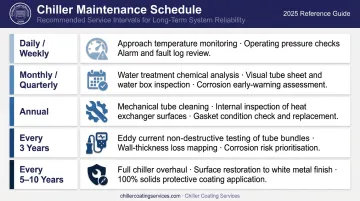
Reference Schedule by Frequency
| Interval | Tasks |
|---|---|
| Daily / Weekly | Monitor approach temperature and condenser pressure; listen for unusual sounds; check control panel for alarms |
| Monthly / Quarterly | Water treatment review; visual inspection of accessible components; verify chemical dosing levels |
| Annual | Full tube cleaning, tube sheet visual inspection, gasket replacement, performance baseline comparison |
| Every 3 Years | Non-destructive tube testing (eddy current); condition assessment to inform next overhaul timeline |
| Every 5–10 Years | Full overhaul: tube bundle cleaning to bare metal, tube sheet surface restoration, protective coating application |
Scheduling by Facility Type
Frequency alone doesn't determine when maintenance happens — facility type shapes the entire scheduling strategy.
Continuous-operation facilities — hospitals, data centers, pharmaceutical plants, and manufacturing facilities — require a different approach than seasonal buildings. Chiller Coating Services uses single-chiller-at-a-time mobilization for data centers operating under N+1 or 2N redundancy requirements, maintaining uninterrupted cooling coverage throughout the service event.
For hospitals, mobilization is coordinated around low-load shoulder seasons in spring and fall, aligned with the facility's internal maintenance calendar and infection-control protocols.
Seasonal facilities and schools have a natural advantage: planned off-season shutdowns create ideal maintenance windows. K-12 schools are typically serviced during summer break; universities can schedule around J-term or summer session shoulder periods.
Consolidating the full scope — tube sheets, tube ends, water boxes, and heat exchanger surfaces — into a single mobilization lowers total cost and eliminates the need for multiple access windows throughout the year.
Conclusion
Consistent chiller tube maintenance keeps energy costs predictable, protects compressor life, and ensures cooling capacity when it matters most. Facilities that skip preventive care eventually face emergency interventions — and those repairs cost far more than the maintenance cycles they replaced.
The right maintenance strategy layers routine cleaning with periodic eddy current testing, performance trending, and scheduled overhaul service on a defined cycle.
For tube sheets and water boxes showing corrosion, professional surface restoration with protective coating is consistently the most cost-effective path — not replacement. Coating applied over properly prepared and reconstructed surfaces:
- Stops galvanic and pitting corrosion from progressing
- Reinforces tube-to-tube-sheet joints
- Extends service life at a fraction of bundle replacement cost
Facilities managers and building owners should document their maintenance history and establish a structured schedule before the next peak cooling season. For facilities across Massachusetts, New Hampshire, Connecticut, Rhode Island, Maine, Vermont, and New York, Chiller Coating Services offers free on-site inspections to assess tube sheet condition and determine the appropriate scope of work. Reach them at (877) 427-0090 or at chillercoatingservices.com/contact.
Frequently Asked Questions
How often should chiller tubes be cleaned?
Most commercial facilities should clean chiller tubes at least once per year, typically during planned off-season downtime. Facilities with hard water, heavy year-round usage, or inadequate water treatment programs may need cleaning every six months to prevent significant fouling-related efficiency loss.
What is a chiller tube?
Chiller tubes are the heat exchange surfaces inside a chiller's evaporator and condenser sections. Water or refrigerant flows through them to transfer heat between the two sides of the system — their cleanliness and structural integrity directly determine how efficiently the chiller operates.
What is the purpose of a chiller?
A chiller removes heat from a liquid coolant — typically water — via refrigeration, then circulates the cooled water through a building's air handling system. Commercial and industrial facilities use chillers to cool and dehumidify occupied spaces and process environments.
What type of pipe is used in chillers?
Chiller tubes are most commonly made from copper or copper alloys such as admiralty brass or cupronickel, chosen for their thermal conductivity and corrosion resistance. Stainless steel and titanium tubes are used in more aggressive or corrosive water environments where copper alloys would degrade faster.
What are the main causes of chiller tube deterioration?
Three factors drive most chiller tube deterioration:
- Mineral scale and biofilm from untreated water reduce heat transfer efficiency
- Corrosion from galvanic reactions between dissimilar metals or aggressive water treatment chemistry
- Physical erosion from high water velocity or inlet turbulence, especially on the inlet side of the tube bundle
Can chiller tubes be repaired instead of replaced?
Yes — individual failed tubes can be plugged or relined, and tube sheets can be restored through surface preparation and protective coating rather than full replacement. Full bundle replacement is only necessary when structural metal loss is severe or refrigerant cross-contamination has already occurred.