For facilities managers and chief engineers overseeing hospitals, schools, power plants, or manufacturing operations, a failing heat exchanger means more than a repair bill. It means unplanned downtime, disrupted operations, and — in regulated environments — potential compliance exposure.
The good news: corrosion has identifiable causes and well-proven countermeasures. This guide covers what drives corrosion in heat exchangers, what happens when it's ignored, and the layered prevention strategies that consistently extend equipment life.
Key Takeaways
- Corrosion stems from fluid chemistry, dissimilar metal contact, thermal cycling, and moisture — rarely just one cause
- Left unchecked, it reduces heat transfer efficiency, raises energy costs, and risks structural failure
- Prevention requires layered action: material selection, protective coatings, water treatment, and regular inspection
- Early warning signs — pitting, efficiency drops, rising pressure drop — should trigger immediate assessment
- Tube sheet coatings paired with white metal surface prep are among the most effective rehabilitation options for aging equipment
Common Causes of Corrosion in Heat Exchangers
Heat exchanger corrosion rarely has a single source. It typically arises from two or more interacting factors — fluid chemistry, material compatibility, temperature behavior, and environmental exposure all play a role.
Aggressive Fluid Chemistry
Dissolved chlorides, sulfates, and oxygen in cooling or process fluids initiate electrochemical reactions that attack metal surfaces. The result is pitting, crevice corrosion, and accelerated material loss.
A few real-world conditions that accelerate this:
- Facilities using untreated municipal water with high conductivity
- Coastal installations exposed to salt-laden supply water
- Systems handling food-grade or chemical process fluids with high ionic content
Veolia's cooling water corrosion handbook notes that the primary cathodic reaction in cooling water involves dissolved oxygen, and that corrosion rate increases with conductivity and temperature. Inside pits, chloride concentration and acid generation make attack self-sustaining — catching pitting early prevents the self-reinforcing cycle that makes damage exponentially harder to reverse.
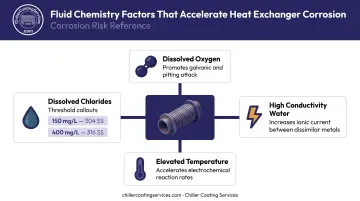
Chloride thresholds for stainless steel are tighter than many assume: 150 mg/L for 304 SS and 400 mg/L for 316 SS before pitting risk becomes significant.
Galvanic Corrosion from Dissimilar Metals
When two different metals — such as copper tubes and a carbon steel tube sheet — share an electrolytic pathway (circulating water), an electrochemical current flows. The less noble metal corrodes preferentially.
This is particularly common in older chiller systems where replacement components of a different alloy were installed without insulating the junction. ASHRAE's documentation on marine refrigeration systems confirms galvanic corrosion is especially severe in seawater-cooled condensers, where a large cathode connected to a small anode drives rapid anode deterioration. One documented case: an oil cooler failed in four months due to galvanic attack between copper tubes and aluminum gaskets.
Thermal Cycling and High Operating Temperatures
Repeated heating and cooling cycles cause metal to expand and contract, generating micro-cracks and surface stress over time. At elevated temperatures, electrochemical reactions accelerate and protective oxide layers degrade faster.
The risk is highest in environments with wide temperature swings:
- High-load commercial HVAC chillers
- Steam heat exchangers in power plants
- Systems subject to seasonal shutdowns and restarts
A stainless steel heat exchanger failure documented in Engineering Failure Analysis showed cracking after just 8 days during startup — attributed to residual stress combined with chloride-polluted steam. Engineers should treat every restart after a seasonal shutdown as a high-risk window, particularly when condensate chemistry hasn't been verified.
Moisture, Condensation, and Poor Venting
Condensation accumulating on or inside heat exchanger surfaces — combined with inadequate venting or dissolved oxygen in closed hydronic systems — creates a persistent wet environment that sustains rust and crevice corrosion.
Typical triggers include oversized HVAC equipment that short-cycles (never running long enough to evaporate moisture), drain pans overflowing onto tube sheets, and poor system de-aeration. Dissolved oxygen in closed hydronic systems accelerates oxygen pitting — a failure mode that compounds quickly once it starts.
What Happens If Heat Exchanger Corrosion Is Ignored
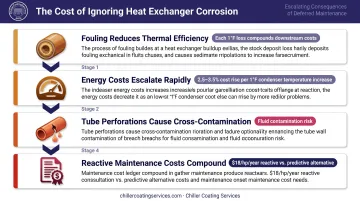
Unaddressed corrosion compounds quickly. Deposit buildup acts as insulation on heat transfer surfaces, forcing systems to work harder to maintain target temperatures.
DOE/FEMP data puts this in concrete terms: improper cooling tower maintenance alone can increase chiller energy use by 2.5–3.5% for every 1°F rise in condenser temperature, costing $2,500–$7,000 per year for a 100-ton chiller.
Fouling affects more than 90% of heat exchangers over time. The operational consequences reach well beyond energy bills:
- Reduced thermal efficiency drives higher utility bills
- Tube perforations allow cross-contamination between fluid circuits
- In hospitals or manufacturing plants, an unexpected shutdown disrupts operations and triggers regulatory concerns
- Reactive maintenance costs approximately $18/hp/year — roughly twice the cost of predictive maintenance programs
Warning Signs You're About to Experience Corrosion Failure
Watch for these indicators before a failure event forces your hand:
- Pitting or rust staining on tube sheets or end caps
- White or grey scale deposits on internal surfaces, indicating active mineral fouling
- Rising supply temperatures or longer cycle times — a measurable drop in heat transfer efficiency
- Unexplained pressure drop across the unit, which can signal deposit buildup from corrosion fouling
- Discoloration around tube-to-tube-sheet joints, a sign of early-stage galvanic or crevice attack
Any combination of these signs warrants an immediate professional assessment, not a wait until the next scheduled maintenance window.
How to Prevent Corrosion in Heat Exchangers
Prevention works as a layered system. No single measure is fully effective on its own. The most resilient systems combine material choices, surface protection, fluid treatment, and routine inspection.
Corrosion-Resistant Material Selection
Specifying the right alloy upfront cuts the risk of pitting, crevice corrosion, and chloride attack. Here's how common materials compare:
| Material | Strengths | Best For |
|---|---|---|
| Stainless steel (316) | Good chloride resistance up to 400 mg/L | General industrial, HVAC |
| Titanium | Superior resistance to chloride pitting | Seawater, coastal, aggressive process fluids |
| Cupronickel (90-10, 70-30) | Develops protective film in clean seawater | Marine, once-through cooling systems |
| Carbon steel | Low cost | Only where fluid chemistry is tightly controlled |
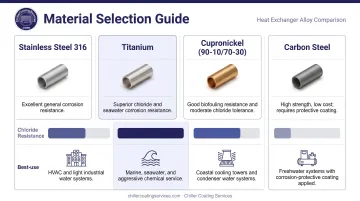
Material decisions are most impactful at the design or replacement stage, but they also guide which components to prioritize for protective treatment in existing systems.
Protective Tube Sheet Coatings
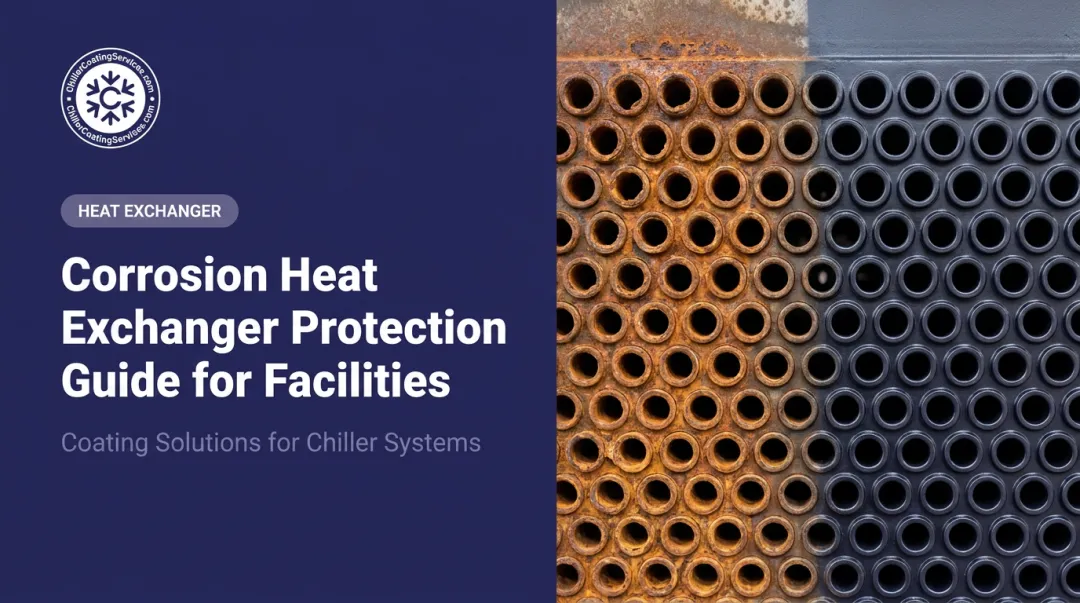
Applying a high-performance protective coating to tube sheets creates a barrier against corrosive fluids, prevents galvanic reactions by adding a non-conductive layer between dissimilar metals, and strengthens tube-to-tube-sheet joint integrity — without requiring full equipment replacement.
The coating approach only works if the surface preparation matches the service environment. AMPP's SSPC-SP 5 / NACE No. 1 white metal blast standard requires complete removal of all rust, scale, oxides, and contaminants before any high-performance coating goes on. Anything less leaves contamination that causes under-film corrosion and premature delamination.
Chiller Coating Services specializes in this process across New England and New York. Their three-step service covers deep cleaning, contained abrasive blasting to white metal finish with reconstruction of severely corroded areas, and application of a 100% solids epoxy coating system. This addresses both surface condition and tube-to-tube-sheet joint integrity.
Their 100% solids formulation (no solvents, no shrinkage during cure, no VOC emissions) delivers maximum film build and a denser cured barrier than solvent-based alternatives, with documented push-out strength gains of over 1,000 pounds in some cases. Quick-cure technology minimizes facility downtime.
When to implement: During scheduled maintenance windows, after inspection confirms early-stage corrosion, or proactively during commissioning or mid-life refurbishment.
Water Treatment and Chemical Corrosion Inhibitors
Treating cooling water with corrosion inhibitors neutralizes the electrochemical conditions that drive corrosion — effectively removing the electrolyte environment that corrosion requires. Key treatment components include:
- Anodic passivators: Molybdate, orthophosphate, and nitrite-based inhibitors that form protective oxide films
- Copper inhibitors: Benzotriazole and tolyltriazole, which protect copper alloy surfaces from oxidation
- Oxygen scavengers: Reduce dissolved oxygen, a primary driver of pitting
- pH balancers: Maintain a pH range that minimizes metal dissolution
ASHRAE Standard 180 establishes minimum inspection and maintenance requirements for commercial HVAC, including monthly chemical water testing for open systems and quarterly for closed systems. DOE/FEMP recommends the same monthly cadence for condenser water.
Water treatment programs must be calibrated to the specific fluid chemistry, system metals, and operating temperatures of each installation. Water quality changes seasonally, so programs need regular review.
Scheduled Inspection and Mechanical Cleaning
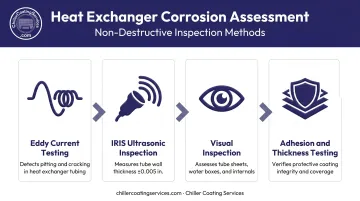
Regular visual and non-destructive inspections allow facilities teams to catch metal thinning and early-stage pitting before it progresses to leaks or failure. Key inspection methods:
- Eddy current testing: Identifies pitting, cracking, and vibration wear in heat exchanger tubing while in service
- IRIS ultrasonic inspection: Measures tube wall thickness with precision of ±0.005 in., detects corrosion and erosion
- Visual inspection: Confirms surface condition of tube sheets, water boxes, and accessible internals
- Adhesion and thickness testing: Verifies coating integrity where protective systems are in place
DOE/FEMP recommends cleaning condenser tubes at least annually and conducting eddy current testing as required. Pair inspections with periodic mechanical or chemical cleaning to remove fouling deposits before they trap corrosive agents against the metal surface. For higher-risk installations — aggressive fluid chemistry, older equipment, or coastal environments — semi-annual inspection is warranted.
Tips for Long-Term Corrosion Prevention and Control
Prevention only becomes sustainable when it is built into facility management routines.
Build these practices into ongoing operations:
- Establish a monitoring schedule that tracks thermal efficiency, pressure drop, and water chemistry trends over time. Use deviations as early warning triggers rather than waiting for visible damage.
- Train maintenance staff to recognize early corrosion indicators and understand the specific risks associated with the system's materials and fluid types.
- Maintain documentation of inspection findings, coating application dates, water treatment logs, and cleaning records — trends only emerge when there's a baseline to compare against.
- Schedule periodic professional assessments, including tube sheet coating inspections and reapplication, as part of a long-term asset protection plan.
- Deploy corrosion monitoring sensors and digital maintenance management systems to automate trend tracking and flag anomalies before they become failures.
For regulated facilities — hospitals, pharma operations, power plants, and data centers — complete service records directly support Joint Commission, ISO/GMP, NERC, and SOC 2 audit requirements.
Programs that sustain equipment performance over decades share one trait: scheduled, data-driven action taken before problems become visible.
Frequently Asked Questions
What are the three methods to prevent corrosion?
The three primary methods are: (1) barrier protection through coatings or linings, (2) electrochemical control via cathodic protection or sacrificial anodes, and (3) environmental control through chemical inhibitors and water treatment. Most industrial heat exchanger systems use a combination of all three, as no single method addresses every corrosion mechanism.
What does a corroded heat exchanger look like?
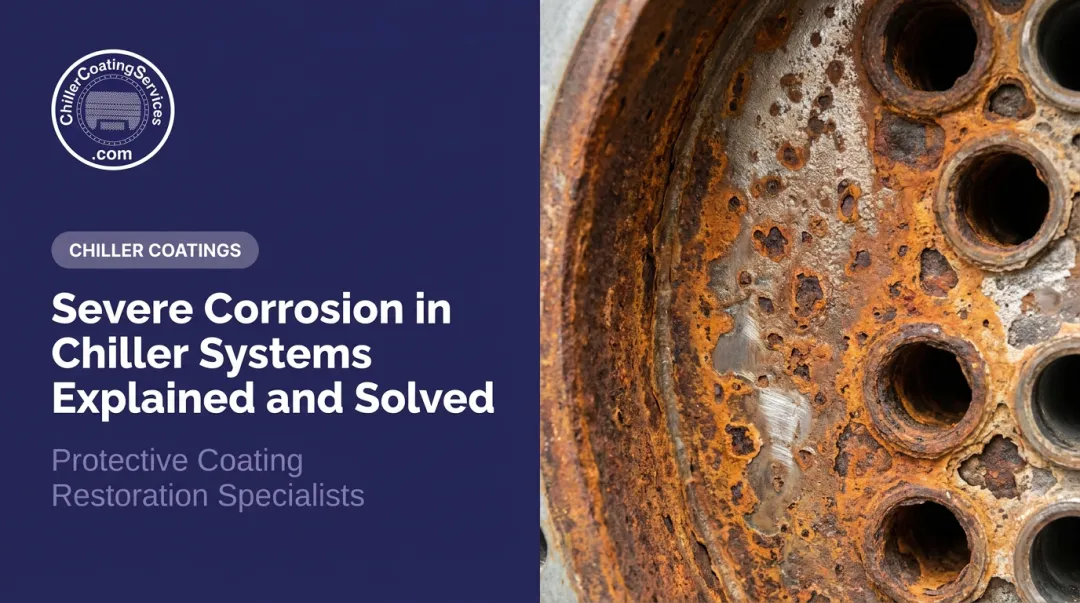
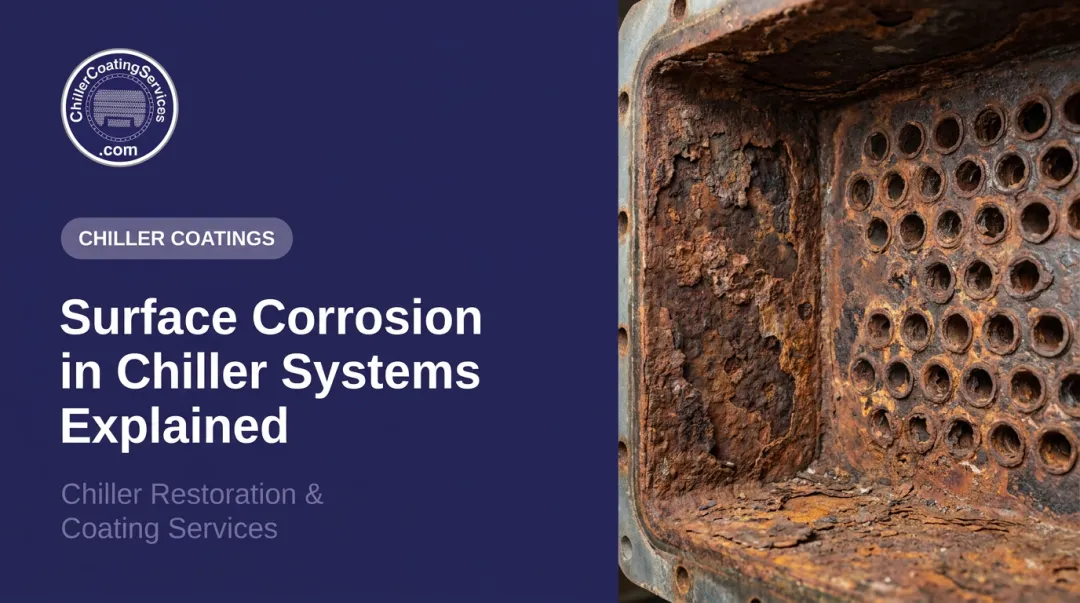
Common visible signs include reddish-brown rust staining, pitted or cratered surfaces on tube sheets, white or grey scale deposits on internal surfaces, and discoloration around tube-to-tube-sheet joints. In advanced cases, you may see visible perforations, structural distortion, or active leakage between fluid circuits.
What is the 10-13 rule for heat exchangers?
This rule of thumb suggests a fouled heat exchanger requires roughly 10–13% more energy to match the output of a clean unit. DOE/FEMP data supports the principle: fouling causes a 2.5–3.5% chiller energy increase per 1°F rise in condenser temperature, and a deposit-to-tube-diameter ratio of just 0.06 can double tube pressure drop.
How often should heat exchanger tube sheets be inspected for corrosion?
Annual professional inspection is the baseline for most commercial and industrial systems, per DOE/FEMP guidance. Higher-risk installations — aggressive fluid chemistry, aging equipment, or coastal environments — warrant semi-annual checks. Findings from each inspection should set the next interval.
Can a corroded heat exchanger be repaired, or does it need to be replaced?
Early-stage corrosion on tube sheets can often be rehabilitated through surface preparation, reconstruction, and professional coating — extending service life without full replacement. Active perforations or metal loss beyond what reconstruction can restore typically require bundle or unit replacement. A professional on-site inspection determines which path applies.