The risks go beyond operational efficiency. Leaking coolant from corroded components can contaminate building water systems, create slip hazards, and trigger compliance issues in regulated facilities like hospitals and schools. For facilities across New England — where seasonal temperature swings, oxygenated condenser water, and aging pre-2000 chiller fleets combine to accelerate deterioration — proactive corrosion management isn't optional.
This guide covers the four main corrosion types affecting facility heat exchangers, the warning signs to watch for, proven protection methods, and a practical maintenance schedule to keep systems performing long-term.
TL;DR
- Corrosion chemically or electrochemically degrades heat exchanger metal, reducing efficiency and structural integrity
- Four corrosion types affect facility heat exchangers: uniform, galvanic, pitting, and crevice — each requiring different prevention strategies
- Early warning signs include rising energy costs, inconsistent temperatures, visible rust or scaling, and unexplained leaks
- Combining water treatment, protective coatings, and routine inspection delivers better long-term results than any single approach alone
- Tie your maintenance schedule to actual usage and environmental conditions — that's what stops reactive, high-cost repairs before they start
Why Corrosion Protection Matters for Facility Heat Exchangers
Facility heat exchangers operate under conditions that actively drive corrosion. Fluctuating temperatures, mineral-laden water, dissimilar metals in contact, and high humidity all accelerate metal degradation — especially in New England climates where freeze-thaw cycling, oxygenated condenser water, and aging infrastructure compound the risk.
The Efficiency and Lifespan Impact
Corrosion doesn't just weaken metal — it impairs heat transfer. According to ASHRAE research on fouling in enhanced condenser tubes, deposits add measurable thermal resistance that forces systems to consume more energy to maintain target temperatures. Corroded and roughened surfaces make this worse, extending run times and pushing up utility costs.
At the structural level, untreated corrosion causes:
- Tube wall thinning from progressive metal loss
- Joint weakening at tube-to-tube-sheet interfaces
- Eventual tube-to-tube-sheet joint failure, which can allow water to enter the chiller and — as Carrier documents — severely damage the compressor or destroy the entire machine
ASHRAE puts the median service life of centrifugal chillers at greater than 25 years. Unchecked corrosion shortens that window significantly.
Compliance and Safety Risks
In regulated facilities, the stakes are higher. Hospitals and healthcare facilities under CMS and Joint Commission requirements must maintain water management programs and documented maintenance records. Leaking coolant from corroded components can contaminate building water systems and create compliance exposure under these frameworks.
Preventive vs. Reactive Cost
Those compliance risks make the cost argument even harder to ignore. Routine corrosion protection — water treatment, periodic inspection, and professional tube sheet coating — costs a fraction of emergency repair, full tube bundle replacement, or extended system downtime.
Consider the gap: a scheduled coating service runs thousands of dollars; an unplanned chiller failure with compressor damage can reach six figures and sideline critical cooling for days or weeks.
Common Types of Corrosion in Facility Heat Exchangers
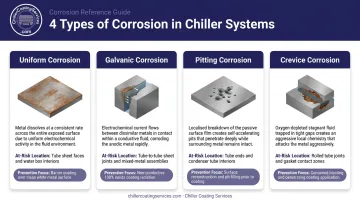
Not all corrosion looks the same. Identifying the type is the first step toward applying the right protection strategy. AMPP recognizes four primary corrosion modes relevant to water-side heat exchanger service.
Uniform Corrosion
Uniform corrosion distributes evenly across the metal surface, gradually thinning tube walls and tube sheets. It progresses slowly, but it progressively reduces structural integrity and heat transfer efficiency over time. Facilities with untreated or mildly acidic water are most susceptible.
Galvanic Corrosion
Galvanic corrosion occurs when dissimilar metals — such as copper tubes and steel tube sheets — are in electrical contact within an electrolyte like circulating water. The more active metal corrodes preferentially and progressively. Heat exchangers with mixed-metal construction in high-conductivity water are especially at risk.
Pitting Corrosion
Pitting creates small, localized holes that are difficult to detect during visual inspection but can penetrate deep enough to cause leaks. Chloride ions, stagnant water, and breakdown of passive metal films are common triggers. In pressurized chiller systems, even a small pit that breaches a tube wall can result in refrigerant-water cross-contamination — a failure mode that may require full tube bundle replacement.
Crevice Corrosion
Crevice corrosion develops in confined, poorly flushed spaces where stagnant water traps corrosive ions. Tube-to-tube-sheet joints, gasket interfaces, and baffle connections are the most common sites. This is one of the most frequent failure modes in shell-and-tube heat exchangers used in commercial facilities — and one of the hardest to catch without deliberate inspection.
Warning Signs That Your Heat Exchanger Needs Corrosion Attention
Catching corrosion early is the difference between a scheduled coating service and an emergency equipment failure. These indicators help facilities managers and engineers spot trouble during routine walkthroughs — before it escalates.
Performance and Efficiency Changes
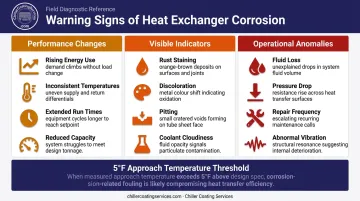
These operational shifts can indicate reduced heat transfer from corrosion deposits or tube wall thinning:
- Rising energy consumption with no corresponding change in load
- Inconsistent supply temperatures across the system
- Extended run times to reach setpoints
- Reduced chiller capacity during peak demand periods
Trane flags a condenser approach temperature greater than 5°F above expected clean performance as a threshold warranting investigation — a useful operational benchmark when trending approach temperature over time.
Visible Physical Indicators
During walkthroughs, watch for:
- Rust staining on tube sheets or headers
- Discoloration or scaling on heat exchanger surfaces
- Visible pitting or pockmarking on accessible metal components
- Coolant discoloration or cloudiness, suggesting contamination from corroded metals
Operational Anomalies
Non-visual warning signs that point to structural weakening from internal corrosion:
- Unexplained refrigerant or fluid loss
- Recurring pressure drop across the heat exchanger
- Increasing frequency of minor repairs
- Abnormal vibration or noise during operation
When visible indicators and operational anomalies appear together, the corrosion is rarely superficial. A professional inspection — including tube sheet and water box assessment — can determine whether surface restoration is still viable or whether structural damage has already set in.
Corrosion Protection Methods for Facilities
Effective corrosion protection is never a single solution. Facilities benefit from a layered strategy combining chemical treatment, physical barriers, and periodic professional servicing.
Water Treatment and Chemical Inhibitors
Controlling water chemistry is the first line of defense. A sound water treatment program includes:
- pH adjustment — Trane's closed chilled-water-loop guidance specifies pH 7.5–9.0 (note: pH above 9 is likely scale-forming); Johnson Controls publishes similar material-specific ranges. Always follow your OEM's specifications.
- Corrosion inhibitor dosing — formulated to protect the specific metals in your system
- Scale control — minimizes mineral buildup that concentrates corrosive ions
- Regular water analysis — catches chemistry drift before it causes damage
This is particularly relevant for New England facilities drawing on municipal water supplies with oxygenated condenser makeup water.
Protective Coatings for Tube Sheets and Internal Surfaces
Water treatment controls chemistry, but it can't repair metal that's already compromised. Protective coatings create a physical barrier directly on vulnerable surfaces — delivering protection that chemical programs alone cannot provide.
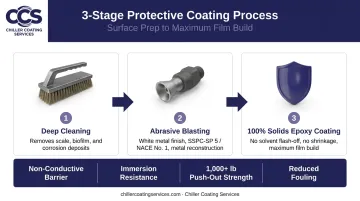
Chiller Coating Services applies a proprietary 100% solids epoxy coating system to heat exchanger tube sheets, tube ends, water boxes, and accessible internal surfaces. The process follows three steps:
- Deep cleaning removes scale, biofilm, and corrosion deposits from all treated surfaces
- Contained abrasive blasting to a white metal finish (SSPC-SP 5 / NACE No. 1 equivalent), with reconstruction of severely corroded areas before any coating is applied
- 100% solids coating application with no solvent flash-off, no shrinkage during cure, and maximum film build
Once cured, the coating system delivers several performance advantages that extend equipment life:
- Non-conductive barrier that electrically isolates dissimilar metals, stopping galvanic corrosion at its source
- Long-term immersion resistance without delamination or blistering
- Push-out strength increase of over 1,000 pounds in some cases at tube-to-tube-sheet joints
- Reduced fouling and inlet turbulence on treated surfaces
The quick-cure technology minimizes facility downtime — valuable in environments like hospitals and schools where extended outages aren't an option. Chiller Coating Services schedules work around facility calendars, including summer break windows for K-12 schools and shoulder seasons for healthcare facilities.
Cathodic Protection
Cathodic protection uses sacrificial anodes or impressed-current systems to divert electrochemical corrosion away from critical metal components. It's most applicable to large facility chillers or cooling water systems where galvanic corrosion is a recurring issue. The approach works best when combined with a protective coating, which addresses any coating holidays where bare metal would otherwise remain exposed.
Routine Inspection and Monitoring
Scheduled inspections catch early-stage corrosion before it becomes structural:
- Eddy current testing (ECT) — identifies defects, signs of corrosion, and eroded pitting in conductive tubing; Carrier recommends a condenser-tube scan every 5 years
- Ultrasonic testing — volumetric examination for tube wall thickness loss
- Water quality monitoring — validates that chemistry controls remain within acceptable ranges
Inspection frequency should increase in high-usage or chemically aggressive environments, including coastal facilities and healthcare campuses.
Corrective Maintenance When Corrosion Is Found
When corrosion is discovered, the response depends on severity:
- Minor pitting → tube plugging or targeted replacement
- Surface corrosion on tube sheets → resurfacing, reconstruction of lost metal, and recoating
- Severe degradation across the bundle → full bundle replacement
Early intervention is far less costly than waiting for a failure event. Coating-based restoration is specifically designed to prevent facilities from reaching the threshold where bundle replacement becomes unavoidable.
Heat Exchanger Corrosion Protection Schedule
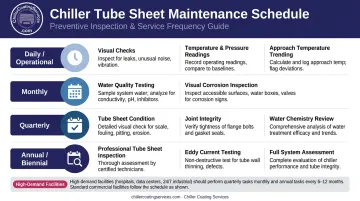
Recommended intervals vary based on facility type, water quality, system usage, and equipment age — but the following framework provides a practical planning baseline.
| Frequency | Tasks |
|---|---|
| Daily / Operational | Visual checks, temperature and pressure readings, approach temperature trending |
| Monthly | Water quality testing, visual corrosion inspection of accessible surfaces |
| Quarterly | Tube sheet condition check, joint integrity review, water chemistry analysis review |
| Annual / Biennial | Professional tube sheet inspection and recoating evaluation, eddy current testing of tubes, full system assessment |
Inspection frequency should reflect actual operating conditions:
- High-demand facilities (hospitals, manufacturing plants, data centers, coastal buildings): compress each interval — monthly tasks become bi-weekly, quarterly tasks become monthly
- Standard-utilization facilities (office buildings, retail, schools): the baseline schedule above applies directly
Following a consistent schedule keeps water treatment, inspections, and professional coating work aligned — so small corrosion issues get caught before they become tube failures or emergency replacements.
Frequently Asked Questions
What is corrosion in a heat exchanger?
Corrosion is the gradual electrochemical or chemical deterioration of metal surfaces inside a heat exchanger, caused by reactions with water, oxygen, dissolved minerals, or incompatible metals. Over time, it produces material loss, leaks, and reduced heat transfer efficiency.
What is the difference between fouling and corrosion?
Fouling is the accumulation of deposits — scale, biofilm, sediment — on heat transfer surfaces that reduces efficiency. Corrosion is actual degradation of the metal itself. Both reduce performance, but they require different remediation approaches: cleaning for fouling, repair and coating for corrosion.
What are the 4 types of heat exchangers?
The four main configurations are shell-and-tube, plate, air-cooled (finned-tube), and double-pipe heat exchangers. Shell-and-tube designs are the most common in commercial facility HVAC and chiller systems and share the same corrosion vulnerabilities addressed in this guide.
What is Type II hot corrosion?
Type II hot corrosion is a sulfate-induced degradation mechanism affecting gas turbine alloys at roughly 650–750°C. It is not relevant to building HVAC heat exchangers, which face aqueous corrosion mechanisms — galvanic, pitting, uniform, and crevice — under very different operating conditions.
How often should heat exchanger tube sheets be inspected for corrosion?
Annual professional inspection is the minimum standard. High-usage systems or facilities with aggressive water chemistry — hospitals, coastal facilities, manufacturing plants — should add quarterly visual checks between annual assessments.
Can protective coatings extend the life of a corroded heat exchanger?
Yes. Professional coatings arrest active corrosion, rebuild lost metal, and create a durable non-conductive barrier against future attack. Chiller Coating Services has documented push-out strength increases of over 1,000 pounds at tube-to-tube-sheet joints following coating, restoring structural integrity at a fraction of full replacement cost.