What separates facilities that manage corrosion effectively from those that face costly emergency repairs isn't access to better equipment. It's understanding the specific mechanisms at work in chiller systems — and acting on that knowledge before damage becomes structural.
This article breaks down the four root causes of pipe corrosion in chiller systems, explains what happens when corrosion is ignored, and outlines a layered prevention strategy that extends equipment life and reduces total cost of ownership.
Key Takeaways
- Four mechanisms drive chiller pipe corrosion: galvanic reactions, water chemistry imbalances, erosion-corrosion/cavitation, and microbiologically influenced corrosion (MIC).
- Watch for discolored coolant, pitted tube sheet faces, and unexplained pressure drops — all signal corrosion before failure occurs.
- Effective prevention combines water treatment, protective coatings, regular inspection, and controlled flow conditions.
- Tube sheet coating restores severely corroded components and extends service life — without full bundle replacement.
- Scheduled coating and maintenance typically costs a fraction of emergency repair or early chiller retirement.
Common Causes of Pipe Corrosion in Chiller Systems
Pipe corrosion in chiller systems is the electrochemical or mechanical deterioration of metal surfaces across pipes, tube sheets, and heat exchanger tubes. The risk profile is specific to these systems: closed-loop or semi-open water circuits, multiple dissimilar metals in direct contact, and continuous high-velocity fluid flow create conditions that standard plumbing never sees.
These causes rarely operate in isolation. When two or more occur together, each amplifies the damage rate of the others.
Galvanic Corrosion from Dissimilar Metals
Galvanic corrosion occurs when two metals with different electrochemical potentials — copper tubes and steel or cast iron tube sheets, for example — are in electrical contact within a conductive fluid. The circulating chilled water acts as an electrolyte, completing a battery-like circuit that drives progressive metal loss from the less noble material.
This pairing is extremely common in chiller heat exchangers. As AMPP documents, aluminum components in contact with copper-containing aqueous solutions face a compounding risk: copper ions deposit on the aluminum surface, creating localized galvanic cells that accelerate corrosion even without direct metal-to-metal contact. The tube-to-tube-sheet interface is ground zero for this mechanism.
Water Chemistry Imbalance
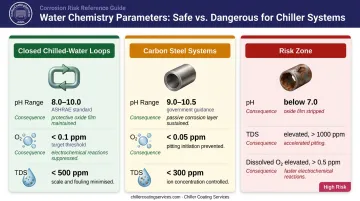
Chilled water loops and cooling tower circuits are highly sensitive to pH, dissolved oxygen, and total dissolved solids (TDS).
- Low pH (acidic conditions): Aggressively strips the protective oxide film from metal surfaces
- High dissolved oxygen: Accelerates oxidation and pitting attack on unprotected metal
- High TDS: Increases the conductivity of the circulating water, speeding up electrochemical reactions
ASHRAE Journal guidance specifies pH 8.0–10.0 for closed chilled-water loops, with some U.S. government facilities guidance recommending pH 9.0–10.5 for carbon steel systems. Open cooling tower circuits face additional pressure: evaporation cycles, makeup water addition, and chemical carryover regularly shift water chemistry outside the safe operating range. Even small pH deviations sustained over weeks can produce measurable pipe wall thinning.
Erosion-Corrosion and Cavitation at Tube Inlets
High-velocity coolant flow — particularly at tube sheet inlets and elbows — physically strips away the metal's protective surface layer through two mechanisms working together: mechanical erosion from fluid turbulence and cavitation from the collapse of vapor bubbles under rapid pressure changes.
This damage concentrates at the first few inches of chiller tubes and at tube-to-tube-sheet joints. Common triggers include:
- Oversized pumps delivering excess flow velocity
- Incorrect flow balancing across tube bundles
- Partially blocked tube bundles forcing remaining tubes to carry excess load
- Worn inlet edge geometries from previous corrosion events
ASHRAE educational material cites a minimum of 3 ft/s to limit fouling, with a design example ceiling around 6.6 ft/s for copper tubes. Check OEM specs for your tube material — copper limits differ from titanium or stainless steel.
Microbiologically Influenced Corrosion (MIC)
Sulfate-reducing bacteria (SRB) and iron-oxidizing bacteria found in condenser water produce corrosive byproducts, including hydrogen sulfide and organic acids, that attack metal surfaces from within. MIC is dangerous because it creates localized, deep pits that are visually undetectable until significant structural damage has already occurred.
Conditions that allow MIC to establish and thrive:
- Stagnant water zones and dead-leg piping sections
- Inadequate or inconsistent biocide treatment
- Warm water temperatures in the cooling tower basin (measured field study values ranged from 20.1–32.3°C)
- Infrequent system flushing that allows biofilm to form on tube and tube sheet surfaces
CDC guidance recommends flushing low-flow pipe runs and dead legs at least weekly to prevent stagnant zones from becoming biological incubators.
What Happens If Pipe Corrosion Is Ignored
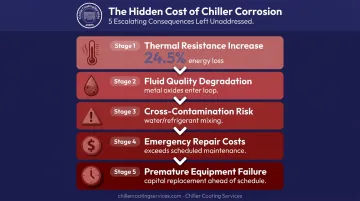
Left unaddressed, pipe corrosion escalates from efficiency losses to full system failure:
- Corrosion deposits and pitting on tube surfaces increase thermal resistance significantly. One Australian HVAC case study documented a minimum 24.5% reduction in electrical energy consumption after addressing condenser tube fouling alone.
- Dissolved metal oxides from active corrosion enter the chilled water loop, degrading fluid quality and eroding pumps, valves, and controls downstream.
- Advanced pitting at tube-to-tube-sheet joints leads to water-side and refrigerant-side cross-contamination — among the costliest failure modes in chiller operation.
- A mid-season chiller failure disrupts building operations entirely, with emergency repair costs that routinely dwarf what scheduled maintenance would have run.
- Corrosion-driven damage pushes equipment past its design life faster, forcing capital replacement years ahead of schedule.
Knowing the consequences is only half the picture. These warning signs indicate corrosion is already active — and that intervention is overdue:
Warning Signs You're About to Have a Serious Corrosion Problem
- Rust-colored, brown, or milky chilled water points to dissolved metal oxides or biological contamination — both signs of active internal corrosion.
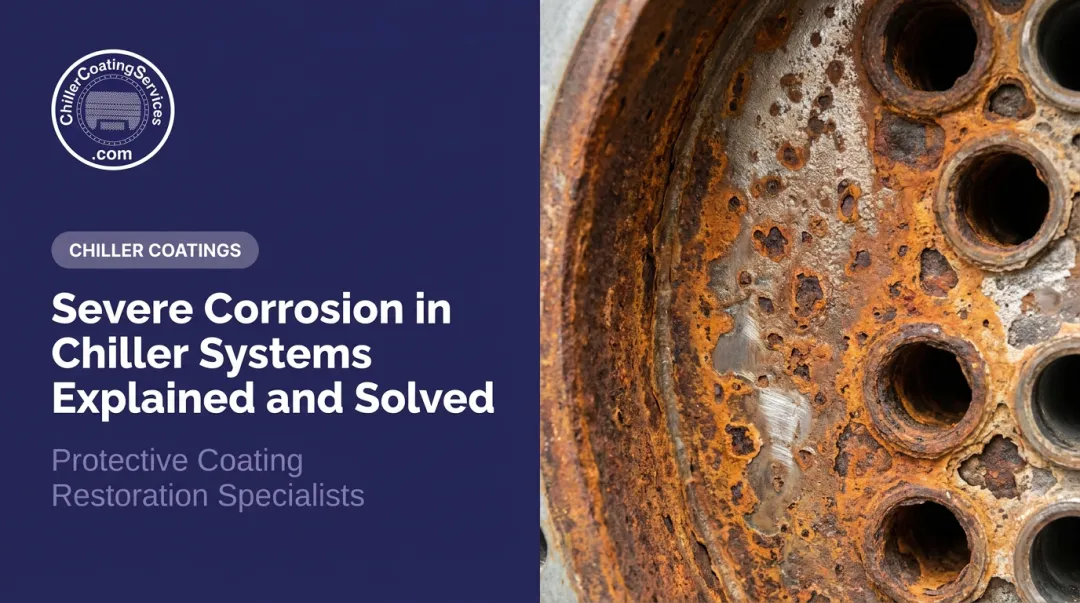
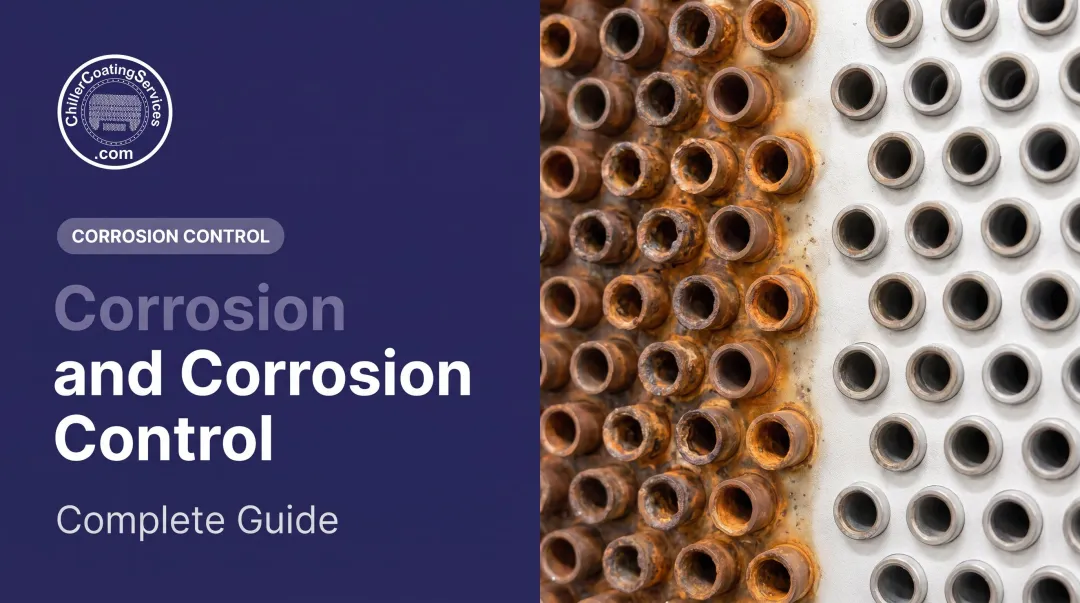
- During any scheduled maintenance opening, etching, pitting, or powdery deposits on the tube sheet face are direct physical evidence of corrosion at the tube-to-tube-sheet interface.
- When corrosion products build up on heat-transfer surfaces, the chiller works harder for the same output — showing up as higher energy bills or an inability to meet setpoints at peak load.
How to Prevent Pipe Corrosion in Chiller Systems
Effective corrosion control is a layered strategy. No single measure is sufficient on its own — water treatment, physical protection, regular monitoring, and controlled hydraulics must work together. Each layer addresses failure modes the others cannot.
Implement and Maintain a Water Treatment Program
A formal water treatment program is the foundation of corrosion prevention in any chiller system.
A complete program addresses:
- pH control within the appropriate range for your system's metallurgy (ASHRAE Journal guidance cites pH 8.0–10.0 for closed chilled-water loops)
- Dissolved oxygen management through oxygen scavengers
- Biological control through biocides that prevent biofilm and MIC
- Corrosion inhibitors appropriate for system metals — ASHRAE Journal guidance lists 200–500 ppm molybdate as a preferred inhibitor for chilled-water systems (molybdate is favored over nitrite because nitrite can support biological growth)
- TDS control through blowdown in open cooling tower circuits
For glycol-based systems, use inhibited glycol formulations and test inhibitor concentration at least annually. Dow's technical guidance recommends covering concentration, pH, reserve alkalinity, and inhibitor condition at each annual analysis.
Apply Protective Coatings to Tube Sheets and Pipe Entry Points
Water treatment controls chemistry, but it cannot create a physical barrier between dissimilar metals or restore metal lost to pitting. Protective coatings fill that gap, providing a physical and electrochemical barrier that addresses galvanic corrosion, erosion-corrosion, and pitting simultaneously.
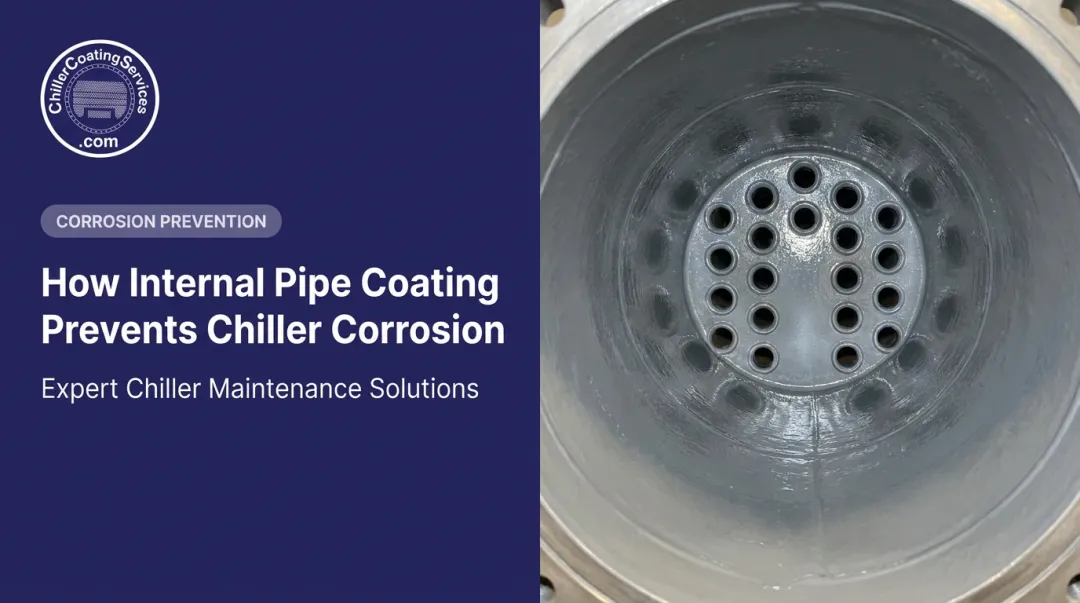
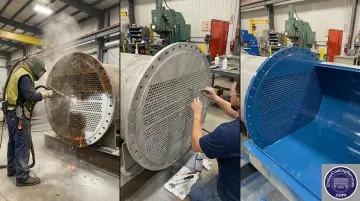
Our 100% solids epoxy coating system is specifically formulated for chiller tube sheets, tube ends, and water box interiors. The three-step process:
- Deep cleaning — removes biofilm, scale, and corrosive deposits to expose sound metal
- Contained abrasive blasting to white metal finish (SSPC-SP 5 / NACE No. 1) — removes all mill scale, rust, and contamination, creating the surface profile required for maximum coating adhesion; severely corroded areas are reconstructed to restore metal thickness before coating is applied
- 100% solids coating application — applied to tube sheets, tube ends, and water box interiors
The 100% solids chemistry delivers no solvent flash-off, no VOC emissions, no shrinkage during cure, and a structurally denser cured film than conventional 50–80% solids coatings.
The non-conductive formulation eliminates the electrolytic pathway between dissimilar metals, stopping galvanic corrosion at its source. At tube-to-tube-sheet joints, the coating delivers documented push-out strength increases of over 1,000 pounds in some cases, reinforcing the mechanical connection where corrosion most commonly causes joint failure.
When to implement: During scheduled maintenance shutdowns (fall or spring shoulder season is ideal), at the first signs of surface deterioration, or proactively when commissioning a system in a high-corrosion-risk environment.
Conduct Regular Inspection and Water Quality Testing
Scheduled inspection catches problems before they become structural.
- Visual inspection: Review accessible tube sheet faces and pipe surfaces during every maintenance opening — minimum annually
- Eddy current testing (ECT): Non-destructive evaluation of tube wall thickness; the Heat Exchange Institute identifies ECT as a principal method for heat exchanger tubing inspection
- Water chemistry testing: Monthly at minimum for chilled water and cooling tower circuits, with increased frequency during peak cooling season
Document all findings with photos and test data. Tracking corrosion progression over time allows corrective action before deferred maintenance compounds the cost.
Manage Flow Velocity and System Hydraulics
Controlling velocity addresses both erosion-corrosion and MIC in one step.
Key actions:
- Verify pump sizing and flow balancing keep velocity within the appropriate range for your tube material and OEM specifications
- Eliminate dead-leg zones where stagnant water allows biofilm and MIC bacteria to establish
- Flush low-flow pipe runs and dead legs regularly — CDC recommends at least weekly for cooling tower-connected systems
Controlled velocity reduces mechanical erosion at tube inlets, prevents cavitation at high-turbulence zones, and eliminates the stagnant conditions that MIC requires to gain a foothold.
Tips for Long-Term Prevention and Control
These practices support consistent corrosion control across the full service life of a chiller system:
- Routine monitoring schedule: Establish defined intervals for water chemistry testing, inhibitor concentration checks, and visual inspection — then log every result to identify trends before they become failures.
- Staff training and written procedures: Maintenance personnel need working knowledge of water treatment requirements, plus written protocols for adding inhibitors, interpreting test results, and escalating abnormal findings.
- Systematic documentation: Keep inspection records that include photos, eddy current test data, and coating condition assessments. These support capital planning, warranty claims, and compliance audits for healthcare (Joint Commission/CMS), manufacturers (ISO/FDA/GMP), and data centers (SOC 2).
- Inline monitoring technology: Consider installing pH, conductivity, and ORP sensors in the chilled water circuit for continuous real-time monitoring. Automated alerts allow faster response to chemistry excursions before corrosion damage accumulates between scheduled tests.
Conclusion
Pipe corrosion in chiller systems has identifiable causes — galvanic reactions between dissimilar metals, water chemistry imbalances, erosion-corrosion and cavitation at tube inlets, and microbiologically influenced corrosion — and each can be addressed through targeted, layered prevention measures.
The numbers favor proactive maintenance every time. Water treatment programs, protective coatings, and regular inspection cost a fraction of what emergency repairs, coolant contamination events, or premature chiller replacement demand. Facilities managers and building owners who treat corrosion prevention as an operational investment extend equipment service life, reduce unplanned downtime, and avoid the far steeper costs that deferred maintenance always brings.
Frequently Asked Questions
What does pipe corrosion look like in a chiller system?
Common signs include pitting or etching on tube sheet faces, rust-colored or cloudy coolant, powdery oxide deposits at tube inlets, and green or reddish-brown surface staining on exposed metal components. Multiple signs appearing at once typically indicate corrosion that has been active for some time.
How do you fix corroded pipes in a chiller system?
The approach depends on severity. Minor surface corrosion responds to cleaning, water chemistry correction, and protective coating application; moderate pitting may require tube plugging or retubing. Severe cases with significant metal loss require area reconstruction before any coating is applied.
Do corroded pipes need to be replaced?
Not always. Early-stage corrosion can often be arrested through protective coatings and water treatment adjustments, extending service life without full replacement. Pipes or tubes with structural wall thinning, active leaks, or joint failure should be replaced promptly.
What is the most common type of corrosion found in chiller systems?
Galvanic corrosion and pitting corrosion are the most frequently encountered types in chiller heat exchangers. The combination of dissimilar metals — copper tubes meeting steel or cast iron tube sheets — and continuous water exposure creates ideal conditions for both to develop simultaneously.
How often should chiller pipes and tube sheets be inspected for corrosion?
Visual inspection should occur at each maintenance shutdown (at minimum annually), and water chemistry should be tested monthly — more often during peak cooling season. Eddy current tube testing is appropriate every few years, or sooner if wall thinning or early corrosion signs appear.
Can pipe corrosion in a chiller system affect energy efficiency?
Yes. Corrosion deposits and pitting on heat-transfer surfaces increase thermal resistance, forcing the chiller to run longer and consume more energy to meet the same cooling load. This shows up directly in higher operating costs and reduced system capacity during peak demand periods.