Introduction
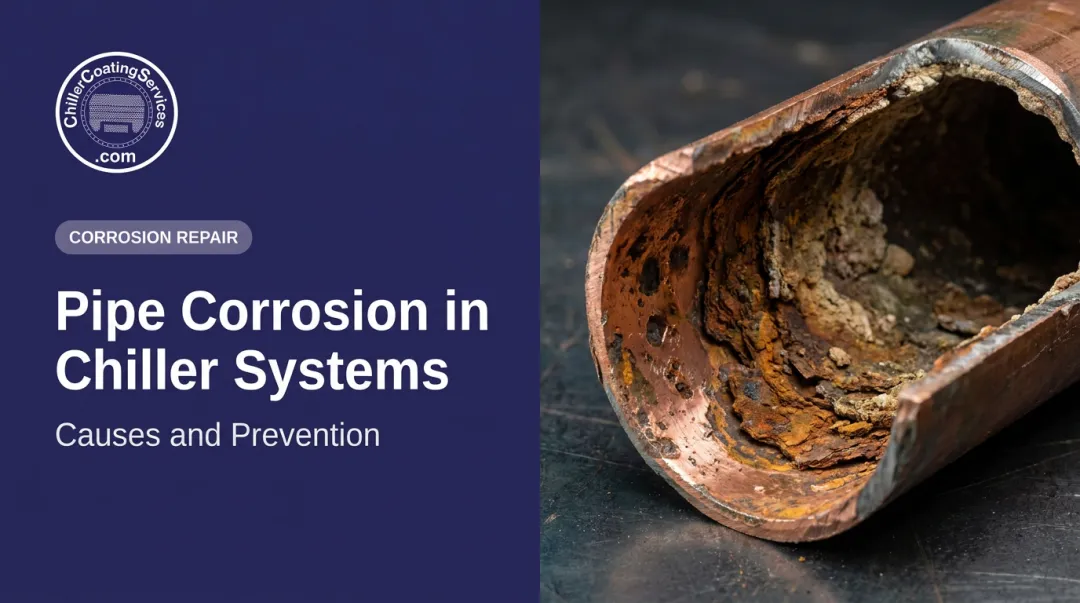
Chiller systems in commercial buildings, hospitals, and industrial facilities face a silent threat. Circulating water, dissolved minerals, dissimilar metals, and constant temperature cycling create conditions where internal corrosion can progress for months (sometimes years) before it produces visible consequences.
The real cost doesn't show up in water chemistry reports. It shows up in failed tube-to-tube-sheet joints, coolant contamination, emergency shutdowns, and six-figure chiller replacements that no capital budget anticipated.
Internal pipe coating addresses this directly. By applying a protective barrier to chiller tube sheets, tube ends, and water box interiors, it eliminates the electrochemical and mechanical conditions that drive corrosion — before damage accumulates. What follows covers how that protective mechanism works, what measurable advantages it delivers, and the specific risks facilities take on when corrosion protection is skipped.
Key Takeaways
- Internal pipe coating creates a non-conductive barrier that stops galvanic corrosion at tube-to-tube-sheet joints
- A 100% solids epoxy system resists erosion, cavitation, fouling, and aggressive water chemistry
- Properly applied coatings reinforce tube-to-tube-sheet joint strength, with push-out strength gains exceeding 1,000 lbs in some cases
- Smooth, coated surfaces reduce fouling accumulation and help maintain design thermal efficiency
- Quick-cure coating systems allow application during planned outage windows with minimal downtime
What Is Internal Pipe Coating for Chillers?
Internal pipe coating is a protective layer applied to chiller internals — tube sheets, tube ends, water boxes, and accessible condenser and evaporator surfaces. Its purpose is to stop corrosive degradation driven by water chemistry, electrochemical reactions, and mechanical wear.
These surfaces sit in constant contact with circulating water, endure pressure cycling, and bridge dissimilar metals in an electrolyte-rich environment. They're where corrosion starts — and where protection matters most.
Where It's Applied
Chiller Coating Services applies its proprietary 100% solids epoxy system to:
- Tube sheet faces, with full coverage to block galvanic attack and pitting
- Tube ends (inlet side), where velocity-induced erosion and cavitation hit hardest
- Water boxes and end bells, including inlet/outlet nozzles and the water box-to-tube-sheet seal area
- Baffle plates and accessible heat exchanger internals in condenser and evaporator sections
Each surface receives the same three-step process: deep cleaning, contained abrasive blasting to white metal finish, and 100% solids coating application. Severely corroded areas are reconstructed before coating goes on — because coating over compromised metal produces premature failure, not protection.
Key Advantages of Internal Pipe Coating for Chillers
Advantage 1: Stops Galvanic Corrosion Before It Starts
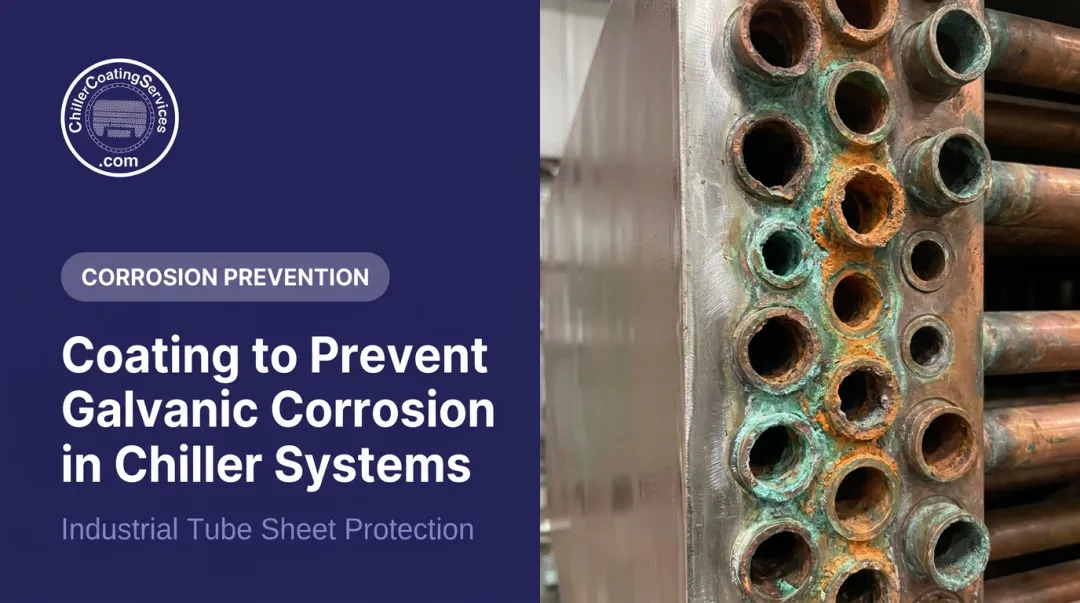
Chiller tube sheets are uniquely exposed to galvanic attack. Where copper or copper-alloy tubes terminate into carbon steel or cast iron tube sheets, two metals with different electrochemical potentials meet in a conductive water environment. ASHRAE's reference data places copper at -0.2 V and mild steel and cast iron at -0.6 V versus a silver/silver-chloride electrode in seawater — a 0.4 V potential difference that, combined with area-ratio effects and dissolved minerals, drives accelerating metal loss at the joint.
The coating eliminates this by breaking the circuit entirely.
How the mechanism works:
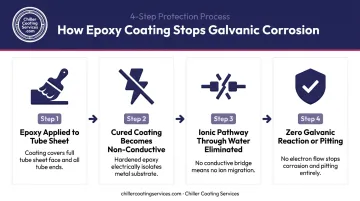
- The 100% solids epoxy is applied across the full tube sheet face and tube ends
- The cured coating is electrically non-conductive — it insulates the metal from the surrounding water
- Without an ionic pathway through the water, electrons cannot flow between dissimilar metals
- No electron flow means no galvanic reaction, no pitting, and no joint degradation
The choice of 100% solids chemistry matters here. Solvent-based coatings (typically 50–80% solids) shrink during cure, leaving micro-voids that allow water infiltration. A 100% solids system cures with zero shrinkage, producing a denser film without the pinholes that would restore the electrolytic pathway.
When this matters most:
- Older chillers showing early pitting or discoloration at tube ends
- Systems using dissimilar metals without material-matched tube sheets
- Facilities with poor water treatment programs or pH below Trane's specified range of 7.5–9.0
- Buildings in coastal New England or NYC where water chemistry compounds corrosion risk
KPIs directly affected: corrosion-related maintenance incidents, coolant contamination events, tube-to-tube-sheet joint integrity, unplanned downtime frequency.
Advantage 2: Extends Structural Integrity and Equipment Service Life
Galvanic corrosion is one mechanism — but chiller tube sheets also face erosion from high-velocity water flow, cavitation at inlet nozzles, and cyclic mechanical stress from pressure fluctuations. Each of these degrades joint integrity over time, independent of water chemistry.
ASHRAE's service-life database reports a 25-year median for centrifugal chillers under documented operating conditions. Equipment approaching that threshold — particularly when corrosion has been active — faces accelerating structural risk at the tube-to-tube-sheet joint. A 2019 IOP peer-reviewed case study documented erosion-corrosion progressing to condenser tube failure in a water-cooled centrifugal chiller, confirming that this failure mode is not theoretical.
What coating contributes structurally:
- Physical barrier against erosion and cavitation damage at tube ends and inlet nozzles
- Reinforcement of the tube-to-tube-sheet joint interface — with push-out strength increases of over 1,000 lbs documented in some cases
- Reduced inlet turbulence, which decreases the mechanical forces that progressively weaken the joint
For facilities operating chillers past their expected service interval, or managing multiple units across a portfolio, coating a chiller that would otherwise require replacement directly defers capital expenditure. When NewYork-Presbyterian Queens replaced a failed 1,100-ton absorption chiller, the whole-project cost reached $1.9M — a figure that reframes what preventive coating costs.
When this situation applies:
- Chillers approaching or past the 20–25 year service range
- High-pressure or high-velocity water systems where erosion is accelerated
- Hospitals, data centers, and manufacturing plants where chiller failure triggers serious downstream consequences
- Facilities under budget pressure seeking to defer CapEx replacement
Metrics this moves: equipment service life (years), joint push-out strength, emergency repair frequency, capital expenditure planning.
Advantage 3: Improves Efficiency and Reduces Operating Costs
Pits, scale deposits, and biofilm roughen tube surfaces — increasing friction, reducing heat transfer, and driving up energy consumption for the same cooling output.
Trane's technical documentation attributes a 34% reduction in heat-transfer efficiency and a 21% increase in energy consumption to just 0.6 mm of scale buildup. ASHRAE's fouling factor data frames this in engineering terms: untreated condenser water carries a fouling resistance of 0.003 h·ft²·°F/Btu — twelve times the design allowance for a well-maintained closed-loop chiller.
Coating addresses this through surface quality, not chemistry alone:
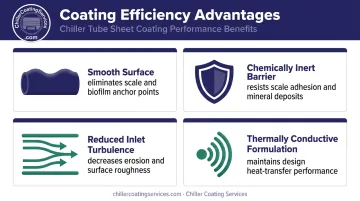
- Smooth surface — eliminates the irregular topography where scale and biofilm anchor
- Chemically inert barrier — resists scale adhesion and mineral deposit buildup
- Reduced inlet turbulence — decreases erosion that creates new surface roughness
- Thermally conductive formulation — engineered to maintain heat-transfer performance, not impede it
Unlike a corroded surface — which degrades progressively, pushing energy cost per ton higher each season — a coated surface arrests that decline at the point of application and holds closer to design efficiency over the long term.
Where the efficiency gains are most pronounced:
- Large commercial buildings and industrial facilities with substantial cooling loads
- Facilities with energy reduction targets or sustainability reporting requirements
- Operations where cooling uptime is directly tied to business continuity or patient/occupant safety
Metrics this moves: chiller energy consumption (kW/ton), fouling frequency and severity, chemical treatment costs, maintenance labor hours, annual energy spend.
What Happens When Chiller Pipe Coating Is Skipped
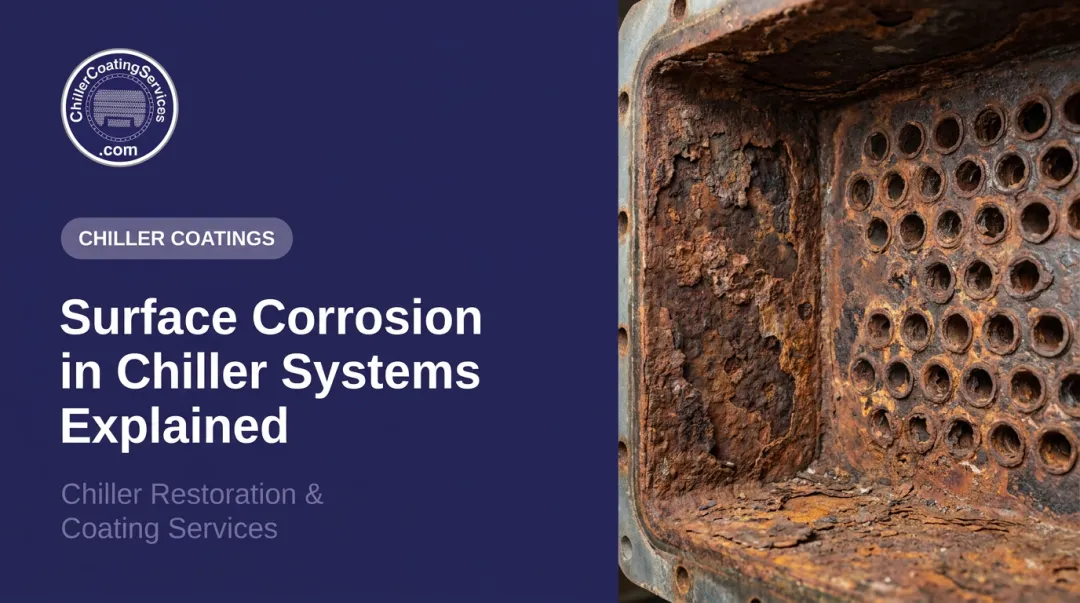
Without a protective barrier, corrosion starts the moment water chemistry contacts bare metal. It develops silently — and by the time it's visible, the damage is already expensive.
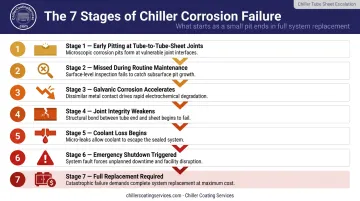
The typical escalation pattern:
- Early-stage pitting develops at tube-to-tube-sheet joints during normal operation
- Pitting is missed or underestimated during routine maintenance
- Galvanic corrosion accelerates as protective oxide films break down
- Joint integrity weakens — push-out strength drops progressively
- Coolant loss begins through compromised joint interfaces
- Emergency shutdown is triggered by tube blowout or cross-contamination
- Full tube sheet replacement or chiller replacement becomes the only viable path
Financial and operational consequences:
- Rising reactive maintenance costs year-over-year
- Shortened equipment service life relative to ASHRAE benchmarks
- Unplanned capital expenditures that disrupt CapEx planning cycles
- Degraded thermal efficiency driving up annual energy spend
- Operational shutdowns in hospitals, data centers, and manufacturing plants that carry consequences far exceeding the cost of the chiller itself
How to Get the Most Value from Chiller Pipe Coating
Coating performance is entirely dependent on three things done correctly.
Three factors determine whether a coating investment holds for the long term or fails prematurely:
Surface preparation. AMPP's SSPC-SP 5 / NACE No. 1 white metal blast cleaning standard defines the minimum preparation level before any long-term immersion coating is applied. Chiller Coating Services treats this as non-negotiable — every tube sheet, tube end, and water box is blasted to white metal finish before coating goes on. Shortcuts in surface prep are the most common cause of premature failure.
Reconstruction before coating. Where corrosion has consumed structural metal, coating over the void doesn't restore the joint — it fails on top of it. Severely corroded areas require reconstruction to restore tube sheet thickness and joint integrity first.
Application by experienced crews. A 100% solids system applied correctly delivers zero VOC emissions, zero shrinkage, and maximum film build (approximately 10 mils per coat). Applied incorrectly — wrong thickness, incomplete coverage at joint interfaces, inadequate cure time — those properties are irrelevant. Chiller Coating Services' 40+ years of management team experience in industrial coatings is what keeps projects off that second list.
Beyond the initial application, treat recoating as scheduled maintenance, not a crisis response. Periodic inspection at planned maintenance intervals — typically annually during shoulder-season outage windows — catches coating wear before corrosion restarts. Identifying degradation early costs a fraction of what emergency repair or tube sheet replacement demands.
Conclusion
Internal pipe coating works because it eliminates the conditions that allow chiller corrosion to begin. A non-conductive, chemically resistant barrier stops galvanic attack, resists erosion and fouling, reinforces joint integrity, and maintains the smooth surface that preserves thermal efficiency. Each of those outcomes compounds over time.
A chiller coated correctly at its first maintenance interval avoids years of incremental degradation, translating directly into lower operating costs, fewer emergencies, and a longer serviceable life.
For facilities managers and engineers across New England and New York, that outcome is entirely achievable. Chiller Coating Services has spent over 40 years helping hospitals, data centers, schools, and industrial facilities protect their systems with minimal downtime — and documented service records to back it up.
Frequently Asked Questions
What causes corrosion inside chiller tubes and tube sheets?
Chiller corrosion is primarily driven by galvanic reactions between dissimilar metals (copper tubes meeting steel or cast iron tube sheets), combined with dissolved oxygen, minerals in circulating water, and mechanical stressors like cavitation and erosion. Every operating chiller faces these conditions; the difference is whether a protective barrier is in place.
How does internal pipe coating prevent galvanic corrosion in chillers?
The coating applies a non-conductive barrier directly to the tube sheet face and tube ends, electrically insulating the metal from the surrounding water. Without an ionic pathway through the water, dissimilar metals cannot exchange electrons — the electrochemical circuit is broken, and galvanic attack cannot proceed.
Does internal pipe coating affect chiller heat transfer efficiency?
Properly applied thin-film coatings are formulated to maintain thermal conductivity while providing a smooth, fouling-resistant surface. The efficiency gains from reduced fouling and eliminated corrosion byproducts consistently outweigh any marginal thermal resistance the coating layer itself adds.
How long does a chiller tube sheet coating last?
Professionally applied 100% solids coatings over a white metal blast finish are built for long-term immersion service, with surface preparation quality being the primary factor in how long protection holds. Operating conditions also affect longevity. Contact Chiller Coating Services at (877) 427-0090 for a project-specific assessment.
Can internal pipe coating be applied to an existing chiller without replacing it?
Yes. Coating is applied to in-service chillers during scheduled maintenance downtime — this is the standard application scenario. Quick-cure coating systems minimize the outage window, and severely corroded areas can be reconstructed before coating to restore structural integrity without requiring tube sheet or bundle replacement.
How often should chiller tube sheets be inspected for coating wear or corrosion?
Inspection at each planned maintenance interval — typically annually during fall or spring shoulder seasons — is the recommended approach. Catching early coating wear before corrosion restarts keeps protection intact and avoids the escalating costs of deferred action or emergency repair.