
Neglecting that cleaning has real consequences: rising pressure drop, declining heat transfer, higher energy consumption, and - left long enough — accelerated corrosion that shortens equipment life considerably. According to SWEP, a 30% or greater increase in pressure drop versus nominal performance is a confirmed indicator that BPHE cleaning is required.
This guide covers why BPHE cleaning matters, which methods actually work, a step-by-step CIP process, warning signs to watch for, and a practical maintenance schedule.
Key Takeaways
- BPHEs are permanently sealed — chemical CIP cleaning is the only viable method
- Fouling and scale reduce thermal efficiency, raise pressure drop, and increase operating costs
- Use 5% phosphoric acid for routine mineral scale, or 5% oxalic acid for heavier buildup
- Never use chloride-based cleaners — they cause irreversible pitting corrosion on stainless steel
- A 30% pressure drop increase above baseline is your primary cleaning trigger
- Clean every 3–6 months in high-fouling environments, or every 6–12 months under standard conditions
Why Cleaning Brazed Plate Heat Exchangers Matters
Fouling in a BPHE doesn't happen all at once — and it compounds fast. Two distinct mechanisms drive it, and both attack performance from different angles.
Biological and Particulate Fouling
Suspended solids, organic material, and biological matter in process fluids colonize heat transfer surfaces as biofilm. Once established, biofilm is difficult to dislodge mechanically, and in a BPHE's narrow channels, even partial blockage dramatically reduces flow and heat transfer capacity.
Mineral Scale (Crystallization Fouling)
Dissolved minerals in hard water — primarily calcium carbonate and calcium sulfate — precipitate as scale when water temperatures rise. CIBSE research on BPHE water quality notes that scaling is rarely found when wall temperatures stay below 65°C, making high-temperature applications the primary risk zone.
The Performance Penalty
Both fouling mechanisms attack performance simultaneously but differently:
- Biofilm and scale add thermal resistance across plates, cutting heat transfer efficiency
- Debris and crystalline deposits narrow the already-tight internal channels, raising pressure drop
- Pumps work harder to compensate, consuming more energy for less output
The result is a system spending more to do less. How quickly this happens depends partly on your water supply. NYC's municipal water hardness ranges from 18–100 mg/L CaCO3 (average 32 mg/L), which accelerates scale formation. Most New England supplies run softer — Boston's MWRA at approximately 16 mg/L, Hartford's MDC at 15 mg/L — but even soft water creates real scaling risk at high operating temperatures.
Long-Term Equipment Risk
Uncleaned BPHEs don't just lose efficiency — corrosion accelerates in parallel. Scale deposits trap corrosive ions against stainless steel surfaces, creating the localized chemistry that initiates pitting and crevice corrosion.
Once pitting starts, it self-reinforces: the pit geometry concentrates corrosive chemistry and depletes oxygen locally, driving the attack deeper. Left unaddressed, this leads to through-wall penetration and refrigerant-water cross-contamination.
For facilities in New England and New York, protective coatings applied to heat exchanger tube sheets, water boxes, and accessible internal surfaces complement routine cleaning. Chiller Coating Services applies these coatings to reduce fouling adhesion, resist corrosion, and extend the intervals between required cleaning cycles.
Cleaning Methods for Brazed Plate Heat Exchangers
Because BPHEs are permanently sealed, the entire cleaning approach differs from gasketed plate heat exchangers. There's no disassembly, no manual scrubbing — every method works with the unit in place.
Chemical Cleaning (CIP — Cleaning in Place)
CIP is the industry-standard method for BPHEs. A cleaning solution circulates through the heat exchanger without any disassembly, dissolving deposits from within.
Choosing the right chemistry:
| Deposit Type | Recommended Chemical | Concentration |
|---|---|---|
| Mineral scale, limestone | Phosphoric acid | 5% (routine cleaning) |
| Heavy or frequent scale | Oxalic acid | 5% (more aggressive) |
| Organic deposits, biofilm, oils | Alkaline solution (NaOH/sodium bicarbonate) | pH 7.5–10 |
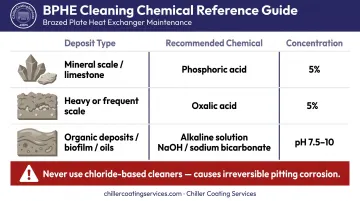
Trane's BPHE cleaning guidance confirms phosphoric acid as the go-to for routine mineral scale, with oxalic acid preferred for units requiring more frequent cleaning or heavier accumulation. SWEP specifies organic acids at 1–5 vol% for general CIP use.
What to avoid: Chloride-based cleaners — including hydrochloric acid — must never be used on stainless steel BPHEs. Chloride ions attack the passive layer of stainless steel, initiating pitting and crevice corrosion that permanently damages the plates. Check the manufacturer's chemical compatibility list before selecting any solution.
Backflushing
Backflushing is typically the first step before CIP, not a standalone cleaning method. It forces water or cleaning solution through the exchanger in the opposite direction of normal flow, dislodging loose debris and particulates before chemical treatment begins.
Key limitations to understand:
- Removes loose particulates and soft deposits effectively
- Cannot dissolve established mineral scale on its own
- Most effective when used to prepare the unit ahead of CIP circulation
Manual / Physical Methods (Not Applicable for BPHEs)
Disassembly and manual plate scrubbing — standard practice for gasketed plate heat exchangers — is not an option here. Attempting to disassemble a brazed unit destroys it. CIP is always the correct path.
How to Clean a Brazed Plate Heat Exchanger: Step-by-Step CIP Process
Step 1 — Safety and Preparation
Before touching anything:
- Shut off all relevant pumps and isolate the heat exchanger from the system
- Drain and fully depressurize both fluid sides of the unit
- Confirm PPE is in use: chemical-resistant gloves, eye protection, appropriate ventilation
- Review the manufacturer's guidelines for your specific unit before selecting cleaning chemicals
Step 2 — Pre-Flush with Clean Water
Run a water flush in both forward and reverse directions to dislodge loose debris and particulates. This also confirms there are no blockages at the inlet ports before chemical solution is introduced. Introducing acid into a partially blocked unit creates uneven cleaning and pressure spikes — so complete the flush before moving on.
Step 3 — Connect Portable CIP Equipment
Attach the CIP pump and solution reservoir to the inlet and outlet connections. Secure all connections and route discharge lines to an appropriate containment vessel.
Spent CIP solutions are regulated — plan disposal before you start:
- The EPA prohibits industrial discharges to POTWs below pH 5.0
- Aqueous waste at pH ≤2.0 or ≥12.5 qualifies as corrosive hazardous waste under RCRA
Step 4 — Circulate the Cleaning Solution
This is where the actual cleaning happens:
- Entry point: Pump solution through the lower connection to expel air
- Flow direction: Circulate in reverse/backflush mode; reverse direction every 30 minutes
- Flow rate: Target 1.5x nominal operating flow rate (SWEP and Trane both specify this)
- Duration: 30–120 minutes depending on fouling severity
- Monitor progress: Track inlet/outlet pressure drop during circulation — cleaning is complete when pressure drop returns to initial baseline value OR pH stabilizes for 30 consecutive minutes
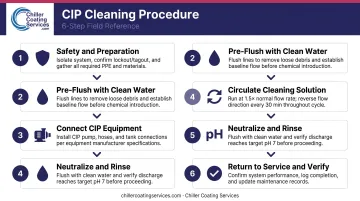
Step 5 — Neutralize and Rinse
Before the final rinse:
- Circulate 1–2% sodium hydroxide or sodium bicarbonate to neutralize residual acid
- Follow immediately with a thorough flush of clean, potable water
- Continue flushing until pH returns to neutral (pH 7)
Alfa Laval recommends thorough rinsing with potable water after neutralization. Residual acid left in the unit will continue attacking stainless steel surfaces, so verify pH at the outlet before considering the rinse complete.
Step 6 — Return to Service and Verify
- Reinstall all connections to original configuration
- Restart the unit and monitor pressure drop, flow rates, and temperature differential
- Compare against pre-fouling baseline readings to confirm performance has been restored
- Dispose of all spent CIP solutions per local environmental regulations — contact your local POTW authority (MWRA in Massachusetts, NYC DEP in New York) for facility-specific discharge requirements
Signs Your Brazed Plate Heat Exchanger Needs Cleaning
Fouling builds gradually — which is exactly why facilities miss it until performance has already degraded. These are the indicators worth tracking.
Performance degradation indicators:
- Pressure drop across the unit has increased by 30% or more above nominal baseline (SWEP's verified cleaning threshold)
- Temperature differential between inlet and outlet has declined from design specifications
- Flow rate has dropped despite unchanged pump operation
- Energy consumption has increased to achieve the same heating or cooling output
Operational warning signs:
- Unexpected equipment shutdowns triggered by overtemperature or pressure protection alarms
- Inconsistent heating or cooling output relative to design specs
- System COP declining when tracked through building management system data
Visual indicators (where accessible):
- Discoloration or visible mineral deposits at inlet and outlet ports
- Water quality testing showing elevated hardness, pH drift, or rising chloride levels
- Biofilm visible on accessible connection points
A single persistent indicator warrants a closer look. Two or more showing up together means the unit should come offline for cleaning before efficiency losses compound into a service call.
Brazed Plate Heat Exchanger Cleaning and Maintenance Schedule
Cleaning frequency is not a fixed calendar event. It depends on water hardness, operating temperatures, process fluid type, and the application. A BPHE in a high-temperature industrial process with hard water fouls significantly faster than one in a low-temperature HVAC application with soft municipal water.
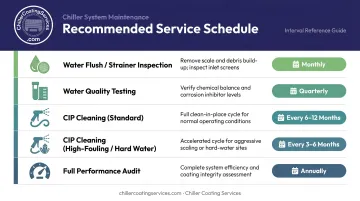
General frequency reference guide:
| Task | Frequency |
|---|---|
| Water flush / inlet strainer inspection | Monthly (or per manufacturer guidance) |
| Water quality testing (pH, hardness, chloride) | Quarterly |
| CIP chemical cleaning — standard conditions | Every 6–12 months |
| CIP chemical cleaning — high-fouling or hard water | Every 3–6 months |
| Full performance audit (pressure drop benchmarking, thermal efficiency review) | Annually |
SWEP recommends 20-mesh strainers on units where process media contains particles larger than 1mm — a simple, inexpensive addition that reduces particulate loading on the exchanger. For systems with high magnetite concentrations, a filter with magnetic function is also recommended.
Two additional practices that extend cleaning intervals:
- Install inlet strainers and filters to reduce particulate loading in narrow BPHE channels, which directly slows fouling accumulation over time.
- Maintain stable water chemistry through consistent treatment to prevent scale formation at the source, reducing both cleaning frequency and chemical damage between cycles.
For facilities in New England and New York where Chiller Coating Services operates, applying a 100% solids protective coating to accessible heat exchanger surfaces after CIP completion creates a smooth, chemically resistant barrier that inhibits future fouling adhesion and slows the return of corrosion, extending the interval before the next cleaning cycle is needed. Contact Chiller Coating Services at (877) 427-0090 or visit chillercoatingservices.com for a free on-site consultation.
Frequently Asked Questions
How often should a brazed plate heat exchanger be cleaned?
Cleaning frequency depends on water hardness, operating temperature, and application type. Standard conditions typically call for CIP every 6–12 months; hard water or high-temperature environments may require cleaning every 3–6 months. Use performance monitoring, particularly pressure drop trending, to guide timing rather than fixed calendar intervals alone.
What is the 10-13 rule for heat exchangers?
The "10-13 rule" describes design-pressure and hydrotest logic for pressure protection, not a cleaning trigger rule. For BPHEs specifically, use SWEP's verified threshold: a 30% or greater increase in pressure drop above nominal performance is the confirmed indicator that cleaning is required.
Can you disassemble a brazed plate heat exchanger for cleaning?
No. Unlike gasketed plate heat exchangers, BPHEs are permanently sealed by the brazing process and cannot be disassembled without destroying the unit. CIP chemical cleaning is the only appropriate cleaning method — disassembly is not a recovery option.
What chemicals are safe to use when cleaning a brazed plate heat exchanger?
5% phosphoric acid (routine mineral scale) and 5% oxalic acid (heavy or frequent fouling) are the recommended options. Alkaline solutions at pH 7.5–10 address organic deposits and biofilm. Chloride-based cleaners , including hydrochloric acid, must never be used, as chloride ions cause irreversible pitting corrosion on stainless steel plates.
What causes fouling in a brazed plate heat exchanger?
Two primary mechanisms drive fouling: suspended solids and organic material forming biofilm on heat transfer surfaces, and dissolved minerals precipitating as scale at elevated temperatures. Both reduce heat transfer efficiency and increase pressure drop. Left unaddressed, both compound over time.
How do I know if my brazed plate heat exchanger needs cleaning?
The clearest indicator is a 30% or greater increase in pressure drop across the unit compared to its baseline. Supporting signals include:
- Declining temperature differential between inlet and outlet
- Higher energy consumption for the same load
- System alarms triggered by over-temperature or pressure limits
Any of these warrants immediate inspection.