Introduction
Moisture protection for industrial chiller systems is the application of coatings, linings, and surface treatments that prevent water, condensation, and process fluids from degrading chiller tube sheets, heat exchanger components, and related metallic surfaces.
For facilities managers, building engineers, and plant owners at hospitals, schools, manufacturing plants, and power plants, this is an operational priority. Uncontrolled moisture accelerates corrosion, reduces heat transfer efficiency, and creates conditions for unplanned shutdowns that cost far more than preventive treatment.
Even so, the specific mechanisms and application requirements inside industrial chiller systems are often misunderstood at the facility level. What does moisture protection actually involve? What drives corrosion in these environments? When does a system need it? This article answers each question in practical terms.
Key Takeaways
- Specialized coatings stop corrosion, erosion, and coolant contamination from constant water-side exposure in chiller systems
- Mixed-metal construction — copper tubes meeting steel tube sheets — makes chillers especially vulnerable to galvanic attack without a non-conductive barrier
- Effective protection follows a fixed four-step sequence — skipping any step undermines the entire system
- Surface preparation quality is the single highest-impact variable — inadequate blasting leads directly to premature coating failure
- Moisture protection requires scheduled inspection and periodic reapplication to remain effective long-term
What Is Moisture Protection for Industrial Chiller Systems?
Moisture protection for industrial chillers means applying engineered coatings and linings to internal components — primarily tube sheets and condenser tubes. The goal is to prevent water, coolant, and condensation from initiating corrosion, pitting, or galvanic attack on metal surfaces.
The intended outcomes are concrete:
- Preserving tube-to-tube-sheet joint integrity
- Maintaining thermal conductivity
- Preventing coolant contamination
- Extending the serviceable life of the chiller
Unlike building vapor barriers or exterior sealants, chiller moisture protection must withstand long-term fluid immersion, chemical exposure, temperature cycling, and mechanical stress inside pressurized heat exchanger environments. The materials and application methods required are in a different category entirely.
Why Moisture Protection Is Critical for Industrial Chillers
The Corrosion Problem Starts with Mixed Metals
The primary failure mechanism is electrochemical corrosion. When moisture contacts unprotected metal chiller components, it creates the conditions for three distinct corrosion types:
- Galvanic corrosion — caused by dissimilar metals in electrical contact through an electrolyte. A 2021 peer-reviewed review documented corrosion potentials of approximately -0.1 V for copper tubes and -0.6 V for carbon steel tube sheets, with galvanic current density reaching as high as 39.81 µA/cm² in tested cases. That voltage gap drives accelerated metal loss at the less noble surface.
- Crevice corrosion — concentrated in the tight clearances at rolled tube-to-tube-sheet joints, where stagnant water chemistry creates localized attack that bulk water treatment cannot reach
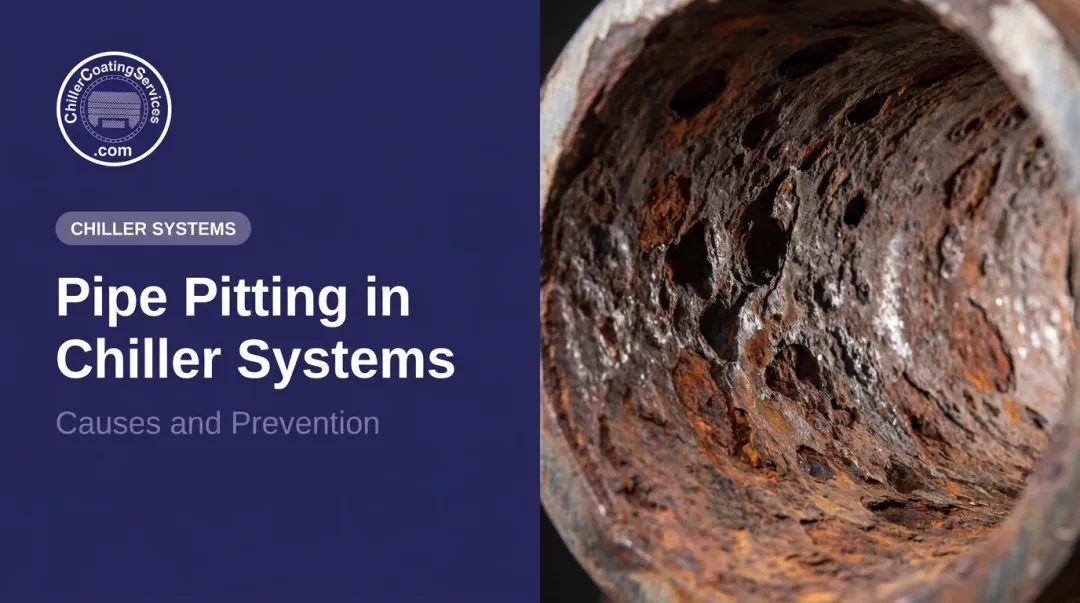
- Pitting corrosion — initiated by dissolved oxygen, scale chemistry, and biofilm, progressing rapidly once started
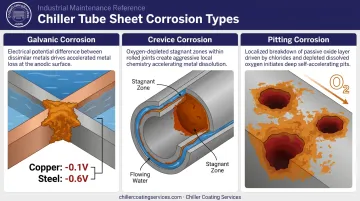
Without a non-conductive protective layer between dissimilar metals, the galvanic cell runs uninterrupted whenever the chiller operates.
What Happens Without Protection
Left unaddressed, corrosion follows a consistent sequence:
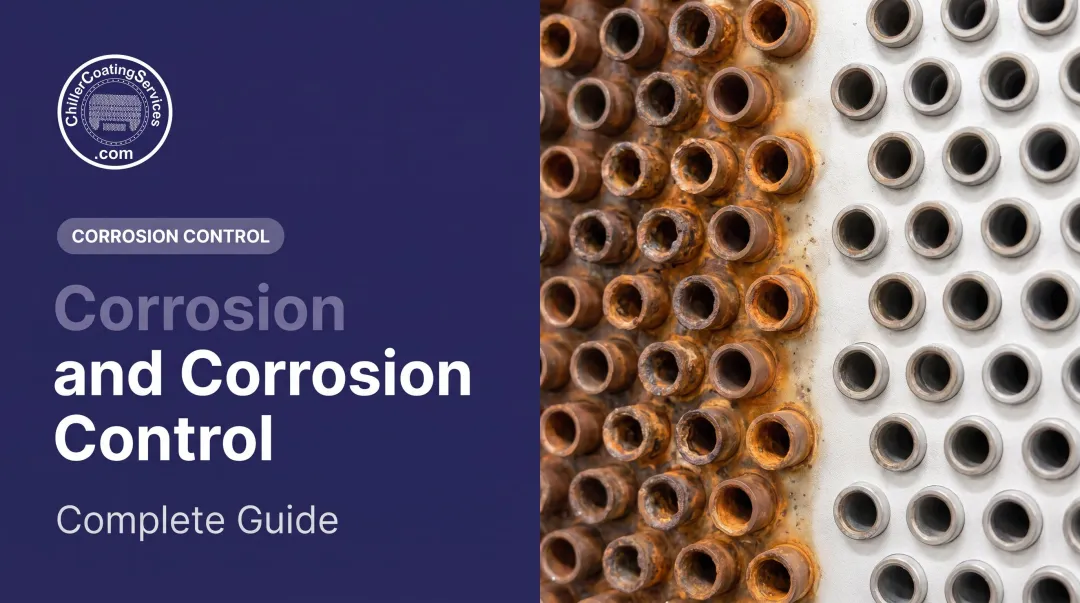
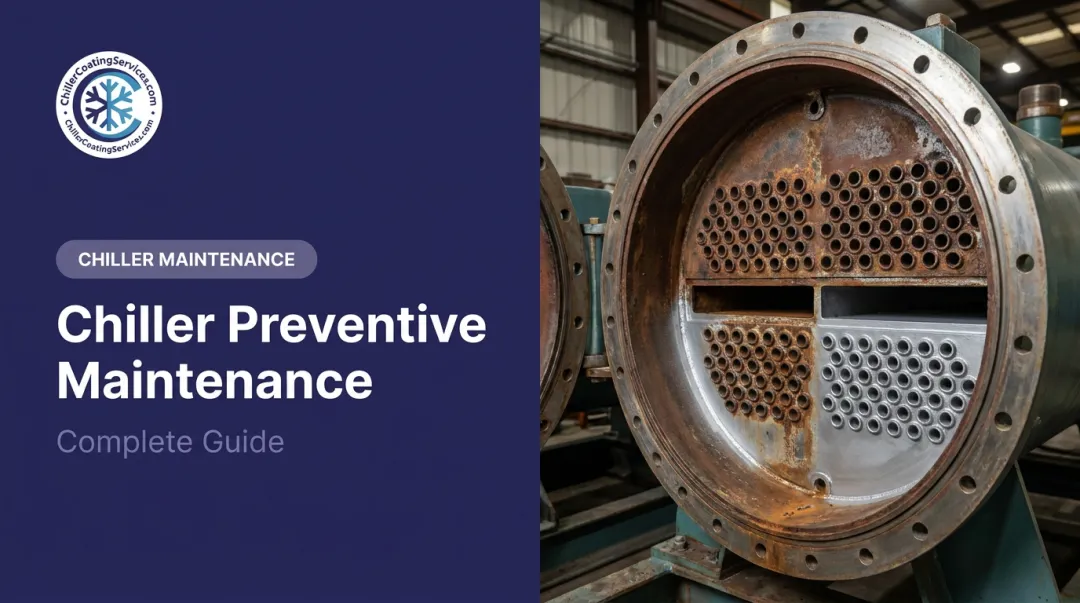
- Tube sheet surfaces corrode and pit
- Heat exchanger surfaces foul from corrosion deposits
- Thermal conductivity drops — iron oxide conducts heat at roughly 0.58 W/m·K versus 52 W/m·K for carbon steel, adding measurable thermal resistance
- Tube-to-tube-sheet joints weaken, eventually leaking
- Refrigerant-water cross-contamination risk rises, potentially forcing full bundle replacement
ASHRAE research confirms that fouling reduces heat transfer performance and raises waterside pressure drop — both of which translate directly to higher energy consumption per ton of cooling output.
Environments That Accelerate the Risk
Certain conditions compound the baseline corrosion threat:
- Coastal and marine exposure — ASHRAE documents severe galvanic corrosion in seawater-cooled refrigeration condensers and heat exchangers
- High-humidity mechanical rooms — condensation accelerates water-side attack on unprotected surfaces
- Aggressive chemical treatment programs — acidic anti-scale treatments designed to protect pipes can degrade uncoated tube sheet metal
- Long continuous run cycles — common in hospitals, data centers, and manufacturing facilities where chillers rarely cycle off
Facilities across New England and New York — hospitals running 24/7, coastal power plants, pharmaceutical manufacturers with strict temperature tolerances — face several of these conditions simultaneously, compounding the corrosion risk beyond what any single factor would produce alone.
Why Proactive Coating Is Best Practice
Visible corrosion on a tube sheet means structural integrity is already compromised. Intervening earlier costs less and preserves more. Properly applied coatings also increase tube-to-tube-sheet joint push-out strength — in some applications, by over 1,000 pounds — making protection a structural upgrade, not just a maintenance measure.
How Moisture Protection Works in Industrial Chiller Systems
The process is sequential. Skipping or shortcutting any phase undermines the entire investment.
Step 1: Surface Assessment and Preparation
Before any coating is applied, the tube sheet and heat exchanger surfaces are inspected for existing corrosion, pitting, fouling, and joint condition. This assessment includes pit depth measurement and crevice corrosion mapping.
Then comes the most critical phase: contained abrasive blasting to a white metal finish, meeting the SSPC-SP 5 / NACE No. 1 surface condition standard. This removes all visible rust, mill scale, paint, and contaminants down to bare, profiled metal.
The word "contained" matters operationally. A containment system is installed before blasting begins, capturing all dust, debris, and spent abrasive media. In active facilities — hospitals near patient areas, data centers near IT equipment — uncontrolled particulate is not an option.
Coatings used in immersion service require the cleanest, most profiled substrate achievable. Residual contamination from commercial or near-white blast grades creates adhesion failures within months — inadequate blasting leads directly to poor adhesion and premature failure.
Where abrasive blasting is impractical due to environmental constraints, water blasting achieves an equivalent surface condition.
That same preparation phase also addresses reconstruction of severely corroded areas. Where galvanic or pitting corrosion has consumed structural metal — thinning tube sheet sections or compromising joint geometry — those areas must be rebuilt to restore original thickness and joint strength before coating proceeds. Coating alone cannot bridge structural voids.
Step 2: Coating Application
With surfaces at white metal and corroded areas rebuilt, the 100% solids epoxy coating system is applied across tube sheet faces, tube ends, and water box interiors.
The 100% solids chemistry is a deliberate specification. Conventional solvent-based coatings contain only 50–80% solids — solvents evaporate during cure, leaving a thinner film with micro-voids. A 100% solids system delivers:
- Every mil applied becomes a mil of cured, protective film — no solvent flash-off, no loss
- Consistent film thickness without voids, because there is no shrinkage during cure
- Zero VOC emissions, which matters in occupied facilities during application
- Denser, stronger cured film per coat — suited for constant immersion service
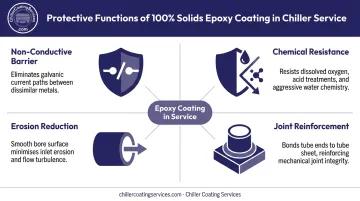
Beyond film integrity, the cured coating performs multiple simultaneous functions once in service:
- Forms a non-conductive barrier that eliminates the electrolytic pathway between dissimilar metals, stopping galvanic corrosion at its source
- Resists dissolved oxygen, acidic anti-scale treatments, and biofilm chemistry
- Creates a smooth surface at tube inlets that reduces turbulence and erosion
- Bonds into tube-to-tube-sheet joint interfaces, reinforcing structural connection
Coating thickness typically runs approximately 10 mils, with the exact spec set per application.
Step 3: Cure, Inspection, and Return to Service
After application, quality assurance verification includes:
- Pull-off adhesion testing to confirm proper substrate bonding
- Thickness measurement using ultrasonic or magnetic gauges against the specified target
- Visual inspection confirming uniform coverage across all in-scope surfaces
Chiller Coating Services' quick-cure formulation allows return to service faster than conventional coatings — which matters for facilities scheduling work within tight outage windows. The entire three-step process is performed on-site, with no disassembly and transport required.
Key Factors That Affect Moisture Protection Outcomes
Not every coating project produces the same result. These variables determine long-term performance:
Pre-application variables:
- Surface preparation quality — the single highest-impact variable. Residual contamination or an inadequate blast profile directly causes premature failure
- Severely pitted or structurally compromised surfaces require reconstruction before any coating is applied — coating over damage accelerates failure
- Temperature and humidity at application time affect cure behavior and adhesion strength
- Coolant chemistry — pH, dissolved oxygen levels, and chemical treatment programs determine what the coating must chemically resist
Once the coating is in service, three variables drive long-term performance:
Post-application variables:
- Thermal cycling frequency — repeated expansion and contraction stresses the coating-to-substrate bond over time
- Water treatment programs designed to protect piping may be incompatible with certain coating chemistries — verify compatibility before treatment changes
- Continuous vibration in high-load systems degrades coating integrity at edges and joints over time
Coating selection must account for all of the above. At minimum, the coating must be rated for continuous fluid immersion (not dry or intermittent exposure), chemically compatible with the coolant in use, and capable of withstanding the system's thermal cycling range.
Large multi-tube heat exchangers in central plant chillers present different preparation and application challenges than smaller process cooling units — which is why variable assessment must happen at the system level, not generically.
Common Issues and Misconceptions About Chiller Moisture Protection
Misconception 1: Chemical Water Treatment Is Enough
Corrosion inhibitors added to coolant water protect bulk water chemistry — they do not protect tube sheet surfaces from galvanic attack at tube-to-tube-sheet joints. The crevice geometry at rolled joints creates a stagnant microenvironment where bulk water treatment chemistry cannot penetrate. Chemical treatment and surface coatings address different problems; one does not replace the other.
Misconception 2: Any Industrial Epoxy Will Work
Coatings for chiller tube sheets must be specifically formulated and rated for continuous fluid immersion, thermal cycling, and the coolant's pH range. A general-purpose structural epoxy is engineered for dry or intermittent exposure — not constant immersion in oxygenated, chemically treated water. Mismatched coatings fail prematurely and can introduce contamination into the water loop.
Misconception 3: Coating Is a Corrective Action
Many operators treat tube sheet coating as a response to visible damage. This reverses the logic. By the time corrosion is visually obvious, structural integrity is often already compromised — joints weakened, metal thinned, leak paths forming. Applying a coating at that stage still requires reconstruction of damaged areas before the coating can perform. Intervening before visible damage appears produces better adhesion, lower total cost, and longer service life from the coating applied.
Conclusion
Moisture protection for industrial chiller systems preserves tube sheet and heat exchanger integrity, prevents galvanic and pitting corrosion, maintains thermal efficiency, and extends equipment service life. Done right, it also reduces the total cost of ownership — shifting budget away from emergency replacements and toward planned maintenance.
Effective moisture protection depends on getting three things right:
- Surface preparation blasted to white metal standard (SSPC-SP 5 / NACE No. 1)
- A coating system engineered for continuous immersion in the chiller's specific water chemistry
- A proactive inspection schedule that catches degradation before it reaches the substrate
Coating applied over inadequate preparation fails. The right chemistry over a properly prepared and reconstructed substrate delivers real service life extension — along with the documented service records that support Joint Commission, ISO, FDA, and SOC 2 audits when regulators ask.
Frequently Asked Questions
What is moisture protection?
Moisture protection is the use of coatings, linings, and surface treatments to prevent moisture from degrading metal or structural surfaces. In industrial chiller systems, it specifically refers to protecting tube sheets and heat exchanger components from corrosion, pitting, and coolant contamination caused by constant water-side exposure.
What's the best moisture barrier for industrial chiller systems?
For chiller tube sheets and heat exchangers, the most effective moisture barrier is a 100% solids, chemically resistant epoxy coating applied over a white metal blast-cleaned surface. The coating must be rated for long-term fluid immersion, thermal cycling, and galvanic isolation between dissimilar metals.
How does moisture cause corrosion in industrial chiller tube sheets?
When water contacts unprotected metal tube sheet surfaces — especially where dissimilar metals like copper tubes meet steel sheets — electrochemical reactions trigger galvanic, crevice, and pitting corrosion. This weakens joint integrity at tube-to-tube-sheet connections and eventually causes coolant leaks if left unaddressed.
Can moisture damage affect chiller energy efficiency?
Yes. Corrosion-driven surface roughness and fouling deposits reduce heat transfer efficiency, forcing the chiller to consume more energy for the same cooling output. A smooth, properly coated tube sheet surface improves flow characteristics, resists fouling accumulation, and preserves designed thermal conductivity over time.
How often should chiller moisture protection coatings be inspected or reapplied?
Annual visual inspection works for most systems. Reapplication is typically triggered by visible coating degradation, increased fouling, changes in coolant chemistry, or as part of a scheduled chiller maintenance program — since operating conditions vary significantly across facility types, there is no single universal interval.